


Seasonal Climate Outlook Archive
Frequently Asked Questions
MEDIA RELEASE - ISSUED 3rd JUNE 1998
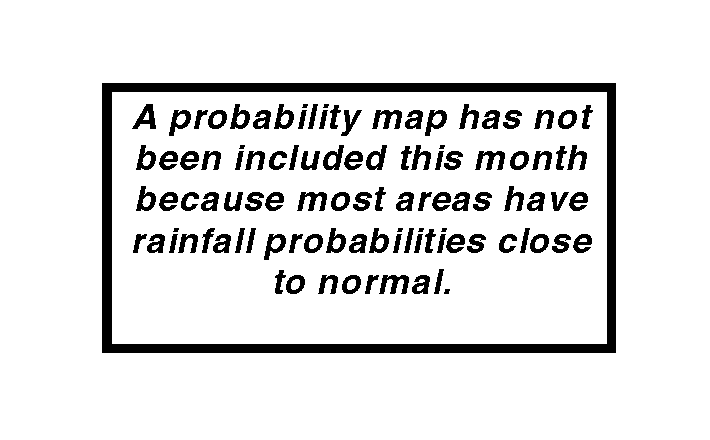
Seasonal Climate Outlook Summary: 3-month rainfall probabilities for Winter 1998
End of El Niño for Australia
"The rapid decline of the El Niño in May means that it should no longer affect Australian rainfall this year", said Mary Voice, head of the National Climate Centre. After over a year of strongly negative values, the SOI rose dramatically to a value of zero in May. Also, ocean temperatures in the central to eastern Pacific were close to normal by the end of the month.
Average to above average falls in winter cropping areas have often occurred following similar situations in the past. In fact, above average rains have fallen over eastern Queensland and New South Wales in the past two months. "However, some of the driest areas of southeastern Australia are still in urgent need of rain", said Ms Voice.
There are other encouraging signs for winter rainfall. In particular, persisting warmer than normal ocean temperatures off Australia's northwest coast favour northwest cloudband development.
In summary, while El Niño's influence may linger for a couple of months more in some parts of the world, Australia's winter rainfall should be unaffected.
Notes/Background
- SOI = Southern Oscillation Index, the basis of the Bureau's Seasonal Climate Outlooks. The skill of this system is still only marginal at this time of year.
- May SOI = 0, April SOI = -24
- See http://www.bom.gov.au/climate/glossary/elnino.shtml for more SOI and El Niño background.
- "Northwest cloudbands" are large cloud sheets which generally extend from the northwest shelf region across central Australia towards the southeast of the continent. Well developed bands often result in widespread rain.
For more information regarding this outlook please contact Grant Beard on (03) 9669 4527, Robert Fawcett on (03) 9669 4603, Joe Courtney on (03) 9669 4288, or Clare Mullen on (03) 9669 4296.
| Frequently Asked Questions |
|---|
|
Q: WHAT ARE THE BUREAU OF METEOROLOGY'S
SEASONAL CLIMATE OUTLOOKS? A:General statements about the probability or risk of wetter or drier than average weather over a three-month period. The outlooks are based on the statistics of chance (the odds) taken from rainfall and sea surface temperature records. They are not, however, categorical predictions about future rainfall, and they are not about rainfall within individual months of the three-month outlook period. Q: WHAT DO WE MEAN BY WETTER OR DRIER THAN "AVERAGE", OR WARMER OR COOLER THAN "AVERAGE"? A:Being above or below the MEDIAN rainfall, MEDIAN maximum temperature, or MEDIAN minimum temperature over the three-month outlook period. The median is the middle value in the historical record for the period in question. In the long term, rainfall or temperature are above median in one half of years, and below median in the other half. Example 1: For the July to September period at Mackay in Queensland, one-half of 3-month rainfall totals have been below 80mm, and one-half have been above. If rainfall was above 80mm in that period it would be "wetter than average" or above median. Over the long haul there is a 50% chance of this occurring. In terms of odds this is even money. Example 2: In Sydney, one-half of summers (Dec-Feb) have a mean maximum temperature above 25.7°C, with the other half being below. Therefore 25.7°C is the median. Note that the mean or average maximum temperature is the average of all the daily highest temperatures for the period. Similarly, the mean or average minimum temperature is the average of all the daily lowest temperatures for the period Q: HOW ACCURATE ARE THE OUTLOOKS? A: In the places and seasons where the outlooks are most skilful, the category of the eventual outcome (above or below median) is consistent with the category favoured in the outlook about 75% of the time. In the least skilful areas, the outlooks perform no better than random chance or guessing. The rainfall outlooks perform best in eastern and northern Australia between July and January, but are less useful in autumn and in the west of the continent. The skill at predicting seasonal maximum temperature peaks in early winter and drops off marginally during the second half of the year. The lowest point in skill occurs in early autumn. The skill at predicting seasonal minimum temperature peaks in late autumn and again in mid-spring. There are also two distinct periods when the skill is lowest - namely late summer and mid-winter. However, it must always be remembered that the outlooks are statements of chance or risk. For example, if you were told there was a 50:50 chance of a horse winning a race but it ran second, the original assessment of a 50:50 chance could still have been correct. Q: WILL CATEGORICAL OUTLOOKS EVER BE ISSUED? (Eg. It WILL be drier than average.) A: Very unlikely. There is a certain level of natural variability in the climate which is chaotic and unpredictable. This is particularly the case with rainfall. For example, rainfall in a season can be significantly above average in one region, and significantly below average less than 50km away. Q: HOW SHOULD THE OUTLOOKS BE USED? A: As another tool in risk management and decision making. The benefits accrue from long-term use, say over 10 years. At any given time, the probabilities may seem inaccurate, but taken over several years, the advantages of taking account of the risks will outweigh the disadvantages. For more information on the use of probabilities, farmers could contact their local departments of agriculture or primary industry. |
| Definitions and Explanations.... |
|---|
|
THE SOUTHERN OSCILLATION INDEX (SOI) is calculated using the barometric pressure difference between Tahiti and Darwin. The SOI is one indicator of the stage of El Niņo or La Niņa events in the tropical Pacific Ocean. It is best considered in conjunction with sea-surface temperatures, which form the basis of the outlooks. A strongly negative SOI (below -10) is characteristic of El Niņo, which is often associated with below average rainfall over eastern Australia, and a weaker than normal monsoon in the north. A strongly positive SOI (above +10) is characteristic of La Niņa, which is often associated with above average rainfall over parts of tropical and eastern Australia, and an earlier than normal start to the northern monsoon season. El Niño & La Niña El Niņo translates from Spanish as "the boy-child", and refers to the extensive warming of the central and eastern Pacific Ocean. La Niņa translates from Spanish as "the girl-child", and refers to the extensive cooling of the central and eastern Pacific Ocean. The term has recently become the conventional label for the opposite of El Niņo. See http://www.bom.gov.au/climate/glossary/elnino.shtml for more on SOI and El Niņo. |
[an error occurred while processing this directive]