


About heating & cooling degree days maps
References & Guides
How were the maps created?
Maximum and minimum temperature data are recorded at a network of weather stations across Australia. The data from these weather stations are stored electronically in the Bureau of Meteorology's database called ADAM (Australian Data Archive for Meteorology).
The average heating & cooling degree days maps were based on daily maximum and minimum temperature from about 350 weather stations. The daily data were extracted from ADAM and a number of quality control checks were then applied to the data. For example, the data were checked for missing values over the length of the data record.
After the quality checks were applied to the data, heating and cooling degree days were calculated and monthly and annual averages produced for each of the weather stations. An objective analysis technique was then applied to these station averages to produce regular gridded datasets (each month and annual) covering Australia. These grids were then used to produce the heating and cooling degree days grids (monthly and annual).
Finally, the gridded data were visualised in a geographic information system and the colour maps created through this process.
You can find out more about the format of the gridded datasets and the analysis technique is described in the metadata.
Stations used in the analysis
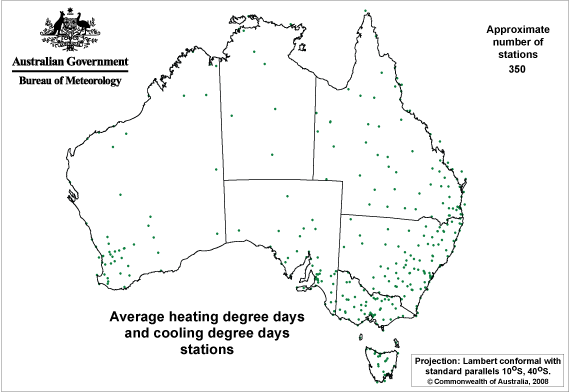
Daily maximum and minimum temperature data from about 350 weather stations across Australia were used to create the average heating & cooling degree days maps. These stations are shown in the map below.
Hetaing & cooling degree days metadata
The following metadata summary, and detailed metadata file, provide information about the monthly and annual gridded heating and cooling degree days datasets. For example, information is provided about the format, spatial extents and analysis techniques used to generate the grids.
| TITLE: | Mean monthly and mean annual heating & cooling degree days data (base climatological data sets) |
| DESCRIPTION: | Mean monthly and mean annual heating & cooling degree days grids. The grids show the heating & cooling degree days values across Australia in the form of a two-dimensional array. The mean data are based on the standard 30-year period 1961-1990. |
| CUSTODIAN: | Bureau of Meteorology |
| GEOGRAPHIC EXTENT NAMES(s): | Australia |
| AVAILABLE FORMAT TYPE(S): | ASCII row major, Arc/InfoTM grid export(.e00), Shapefiles. |
| SCALE/RESOLUTION | The resolution of the data is 0.1 degrees (approximately 10km) |
The detailed metadata file provides more information about these heating & cooling degree days gridded datasets, including information about the analysis technique. You can also find out about the other gridded datasets we have available.
Copyright & contact information
Please note that the copyright for any data supplied by the Bureau of Meteorology is held in the Commonwealth of Australia and the purchaser shall give acknowledgement of the source in reference to the data. Apart from dealings under the Copyright Act 1968, the purchaser shall not reproduce (electronically or otherwise), modify or supply (by sale or otherwise) these data without written permission from the supplier.
If you want to know more, please contact us at climatedata@bom.gov.au
