
Combine your love of travel with work
As a field services technician, no 2 days are the same. You'll travel far and wide in 4WDs, planes, boats and helicopters to look after our vast observing network.
This work takes you to some of Australia's most unique and isolated environments. You'll be one of 200 staff across 8 technical operations centres and remote weather stations.
Video: Field technician jobs at the Bureau
Work for the Bureau of Meteorology's Observing Operations.
We maintain Australia's weather observation networks.
Your daily commute.
We recruit technicians. We recruit schedulers and planners. We recruit team leads. We recruit operations managers.
We provide on the job training.
Do work that touches the lives of all Australians.
A job like no other. Search: BOM Careers.
Technician jobs across Australia
Technicians maintain the service delivery of our observation network. This ranges from radars to flood and rainfall monitoring systems, to space weather instruments and more.
We employ qualified electronics, electrical or instrumentation technicians or engineers. You can also apply as a recent graduate or candidate with a few years of industry experience in:
- engineering trades
- hydrography
- applied science
- metrology
- measurement science.
We regularly recruit for roles across Australia. Our locations include Adelaide, Brisbane, Cairns, Darwin, Hobart, Melbourne, Perth and Sydney. Staff can also apply for temporary postings to Giles weather station, Willis Island, Antarctica and more.
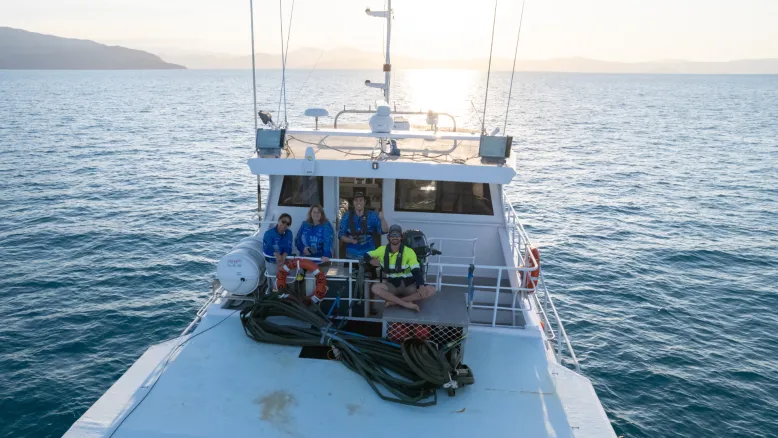
Observing operations staff on a supply trip to Willis Island weather station, 450 km east of Cairns. Credit: Alex Cossu.
Personal and professional requirements
We're looking for people who:
- have qualifications or work experience in electronics, instrumentation, engineering, hydrography, applied science, metrology or measurement science
- have an appetite for working in remote locations and a willingness to travel
- are team players who can get hands-on in the field
- take responsibility for managing projects and are able to balance competing priorities
- build productive working relationships and communicate with influence
- have a reasonable level of physical fitness.
The responsibilities of the role include but are not limited to:
- maintenance and operations
- asset and service management
- documentation and record keeping
- travel and incident response
- data quality
- liaison and representation
- quality management
- compliance
- workplace health and safety.
Our technician roles are advertised as technical officer jobs. Add your name to the talent register, and explore job descriptions and current opportunities on our BOM Careers website.
What it's like to work as a field services technician
Find out what Rebecca and Darcy experienced as technical officers in the field.
My journey to becoming a technical officer hasn't followed a straight path. It's been shaped by curiosity, a love of the outdoors, and an enthusiasm to try something new.
Originally from Melbourne, I started out working in horticulture in remote north-western Australia. I moved to Cairns to study science at James Cook University. I then worked on environmental revegetation projects across regional Queensland.
Those early experiences sparked my appreciation for remote landscapes and hands-on work.
Later, I became an electrician, mostly within the construction industry. And then decided to complete an Advanced Diploma in Electrical Engineering.
Once I'd completed my diploma I moved into teaching Certificate III in electrotechnology. Teaching was incredibly rewarding. But I found myself missing the variety and adventure that comes with field-based work.
While exploring opportunities to work in Antarctica, I came across technical roles with the Bureau of Meteorology. It seemed like the perfect job. It combined technical work and adventure while contributing to environmental science.
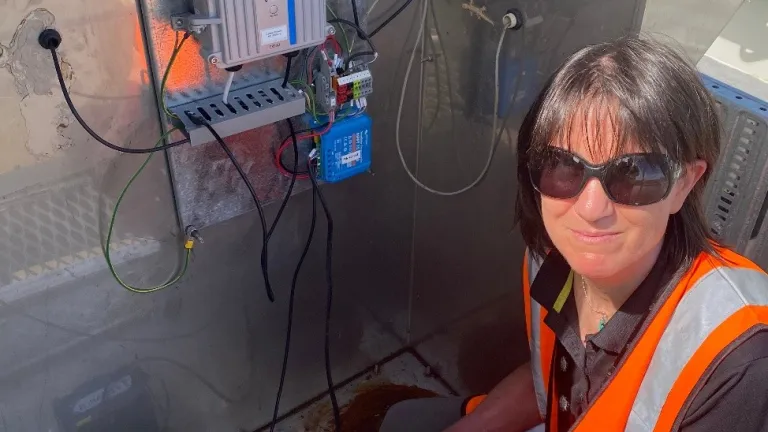
Rebecca completing station inspection and verification at one of our flood warning network sites
Since joining the bureau, I've mostly worked across the flood warning network. I've also had some opportunities to support other networks maintained by the Cairns Hub.
The role has taken me throughout Far North and Central Queensland and into the Gulf of Carpentaria. Places that many people never get the chance to experience.
Some of our flood sites are so remote they're only accessible by four-wheel-drive. This means navigating ridge lines on vast stations using GPS tracks rather than roads. I hadn't done much four-wheel driving before this role. I absolutely love it!
Working in the far north also means staying croc-aware near riverbanks and being mindful that we work in truly wild environments. These moments are balanced by the privilege of seeing incredible wildlife: lizards, frogs and vibrant birdlife. On one amazing trip we had a cassowary crossing back and forth across our track.
Our sites are everywhere. From stunning coastline to elevated rainforest, over mountain ranges and out into wide savannah country. It's a constant reminder of how diverse and remarkable Australia really is.
What I find most meaningful is knowing that our work directly supports communities. During flood events, the data we help deliver is critical for forecasters and emergency services. Being part of something that contributes to public safety is incredibly motivating.
The bureau has also provided fantastic training and development opportunities. Regular trips to Melbourne for courses mean I can stay connected with family while continuing to grow professionally. A balance I really value.
For someone who loves learning, problem-solving and discovering new places, this role has been a perfect fit. Antarctica is still a goal of mine. But even now I feel very fortunate to be part of a career where adventure is simply woven into the everyday.
My background is marine biology and I was doing hydrographic work when this opportunity came up at the Bureau. I started out working on the flood warning network. It's very similar to the hydrographic work that I was doing at my previous state government job – water resource monitoring, looking after rain gauges and water level sites.
When you come into the Bureau as a technical officer (TO), you have the opportunity to learn about all sorts of different equipment. They train you up in different areas, and that's been great because I've been exposed to heaps of different things, like learning about the sea level network. And because of that, in the 12 months I've been at the Bureau, I've been overseas 4 times!
The Adelaide Hub's Sea Level Network team look after the majority of the country's sea level sites and we also look after the sites in the South Pacific. So I've been to Nauru twice, Vanuatu and then I went to Tonga about 6 weeks ago as well.
Before you can go on a trip, even the local ones, you need to do a mandatory 3-week course at the Bureau of Meteorology Training Centre (BMTC) in Melbourne. It's an introductory course on automatic weather station systems. It covers basic electrical theory and then they teach you how to connect to the systems and do data verifications in the field.
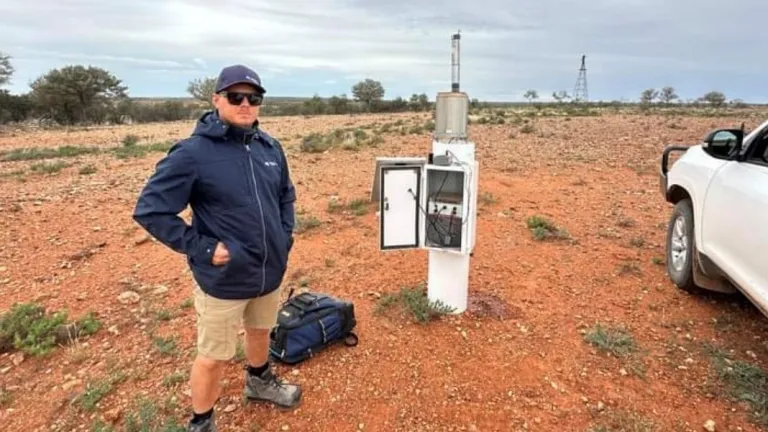
Darcy inspects a weather station at Cawnalmurtee in New South Wales
In each hub, there’s a range of skillsets that complement each other. My background in hydrography means my strength is working on flood warning stations, and then we have people with in-depth electronic experience who work on radar systems. So they might send me along to a radar to help out and learn, but I'm not going to be the person that's expected to fault-find or resolve a radar issue.
But if I'm going on a flood trip, I'll lead the trip and because of my past experience and BMTC training, I have a good understanding of the electronics with the flood network. If there's ever an issue that I can't fix, there's someone in the hub that I can call up to talk through it. I guess it's just about working as a team. You can't expect everyone to be an expert at everything.
I was in my last job for 6 years, with very little progression in that time. The Bureau's definitely heaps better in that regard, there are so many opportunities to progress your development, to do training courses, to act in higher roles. I loved my last job, but the ability to progress and to experience new opportunities wasn't there. I'd say the biggest benefit though is lifestyle. I think the flexibility and the ability to shift your work around your life is second to none. This week we went to Mildura to fix some storm damage, 6 weeks ago I was in Tonga, and then next week I'll be in the Adelaide Hills fixing up rain gauges. It's a forever changing landscape, in a positive way. It's good for me at this stage of my life.
If you're thinking about applying for a job as a TO, do it for sure. I think it's an open door to a million other doors.