
Managing severe weather in Australia
Weather-related emergencies include a wide range of events. For example, heatwaves, droughts, floods, bushfires, storms, tropical cyclones and tsunamis.
In Australia, managing these emergencies is a shared responsibility that involves:
- federal, state and local governments
- emergency service agencies
- non-government organisations, such as charities and community organisations
- community and volunteer groups
- individuals.
Community awareness during weather emergencies
To help all Australians prepare, we provide forecasts and warnings.
We work with many media agencies to share and amplify this information. This includes the Australian Broadcasting Corporation (ABC), which is a key emergency broadcaster.
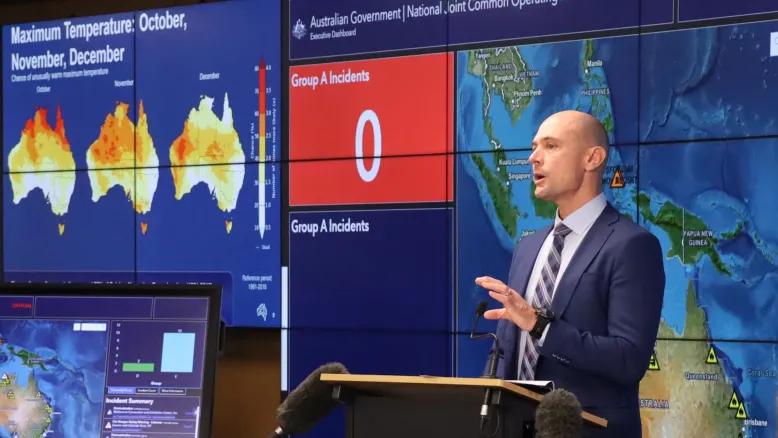
Briefings on higher-risk weather for the season ahead are among services we provide to emergency services and the Australian community
Supporting emergency services
During severe weather, we work with emergency service agencies 24 hours a day, 7 days a week.
We provide services according to an agreement between governments across Australia. For details, view the intergovernmental agreement on federation.gov.au.
Services that we provide under the agreement are outlined in documents called service level specifications. They state the responsibilities and level of service for flood, fire weather and other hazards. You'll find these in our knowledge centres.
Specialist data feeds
Fire and emergency service agencies across Australia can access specialist data feeds that integrate into their own systems. Explore our data services or, if you're already registered, log in.
Short, medium and long-term forecasts
We also deliver short, medium, and long-term forecasts to state and territory emergency services, and the National Emergency Management Agency (NEMA). NEMA coordinates Australian Government disaster and emergency management response.
For more about this, view the Australian Government Crisis Management Framework.
Sharing expertise
Our weather and water experts work in state and national disaster management centres. This can be on a short-term or ongoing basis. These 'embedded' meteorologists and hydrologists provide incident controllers and disaster managers with critical information to support decision-making.
Kevin Parkyn works as one of our embedded meteorologists within Victoria's State Control Centre. Operated by Emergency Management Victoria, the State Control Centre is both a facility and an organisational arrangement for state-level coordination of emergencies – primarily fires, floods and storms.
What services do you provide?
I provide weather briefing services to a number of different audiences within the emergency services sector. These include the heads of emergency response agencies such as the State Emergency Service, the Country Fire Authority, Victoria Police, Ambulance Victoria and the Department of Environment, Land, Water and Planning.
A key function of my role is to communicate the risk of significant weather occurring or of weather influencing emergency agency operations.
What hours do you work?
Either myself, or one of my colleagues, is at the State Control Centre year-round. From November to April, when Victoria sees the most severe weather, I work rostered 12-hour shifts. I start at 7 am – often earlier on significant weather days – to prepare for the first briefing to the State Control Team at 7:30 am.
How do you convey information to those who need it?
I give face-to-face briefings to the State Control Team, as well as online presentations for anyone in the emergency management community, about what’s happening now and what’s coming up on the weather front.
I share and explain weather modelling information and generally act as a resource for decision-makers within the sector. As well as the severe weather that brings fire, flood and damaging winds, this can be in relation to year-round fire-management activities. For example, phone discussions about 'weather windows' for planned burns and any risks involved.
With representatives from emergency management agencies, I'm sometimes required to provide the media with an update on the weather leading up to, during or after a significant event.
How does a typical day start?
'Hit the ground running' is a good way to describe it.
I quickly ascertain the current weather situation and what has occurred overnight, working closely with Bureau colleagues. I'll then review the early morning issue of forecasts and warnings, picking up on any notable updates or changes – like any observations that might trigger us to believe severe weather has become more likely.
Or, if a heavy rain event is unfolding, I’ll be watching the satellite and radar and comparing them with our modelling to make sure we have the richest understanding possible of the likely course of that event.
Does your role change on days when major fire emergencies develop?
Yes, it shifts from communicating weather with a focus on preparation for what could happen, to analysing the current situation and weather influences on fire behaviour.
I’ll also be working closely with the fire behaviour analyst – who looks at landscape characteristics and information on fuel conditions, as well as forecasts/actual weather to predict how the fire is likely to develop.
At the same time I’m liaising with the Bureau’s operational meteorologists (who produce Victoria’s forecasts and warnings) – especially during significant fire events when critical details like timing of wind changes are communicated. The meteorologists factor this first-hand intelligence on the status of fires and the priority incidents being managed by the emergency services into their activities.
What’s the most rewarding part about working at the State Control Centre?
For me it’s communicating weather information that influences decision-making and prepares the emergency services leading up to significant weather days. Ultimately this makes the community safer and more resilient.
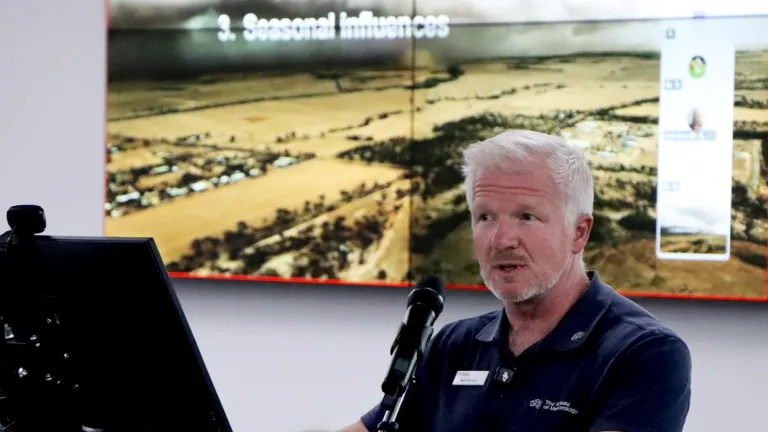
Embedded meteorologist Kevin Parkyn at a high-risk weather season briefing in the Victorian State Control Centre
Technical advice and research
Our technical advice informs the work of the:
- Australasian Fire and Emergency Services Authorities Council, which supports contemporary fire and emergency service knowledge and practice
- Australian Institute for Disaster Resilience
- Australian Climate Service
- Natural Hazards Research Australia.
To better understand and prepare for the local impact of severe weather and natural hazards, we collaborate with other scientific research organisations. This includes CSIRO and Geoscience Australia. Learn more about research and development.