


About the cyclone timeseries graphs
Cyclone indices
Low pressure systems (often called cyclones) include midlatitude cyclones, monsoon lows, and tropical cyclones, and are responsible for much of the rainfall and strong winds we experience. Their distribution and strength reveal rainfall locations and regions of potentially dangerous weather.
Low pressure systems are associated with a cyclonic rotation of air about a central low point in atmospheric surface pressure, which is clockwise in the southern hemisphere. The depth of the central atmospheric pressure and the gradient in pressure determine the strength of the cyclone. In terms of climate change monitoring, long-term changes in the nature or number of low pressure systems in a given region may indicate changes in storm tracks and hence impact upon rainfall and temperature changes.
Here, we provide two measures of low pressure systems:
(a) Cyclone density represents a count of the number of cyclones for a given area for a given season. This is expressed per degree of latitude (a grid area of 111 km by 111 km) squared as an average number.
(b) Cyclone intensity represents the average central pressure of the low pressure systems (in hPa) for a given region over a given season.
Analyses available
Mean cyclone density and cyclone central intensity are provided from 1950 to present for a boxed region around Australia (from 0° to 50°S and from 94°E to 174°E), as well as for six regions within this box: the Northern Tropics (0°S-22°S, 94°E-174°E), the Southern Region (30°S-50°S, 94°E-174°E), the Southwest Region (22°S-46°S, 94°E-116°E), the Northwest Region (4°S-22°S, 94°E-130°E), the Coral Sea (4°S-26°S, 142°E-174°E) and the Tasman Sea (26°S-46°S, 150°E-174°E).
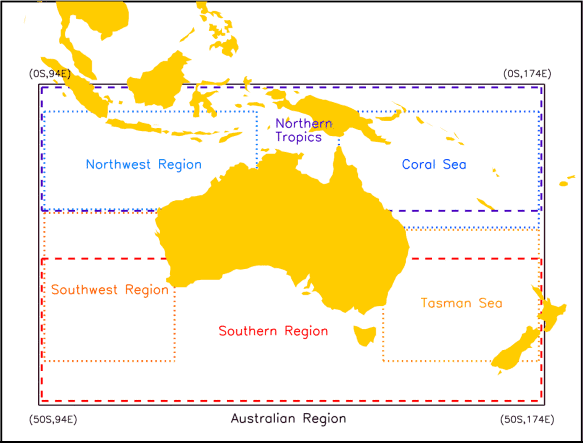
Timeseries are determined for the seven regions shown above.
Data used
The data used to analyse cyclone density and cyclone central pressure are the NCEP/NCAR, 6-hourly, surface pressure reanalysis. These data are available from the National Center for Environmental Prediction (NCEP) website https://www.weather.gov/ncep/. The analysis method makes use of the cyclone tracking algorithm developed at the Bureau of Meteorology and the University of Melbourne described in Jones and Simmonds (1993). The intensity of cyclones in terms of gradients of pressure is required to be at least 0.15 hPa per degree of latitude squared, as averaged within a 5 degree (~550 km) radius of the centre of the anticyclone.
Please note that any use of the data analysed on these web pages should be acknowledged to the Bureau of Meteorology. Apart from the purposes of study, research, criticism and review, no part of these data may be reproduced, or redistributed for any commercial purposes, or distributed to a third party for such purpose, without written permission from the Director of Meteorology.
The actual data values used to produce each graph are available via the "Raw dataset" link. The format for these data is:
<start year><start month><end year><end month> <value>
The "Sorted dataset" link provides the timeseries as a sorted list in order to place recent values in historical context.
Further information
Murray RJ and Simmonds I 1991. A numerical scheme for tracking cyclone centres from digital data. Part I: Development and operation of the scheme. Australian Meteorology Magazine, 39, 155166.
Jones DA and Simmonds I 1993. A climatology of southern hemisphere extratropical cyclones. Climate Dynamics, 9, 131-145.
Simmonds I and Keay K 2000. Mean southern hemisphere extratropical cyclone behavior in the 40-year NCEP-NCAR reanalysis. Journal of Climate, 13, 873-885.
Simmonds I and Keay K 2000. Variability of southern hemisphere extratropical cyclone behavior, 1958-97. Journal of Climate, 13, 550-561.
Pezza AB, Simmonds I and Renwick JA 2007. Southern hemisphere cyclones and anticyclones: recent trends and links with decadal variability in the Pacific Ocean. International Journal of Climatology, 27, 1403-1419.

