There are currently no formally monitored deficiency periods
During the absence of large-scale rainfall deficiencies over periods out to around two years' duration, the Drought Statement does not include any formally monitored deficiency periods. We will continue to monitor rainfall over the coming months for emerging deficiencies or any further developments.
Rainfall history
 Australian rainfall history
Quickly see previous wet and dry years in one (large) screen.
Previous three-monthly rainfall deciles map
See also: Rainfall maps | Rainfall update
Soil moisture details are reported when there are periods of significant rainfall deficits.
Soil moisture data is from the Bureau's Australian Water Resources Assessment Landscape (AWRA-L) model, developed through the Water Information Research and Development Alliance between the Bureau and CSIRO.
See also: Australian Water Outlook: Soil moisture
See also: Murray-Darling Basin Information Portal
Previous issues
Related links
Deficiencies persist, but ease somewhat after November rainfall
November rainfall was above average across most of the Northern Territory, South Australia, the southern half of Western Australia (away from the west coast and southwest), western Queensland, northeastern Tasmania, and large areas of New South Wales. This has eased short- to medium-term rainfall deficiencies across large areas, but at the longer 20-month timescale deficiencies remain largely unchanged.
Meteorological drought is rarely broken in a single event or month; typically, regular rainfall over a period of several months is required to remove the large rainfall deficiencies currently in place.
Rainfall for November was below average across eastern Queensland, extending into northeastern New South Wales, and other smaller areas in northern and west coast Western Australia. Correspondingly, rainfall deficiencies have increased in northern Queensland.
The year to date has been exceptionally dry for New South Wales, Victoria, eastern South Australia, and the southern half of Queensland. Significant rainfall deficiencies continue to affect large areas of eastern Australia at timescales out to around two years' duration. This has been the seventh-lowest January to November rainfall since 1900 for the Murray-Darling Basin, eighth-lowest for New South Wales, and ninth-lowest for Victoria.
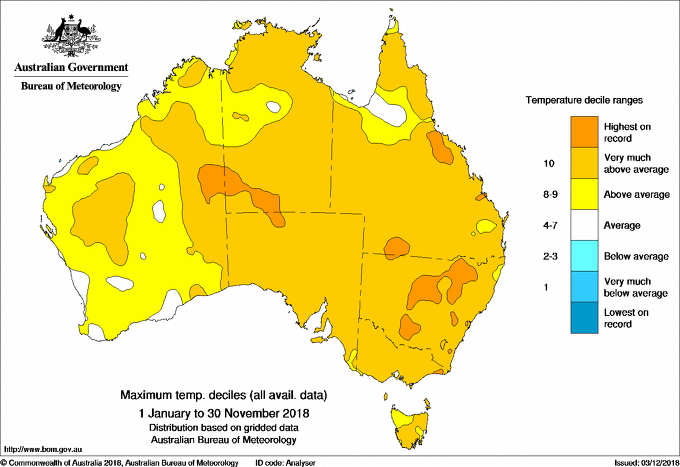
The year so far has also been very warm, which has added to the impact of low rainfall. Australian maximum temperatures for 2018 to date have been the second-warmest on record with an anomaly of +1.33 °C (behind 2013 with an anomaly of +1.51 °C for January to November). New South Wales (+2.07 °C) has experienced its warmest January–November period on record, while Victoria (+1.41 °C) has tied for equal-second-warmest (with 2007, both behind 2014). Record warm temperatures in late November in Queensland contributed to large and severe fires in a number of areas in the east of the State.
8-month rainfall deficiencies
The southern rainfall season spans the eight months from April to November and corresponds to the main cropping season for southern agricultural regions. For 2018, the southern rainfall season saw below average rainfall across much of Australia for the seven months to October, then average rainfall for November across large parts of the southeast and southwest. Serious or severe rainfall deficiencies persist across much of the eastern mainland, although deficiencies have decreased in large areas.
Above average rainfall for November has reduced or removed deficiencies in parts of western and southern Queensland, much of New South Wales away from the northwest, eastern South Australia and Central Australia. However, deficiencies have increased in the northern half of Queensland, and to a lesser extent in other parts of northern Australia experiencing deficiencies.
Large areas of serious or severe rainfall deficiencies are in place in northern and eastern Victoria; areas of eastern South Australia; large areas of southern, northwestern, and inland northeastern New South Wales; large areas of Queensland away from the west and the southeastern quarter of the State; areas of Western Australia in the Southeast Coastal District and the northeast of the Interior District and Kimberley; and in the northeast of the Top End in the Northern Territory.
11-month rainfall deficiencies
For the year to date, deficiencies have decreased slightly in severity across most of the affected area following above-average November rainfall.
Serious or severe rainfall deficiencies remain in the eastern half of South Australia except the far southeast and far northeast; most of Victoria except the southwest; most of New South Wales except the central and northern coastal regions; southwestern Queensland and the Warrego District, in the Central Highlands and Coalfields, and in pockets on the Central Coast and along the southern border of Queensland inland of the ranges; and in Western Australia's South Coastal District.
20-month rainfall deficiencies
The effect of November rainfall on deficiencies at longer timescales has been less than at the shorter timescales, however deficiencies for the period starting in April 2017 have been reduced somewhat in Queensland's Channel Country, and central and southern New South Wales.
Serious or severe rainfall deficiencies continue across most of New South Wales excluding the northeast to central coast and much of the Riverina and North West Slopes and Plains districts; across eastern to central southern Victoria; small areas of coastal eastern and northern Tasmania; much of eastern South Australia away from the far southeast and far northeast; southwestern to central Queensland, and a pocket of southeastern Queensland inland of the ranges.
Deficiencies also persist in Western Australia along the west coast between the Pilbara and the South West, and extend into the South Coastal District.
NULL
Soil moisture
Above average November rainfall has increased lower-layer soil moisture (from 10 cm to 100 cm deep) over the southern half of Western Australia, Central Australia, southwestern Queensland, and South Australia. Soil moisture values have also increased to near average over much of New South Wales inland of the ranges and in large areas of central Queensland.
Soil moisture for November was below average for most of Victoria, parts of southeastern South Australia, southeastern New South Wales and along the ranges and Northern Tablelands, South West Western Australia, and most of Tasmania except the Central Plateau. Below average soil moisture was also observed in the western Pilbara in Western Australia, the eastern Top End in the Northern Territory, along parts of Queensland's northern coasts, and in scattered areas from inland northern Queensland to the Darling Downs.
Conversely, soil moisture was above average for much the southern half of Western Australia, excluding the South West, the West Coast and Northwest Pastoral districts of South Australia, southwestern Queensland and the south of the Northern Territory, large parts of the remainder of the Northern Territory, extending into northwestern Queensland. Scattered small areas along the ranges in eastern Queensland, western and Riverina New South Wales, and the Pilbara and Kimberley in Western Australia also observed above average November soil moisture.
- November rainfall above average for much of Australia, but below average across eastern Queensland and western coastal areas of Western Australia
- Rainfall deficiencies decreased at the 8- and 11-month timescales across Central Australia and eastern Australia, but increased in northern Queensland
- Longer-term deficiencies continue with little change in most areas
- Lower-level soil moisture below average for November across Victoria, large parts of eastern New South Wales, South West Western Australia, and much of Tasmania
Product code: IDCKGD0AR0
 Unless otherwise noted, all maps, graphs and diagrams in this page are licensed under the Creative Commons Attribution 4.0 International Licence