Tropical outlooks and monitoring
- Tropical (MJO) monitoring
- Northern rainfall onset
- Tropical cyclones: Australian outlook | South Pacific outlook
- Gradient level wind analysis: 00 UTC | 12 UTC
- Asia MSLP analysis
- Satellite images: Basic resolution | High resolution
2024–25 Severe weather seasonvideo
October to April is the peak time for severe weather, including:
- Tropical cyclones
- Severe storms
- Damaging winds
- Floods
- Bushfires
- Heatwaves
About tropical cyclones
Tropical Climate Update
Australian region
Recent conditions
Throughout the week ending 19 October, inland troughs triggered thunderstorms, some severe, and showers across the Northern Territory and Queensland. Severe thunderstorms with damaging winds and hail caused property damage in Alice Springs. Alice Springs Airport recorded a 96 km/h wind gust on 12 October, its ninth-highest for October.
For the week ending 19 October, widespread totals of 5 to 50 mm were recorded across much of the Northern Territory and Queensland, and far northern parts of Western Australia. Parts of central and eastern Queensland recorded weekly totals of 50 to 200 mm.
Maximum temperatures for the week ending 18 October were above average across northern Australia, except for some coastal areas, and parts of southern Queensland. Temperatures were more than 4 °C above average for inland Western Australia and the south-western Northern Territory. Minimum temperatures for the week were above average across most of northern Australia.
Fortnightly forecast
For the fortnight 24 October to 6 November, there is an increased chance of above-average rainfall for much of northern Australia except in eastern Queensland, far northern parts of the Top End and western parts of Western Australia, where there are roughly equal chances of above or below average rainfall. Below-average rainfall is likely for northern parts of the Cape York Peninsula.
Maximum temperatures are likely to be below average across much of the north. In contrast, minimum temperatures are likely to be above average across most of northern Australia.
Tropical cyclone season
Tropical cyclone risk increases from November to April, the official tropical cyclone season in the Australian region. They can bring heavy rainfall, damaging winds, large waves and storm surge causing coastal erosion. At least one tropical cyclone has made landfall on the Australian coast each season since reliable track records began in 1970–71. Tropical lows can also cause substantial impacts, as can tropical cyclones that remain offshore.
Our tropical cyclone season page includes information about this season, past seasons and future seasons.
Northern rainfall onset
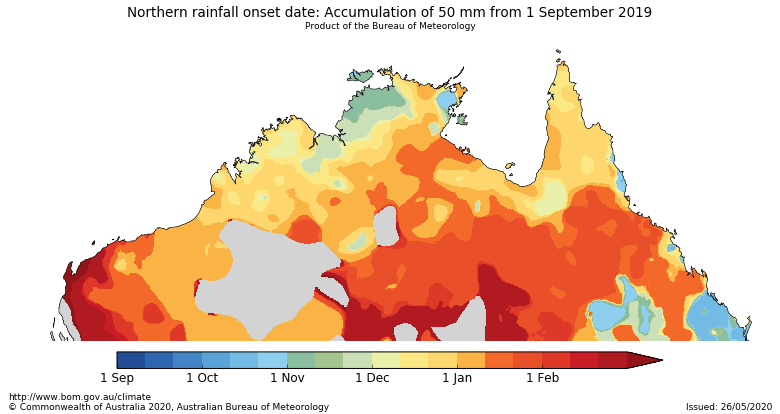
The northern rainfall onset occurs when enough rain has fallen to stimulate plant growth after the northern dry season. This is defined as the date when rainfall accumulated after 1 September totals at least 50 mm.
As at 20 October, some southern parts of northern Australia, and smaller areas in the far western Top End, and north-eastern Queensland have observed an earlier than the normal onset.
Our Northern rainfall onset outlook includes information about the northern rainfall onset observation and outlook.
Madden–Julian Oscillation
The moderate Madden–Julian Oscillation (MJO) is currently in the Indian Ocean. As of 18 October, forecasts indicate it is most likely to be weak over the coming week, largely influenced by the strong El Niño signal.
International Conditions
Tropical cyclone Wati
Tropical Cyclone Wati was declared a Category 1 cyclone on 17 October just offshore from the Cook Islands, becoming the first tropical cyclone of the 2026-27 Southern Hemisphere cyclone season, around two weeks ahead of the official season start on 1 November. The system tracked south-south-east across the Lower Cook Islands before beginning an extratropical transition. Its unusually early formation was linked to warmer-than-average Pacific Ocean temperatures associated with the developing El Niño. Its impacts were largely confined to the Cook Islands.
Super Typhoon Champi
Super Typhoon Champi developed on 15 October 2026 in the western North Pacific and rapidly intensified, reaching Category 4-equivalent strength on 17 October before intensifying to Category 5 six hours later, early on 18 October. Champi tracked generally west-northwest over open waters of the western Pacific, remaining away from major population centres through the week ending 20 October. Impacts were largely confined to hazardous marine conditions, including destructive winds and very rough seas. It is the ninth Category 5 system observed globally so far in 2026.
Hurricane Trudy
Hurricane Trudy formed on 13 October 2026 in the eastern North Pacific south-west of Mexico. The system strengthened to Category 3 hurricane intensity on 16 October before weakening to a tropical storm by 19 October. Trudy tracked north-westward offshore of Mexico before becoming near stationary and weakening over cooler waters. Impacts were mainly heavy rainfall, rough seas and strong winds over adjacent coastal waters, with no significant landfall reported.
Product code: IDCKGEW000