Summary
Severe Tropical Cyclone Bakung was a small Indian Ocean cyclone named by Indonesia that had no impact to island communities. It was notable for having two short lived peaks at severe tropical cyclone intensity.
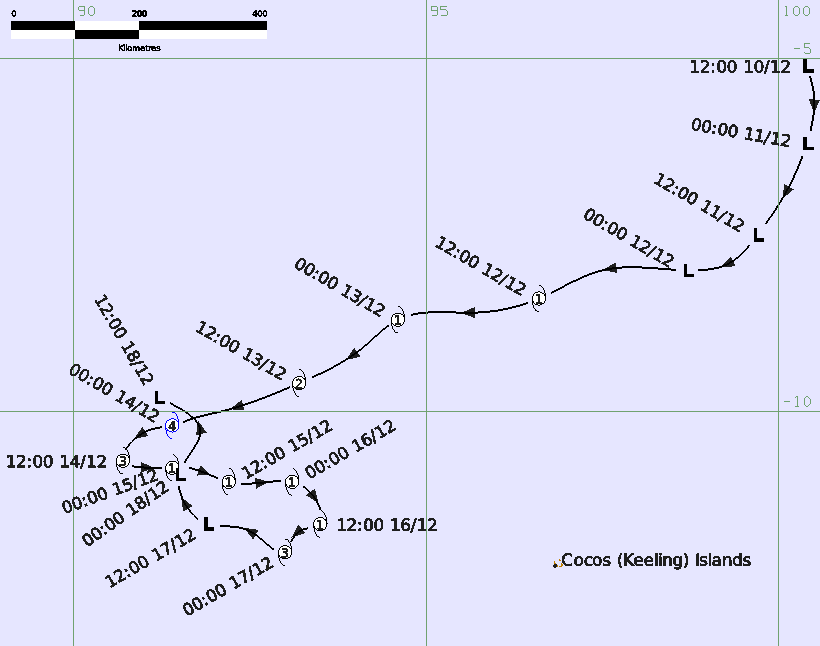
A tropical low developed west of Sumatra on 10 December. Gales were detected by scatterometry on 12 December and tropical cyclone intensity was estimated at 0600 UTC. Jakarta Tropical Cyclone Warning Centre (BMKG, Indonesia) named the cyclone 'Bakung'. Bakung initially moved to the south southwest then adopted a west southwest track on 12 December passing well to the north of Cocos (Keeling) Islands overnight 12-13 December.
Under favourable environmental conditions of low wind shear, Bakung developed rapidly on 13 December as it continued moving to the southwest passing south of 10°S into the Australian area of responsibility overnight from 13-14 December. Bakung peaked at category 4 intensity with maximum winds of 90 kn (165 km/h) on 14 December.
Bakung then weakened under increased wind shear, and slowed, taking an abrupt turn to the east southeast overnight 14-15 December then southeast on 15 December whilst weakening under wind shear. Bakung remained at category 1 intensity on 15-16 December. During 16 December Bakung was steered to the southwest. Overnight on 16-17 December Bakung rapidly intensified to briefly reach category 3 intensity early on 17 December.
Bakung rapidly weakened on 17 December as it turned to the northwest. The circulation dissipated on 18 December as it moved north of 10°S out of the Australian region.
There were no impacts to the Cocos (Keeling) Islands.
For more information see the TC Bakung Report (doc).
Track and Intensity Times in UTC (AWST-8h)