
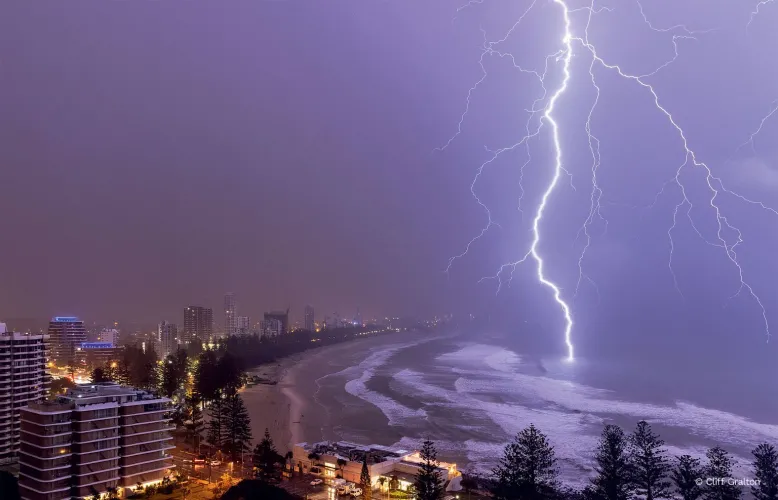
Lightning strike, Burleigh Heads, Queensland. Credit: Cliff Gralton.

Photographer Cliff Gralton. Credit: Cliff Gralton.
A crack of thunder in the night was the catalyst for keen photographer Cliff Gralton capturing the April image in the 2026 Australian Weather Calendar.
While visiting Burleigh Heads from his home on the Mid-North Coast of NSW, Cliff was woken at around 4am by a thunderstorm off the coast from his ocean-view accommodation.
“I woke up and I could see the lightning, it was just going absolutely nuts,” he recalled.
“I quickly grabbed my camera gear, set it up on the on the balcony and tried to get it into focus as quick as I could because there were strikes dropping everywhere.
“And once I focused the camera, as soon as I took my finger off the button, there was this huge flash and an instant bang, which had me ducking for cover.
“When I checked the camera, I saw this enormous bolt in the right third of the shot. I was pretty stoked with it.”
A thunderstorm electrifies as ice particles within the cloud formations grow, interact, collide and break apart.
Small ice particles tend to acquire a positive charge and are carried high into the storm, causing a strong negative electrical charge to build up at the base.
Once that charge is strong enough, it branches down from the cloud in a stepped ladder, in a process invisible to the human eye.
But when a return positive electrical charge from the ground snakes up to meet it, a powerful electric current bursts through, producing the visible flash of lightning forking from the sky to the ground.
With thunderstorms usually lasting between only 15 and 30 minutes, Cliff only captured one image with visible lightning strikes during the storm, as the short-lived weather phenomenon, passed over.
It was a thunderstorm which first piqued Cliff’s interest in weather photography.
“I thought I wouldn't mind getting a shot at some lightning,” he said.
“And once I got that one bolt, that was it.
“Every single day I'm checking the BOM app just to see if there's going to be anything potentially coming my way.
“If there's a major weather event, I'm normally trying to get to it.”
Cliff took up photography around 10 years ago after a spinal cord injury caused him to give up his hobbies of motorcycle-riding and surfing.
He has since become a dedicated weather and astro-photographer.
“I decided to pick up the camera and take it to the beach one day and I got a picture of a wave,” he said.
“And I was instantly hooked from that point on.”
The Bureau's 2027 Australian Weather Calendar national photo competition is currently open for submissions until March 31.
For the full terms and conditions of entry, and to submit a photo, visit: http://www.bom.gov.au/calendar/contest/