
Dramatic thunderstorms, amazing auroras and dust storms are some of the diverse weather events featured in the 2027 Australian Weather Calendar.
Captured by both professional and hobby photographers, this year's calendar showcases photographs taken all over the country.
Every photo featured in the calendar sits beside a meteorological description of the phenomenon shown, giving the scientific explanation behind the weather.
Bureau of Meteorology National Community Information Manager Andrea Peace said the 2027 Australian Weather Calendar showcases the power, beauty and wonder of Australia's landscapes.
"We have photos from all over the country depicting vastly different weather events," Ms Peace said.
"The submissions we received are spectacular and, as always, it was an incredibly tough task picking the winners."
Ms Peace said one of the standout photographs was Ivan Sajko's lightning bolt, captured in Port Macquarie, NSW.
"The judges were mesmerised by the drama and scale of this weather event," she said.
"From a meteorological perspective, this photograph is remarkable, capturing four different types of lightning in a single frame."
"To witness that moment and capture it on camera is truly incredible."
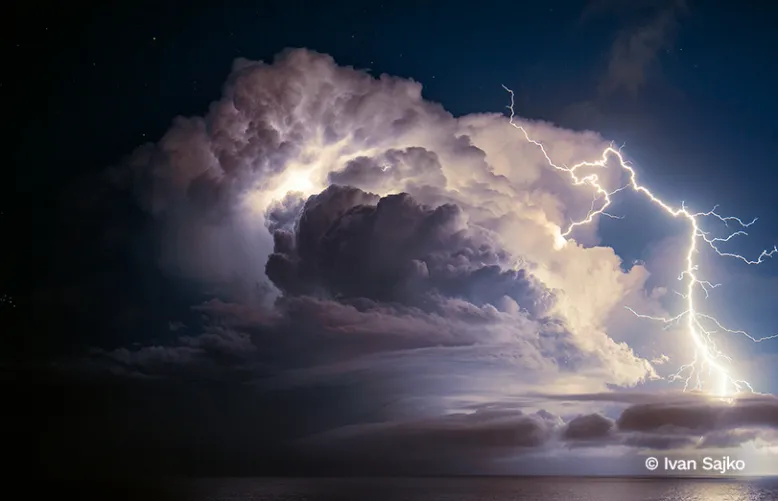
This lightning bolt, captured by Ivan Sajko in Port Macquarie, is June's photo. Credit: Ivan Sajko.
This year's cover photo is unique, the intricate cross-section of a hailstone.
Bureau scientist and honorary hailstone researcher, Joshua Soderholm, took the photo under precision lighting at a sub-zero freezer in Brisbane.
The image allows scientists to trace different stages of the hailstone's development, from a tiny ice particle at its core to the large, complex hailstone eventually collected on the ground.
Also captured this year are curious cloud formations, transforming the most ordinary view into something extraordinary.
Buffeted by wind and spray above a Kakadu waterfall, Patch Clapp captured a newly recognised cloud formation, which features as April's photograph.
The image marks the first time a cataractagenitus cloud, one that forms over a waterfall, has appeared in the Australian Weather Calendar.
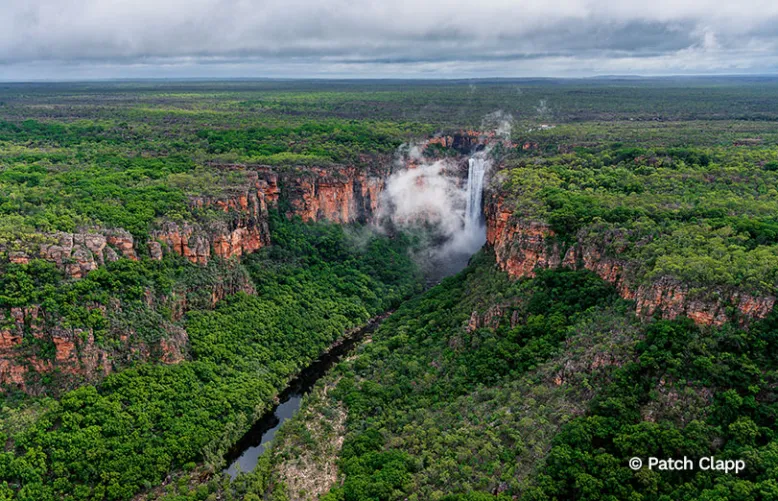
These waterfall clouds, captured by Patch Clapp in Kakadu National Park, feature as April's photo. Credit: Patch Clapp.
A menacing dust storm towering over Broken Hill was chosen as January's photo, captured by Patrick Reincke.
This dramatic scene was accompanied by the city's historic mining headframes, capturing both the city's heritage and the scale of the approaching weather system in a single frame.
The 2027 Australian Weather Calendar is on sale now.
Order online at https://shop.bom.gov.au/
[ENDS]
More information, including detailed meteorological information, high resolution copies of images and photographer profiles, is available by contacting the bureau's media team.
Detailed information on each photo's location and weather phenomenon is listed below, with photo credits.
Per the conditions of entry, all winning images can only be published in support of Australian Weather Calendar promotion or story. The images cannot be used for any other purpose or project, or in conjunction with any other bureau media. The photographers retain all rights so image copyright line must accompany each image.
Cover: Hailstone, Forestdale, Qld – Joshua Soderholm
January: Dust storm, Broken Hill, NSW – Patrick Reincke
February: Lightning and rainbow, Pannawonica, WA – Heather Osborne
March: Fog, Brisbane, Qld – Michael Coombes
April: Waterfall clouds, Kakadu, NT – Patch Clapp
May: Cirrus clouds, Mingenew, WA – Barend Becker
June: Lightning strike, Port Macquarie, NSW – Ivan Sajko
July: Fallstreak cloud, Brisbane, Qld – Lee Earle
August: Roll cloud and storm, Maroochydore, Qld – Christina Stubbs
September: Pyrocumulonimbus cloud, Walwa, Vic – Lara Tobin
October: Lenticular clouds, Sheffield, Tas – Andrew Thomas
November: Sunset, Heard Island, Southern Indian Ocean – Jeff Miller
December: Aurora australis, Kangaroo Island, SA – Steven Genesin