
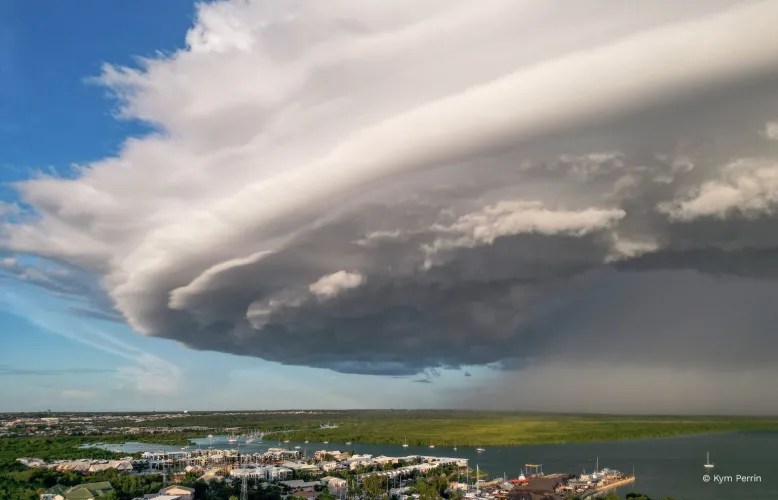
Thunderstorm in Darwin, Northern Territory. Credit: Kym Perrin.
With the wet season drawing to a close, Kym Perrin was on high alert for promising clouds when she spotted a monster storm brewing from the balcony of her apartment in Darwin.
“I was inside with the air-con on, and I heard thundering outside and I was like, ‘Oh goody’”, she said.
“I picked up my phone, went to the BOM Weather app and checked the rain radar.
“There was a really interesting structure sort of moving up, and there were bits of orange in it, so I knew this was going to be good.”
The keen photographer quickly gathered her photography drone and ran down the street from her home to capture the storm in all its glory.
Sending her drone – which she affectionately calls Dwayne – into the sky, Kym hunted for the best angle of the spectacle.
"Initially, I was facing towards the ocean, and it was just blue skies and sun,” she said.
“But when I panned around, and as everything came into view, a massive shelf cloud was just there, and the sun was projecting onto the rain curtain, and there was a little bit of a rainbow.
“The more I panned around the more I could see, it was just the most incredible thing I've ever seen in my life.”
Thunderstorms form when warm, moisture-laden air is forced to rise high into the atmosphere.
The air cools as it ascends, causing water vapour to condense into liquid drops, producing cloud.
When lightning discharges within the storm cloud or to the ground, a resulting explosive expansion of air creates the sound of thunder.

Photographer Kym Perrin. Credit: Kym Perrin.
As she snapped away with Dwayne the drone in the air, Kym felt the conditions around her begin to change.
“I just kept going until the storm got close enough that I started to feel the leading winds, and the rain was getting closer, and I thought if I don't get down and get out of here, I'm going to get very soaked,” she said.
“I didn't really realise what I’d caught until I transferred the photos and looked at them on the bigger screen at home.
“I was just really stoked with what I caught.
“Every time I put him up, I'm not expecting a magical shot, but this particular day, I don't know, the storm gods shined on me."
Living in the Northern Territory, Kym usually has to hold out through the clear skies of the dry season for the wet season to capture storms like this.
But with Darwin experiencing the most thunder days per year of all the Australian capital cities, the wait usually pays off.
Having a long-held interest in weather, which has only increased for Kym since she moved to the NT from Canberra a few years ago, she has in the past focused on capturing photos of storms, lightning and fireworks with her DSLR camera.
But using Dwayne the drone gives another perspective, taking photos close to the clouds she’s photographing.
This wet season, Kym is aiming for Dwayne to meet Hector the Convector, a thunderstorm cloud that forms regularly over the Tiwi Islands off the Darwin coast, and capture more dramatic shots.
Order your copy of the 2026 Australian Weather Calendar now at https://shop.bom.gov.au/.