
Increasing global temperatures
Increasing greenhouse gases in the atmosphere mean that surface temperatures across the globe are increasing. The frequency and intensity of weather and climate extremes are also increasing.
For more about greenhouse gases and their impact, view our Climate change in Australia page.
Drought is more likely
As the climate warms, the hazards Australia faces will change. Climate change means it is likely southern Australia will spend more time in drought. Increasing temperatures can mean a drought has more impact, by worsening dry conditions.
Rainfall has decreased
Recent decades have seen decreases in cool season rainfall (April to October) across many regions of southern Australia.
South-west Australia
- April to October rainfall is down about 16% since 1970.
- May to July rainfall has seen the largest reduction, by about 20% since 1970.
South-east Australia
- April to October rainfall is down about 9% since 1994.
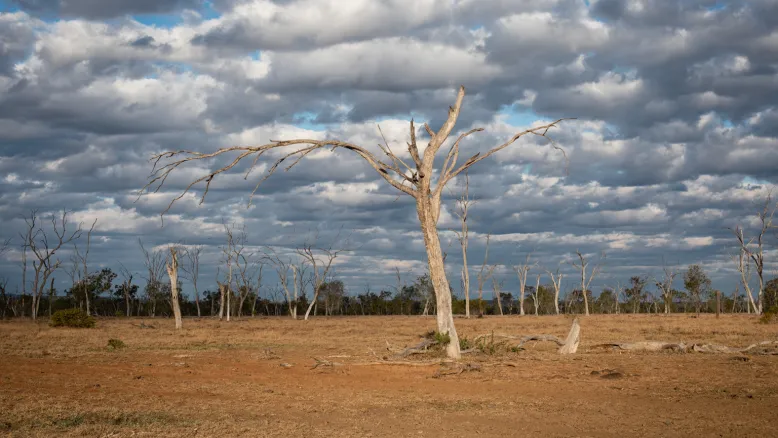
Drought can have more impact as rising temperatures make dry conditions worse
Drought projections
The decrease in rainfall is expected to continue, with likely longer droughts on average. This is linked to projected changes in the track of rain-bearing frontal systems further south.
Australia's National Climate Risk Assessment 2025 reports:
- Time spent in meteorological drought is projected to increase across large areas of the country, particularly in the south and east (low to medium confidence).
- Aridity is projected to increase in the south-west of Western Australia and across parts of the southern mainland (high confidence).
- Streamflow and runoff in southern and eastern Australia have declined since 1950, with increased time spent in hydrological drought.
- The rate of change of drought is unlikely to be linear (low confidence), with abrupt changes observed in the past.
This aligns with the State of the Climate report that we produce with CSIRO.
Impact on water resources
Decreasing rainfall, with fewer very wet years, makes it harder for water storages and groundwater to recover.
While there may be enough water to meet short-term needs, we become more vulnerable to another drought. We may not have the reserves to sustain us over periods of lower-than-average rainfall.
For the projected impact of climate change on rainfall, soil moisture, runoff and evaporation, see the Australian Water Outlook.