
What information goes into a forecast?
The information and tools meteorologists draw upon to build a forecast include:
- weather observations
- weather models
- meteorological knowledge and experience.
Observations
Every forecast starts with understanding what the weather is doing right now. We use recent and current observations to build this picture of the atmosphere.
Observations are records of different weather elements that we collect from Australia's observation network. These include:
- quantities like air pressure, temperature and rainfall at the Earth's surface
- measurements in the upper atmosphere from weather balloons and aircraft
- data from weather radars and satellites.
Weather models
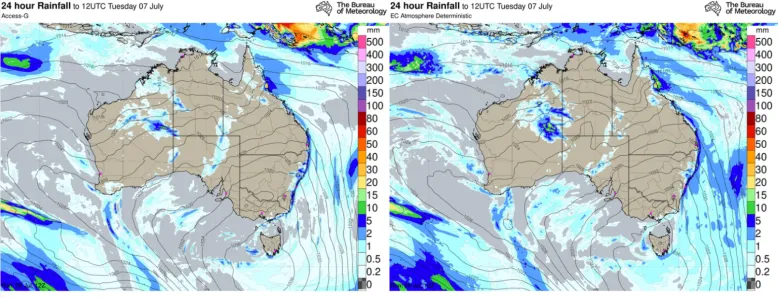
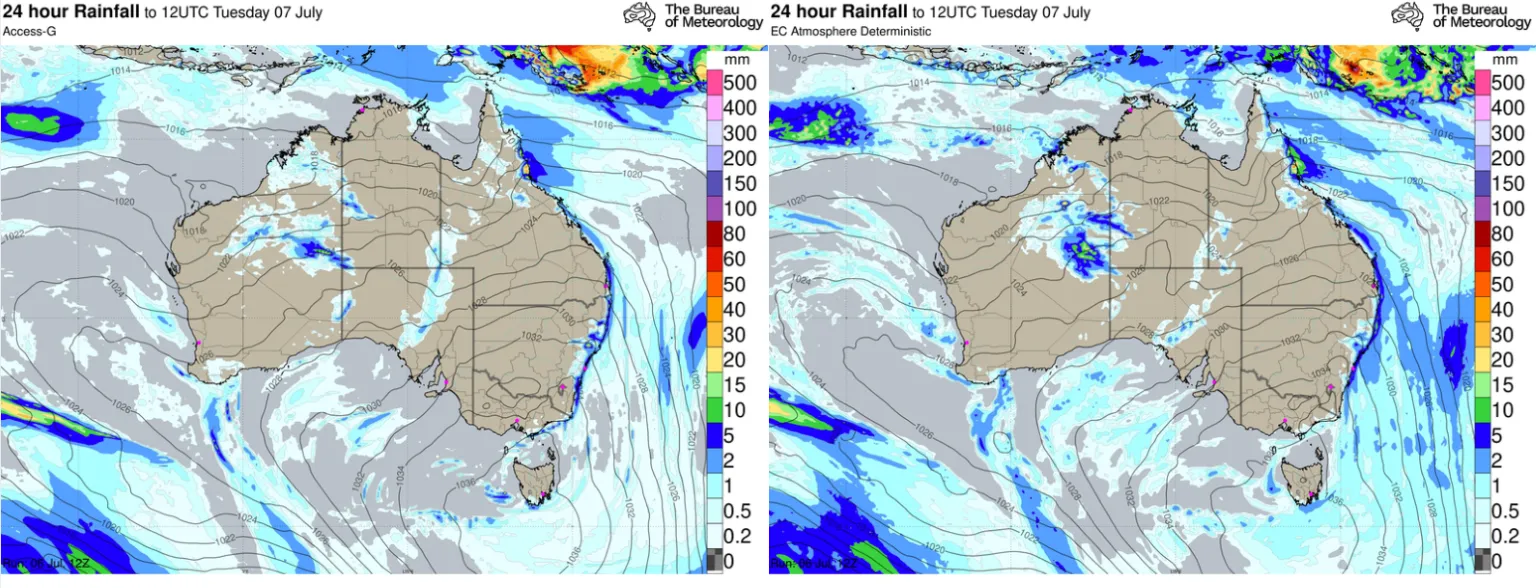
Weather models are our main forecasting tools. We use numerical weather prediction models.
These models use current and past observations of the atmosphere and ocean. They process this data through complex mathematical equations.
The equations calculate how weather patterns are likely to develop. With this information, meteorologists apply their scientific expertise and experience to produce the forecast.
Our main weather model is the Australian Community Climate and Earth-System Simulator (ACCESS). Learn more about weather models.
Scientific expertise and experience
Data and models are a powerful force but human insights are also a key ingredient in forecasting.
Meteorologists draw on their knowledge of how the atmosphere works to produce a forecast. This knowledge is gained through on-the-job experience, training and several years of university study.
To produce a forecast, meteorologists:
- assess information provided by the models
- compare different models
- monitor observations
- apply their understanding of local geography and weather patterns.
Our meteorologists work with scientific organisations around the world to compare international models. Together, they identify the most reliable information. This includes for specific weather events, such as tropical cyclones.
During major weather events, a meteorologist's experience can be vital, particularly for emergency services. It helps them understand the expected evolution of the weather, based on knowledge of similar events in the past.