Summary
Severe Tropical Cyclone Fina was a remarkable early season tropical cyclone, impacting both the western Top End of the Northern Territory and the northeast Kimberley coast in Western Australia. Fina was notable for being the most intense tropical cyclone to occur in the Australian region during November and also equalled the record for earliest landfall in a season by a cyclone on the Australian mainland.
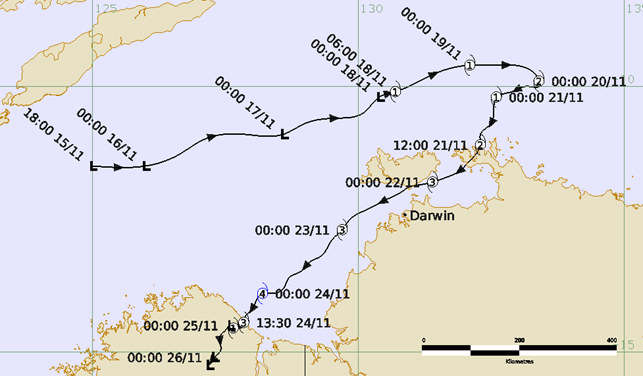
A tropical low (02U) formed on 15 November north of the Kimberley. The low tracked steadily towards the east and slowly consolidated. Environmental conditions were favourable for development and the system developed into Tropical Cyclone Fina on 18 November, around 260 kilometres north of Darwin. Fina moved over waters of 30.5-31°C, about 0.5°C warmer than normal.
Fina intensified into a category 2 system on 19 November, before taking a sharp turn to the south to southwest on 20 November and briefly weakening to category 1 intensity. Fina re-intensified to category 2 prior to crossing the Cobourg Peninsula late on 21 November. This equals the record for the earliest cyclone landfall on the Australian mainland with Severe Tropical Cyclone Ines, which crossed the north Kimberley coast of Western Australia on 21 November 1973.
On 22 November, Fina intensified further into a severe (category 3) tropical cyclone as it moved to the west southwest through the Van Diemen Gulf over the southern tip of Melville Island (of the Tiwi Islands) and to the north of Darwin. Wurrumiyanga on Bathurst Island (Tiwi Islands) was the worst affected community sustaining significant damage. The greater Darwin region missed the very destructive core but still experienced damaging wind gusts estimated to 65 kn (120 km/h) that caused widespread power outages mostly as a result of fallen trees.
Severe Tropical Cyclone Fina continued to track towards the southwest on 23 November and intensified further in favourable environmental conditions. Fina reached a 10-minute mean maximum wind peak intensity of 105 kn (195 km/h) between 2100 UTC 23 November and 0300 UTC 24 November, a high-end category 4 system. This makes it the strongest tropical cyclone to occur in the Australian region during November.
Fina weakened only slightly to a category 3 system as it crossed the northeast Kimberley coast near the Berkely River Mouth late on 24 November. The Berkeley River Lodge suffered significant wind damage to structures and vegetation. Fina rapidly weakened as it moved slowly overland and was below tropical cyclone intensity on the morning of 25 November.
No surface observations were recorded in the destructive core of Fina. The strongest wind gusts reported were 59 kn (109 km/h) at Croker Island Airport on 21 November, and 58 kn (107 km/h) at Darwin Airport on 22 November. The most notable 24-hour rainfall total was at Middle Point (near Darwin), which recorded 430.0 millimetres in the 24 hours to 9am 23 November. Many NT locations including Darwin, set new daily rainfall records for November.
For more information see the TC Fina Report (doc).
Track and Intensity Times in UTC (ACST-9.5h; AWST-8h)