Summary
Tropical Cyclone Iggy was a small, short lived tropical cyclone in the Indian Ocean that brought heavy rainfall to Christmas Island.
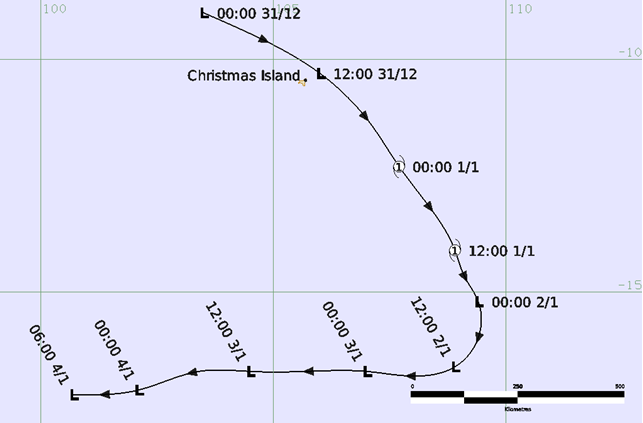
An increase in westerly winds assisted in the formation of a tropical low (10U) southwest of Sumatra on 30 December. It moved quickly to the southeast and entered the Australian region (10°S) on 31 December. The low passed just to the east of Christmas Island late on 31 December producing heavy rainfall (57.8 mm of rain recorded to 9 am 31 December and further 93.4 mm to 9 am 1 January), however no impacts were reported on the island.
The system intensified into a tropical cyclone at 0800 AWST 1 January and peaked at Category 1 intensity, with estimated maximum wind gusts near the centre of 100 km/h, before weakening below tropical cyclone intensity some 18 hours later at 0200 AWST 2 January. Iggy was a very small cyclone, with the largest extent of gales being 75 km. Overnight from 1 to 2 January, gales became confined to the eastern side of the centre before ceasing completely later on 2 January. The remaining low then turned westward and eventually dissipated over the Indian Ocean.
For more information see the TC Iggy Report (doc).
Track and Intensity Times in UTC (AWST-8h)