
Every day, the Bureau of Meteorology issues roughly 3,650 forecasts across Australia.
The 3,650 forecasts are made up of:
| Forecast type | Percentage |
|---|---|
| Precis (concise, individual location forecast) | 62% |
| Town/Metro | 15% |
| Coastal/High Seas | 12% |
| State/District/Fire Rating | 11% |
Understanding if these forecasts are accurate requires comparing them with real world observations. For example, how much rain fell or how warm it was.
Sounds simple, but for these assessments to be meaningful the comparison needs to be done in the same way, over extended periods of time, using lots of quality-controlled data points.
This process is called verification.
The final result of this complex task helps the bureau report on its forecast accuracy.
These figures are updated each year on the bureau's website and annual report.
The bureau generally reports on its forecast accuracy on a national scale, but in some instances state or location results are available.
Results are not available everywhere because some individual locations may not have enough observations to produce reliable data needed for verification. This is especially the case for remote locations.
The national results provide a simple and clear picture of overall performance and help governments and the community track forecast improvement over the long term.
Bureau forecasters also have access to systems that compare forecasts with observations in near real time, allowing them to continuously monitor forecasts, updating them when required and to support ongoing improvement.
In a nutshell, we verify forecasts to:
- Monitor forecast quality
- Improve forecast quality
- Compare and enhance forecast models, which helps improve forecasts
So what is the data telling us?
The bureau's forecast accuracy has continued to improve thanks to advances in technology and science.
Over the past decade, temperature forecasts have gained more than a day’s worth of skill. This means today's forecast for 2 days ahead is now about as accurate as the 1 day forecast ten years ago.
How accurate are temperature forecasts?
Temperature and wind are pretty straight forward.
They can be relatively uniform across large areas, making them easier to predict than other things like rainfall.
The forecast for tomorrow's maximum temperature is normally within 2 °C of what's observed 90% of the time.
For minimum temperature, the forecast is generally within 2 °C of what's observed 84% of the time.
For wind, all hourly wind speed forecasts for the next day are within 5 knots of what's observed 90% of the time.
Extreme conditions can still be a challenge and are always an area of extra forecasting effort.
How accurate are rainfall forecasts?
Rainfall is a bit tricker as it can vary so much across small areas. Everyone has experienced the situation where showers or storms bring rain to one place but it's dry just down the road.
That's the reason bureau forecasts include information about the possible rainfall range.
When it comes to rainfall, the bureau's forecasts are usually expressed in ‘probabilistic’ form.
This means that instead of giving a single amount of how much rain will fall, they provide a range of possible amounts, and the likelihood of reaching those amounts.
This is known as the rainfall range and is designed to help everyone understand how dry or wet it could be.
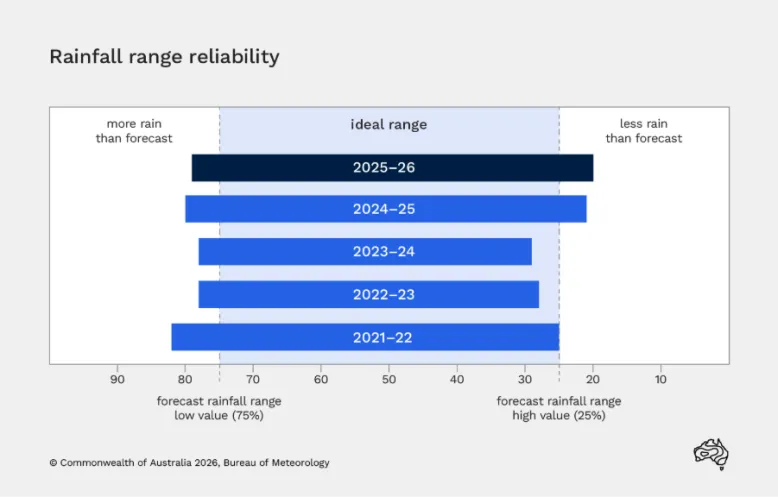
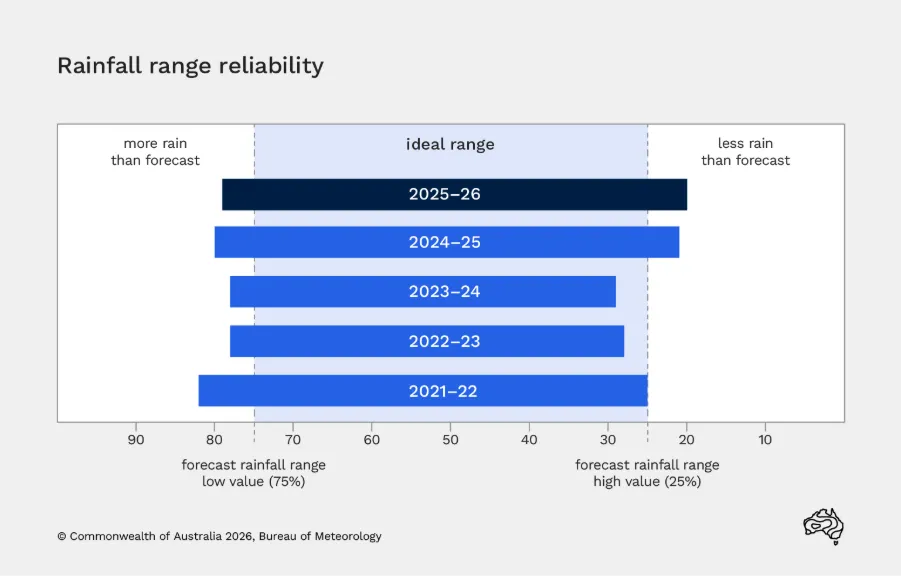
The most recent national figures from 2025-2026 show the Bureau’s probabilistic rainfall forecasts were reliable.
What we mean by reliable, is that when we say there is a 50% chance of getting at least, say, 10mm of rain, that is what should happen 50% of the time.
National figures showed that:
When the Bureau forecasts a 25% chance of exceeding a rainfall amount for the next day, that result occurred 19% of the time. Similarly, for the 50% chance amount, it occurred 49% of the time and for the 75% chance amount it occurred 80% of the time.
How does the bureau assess rainfall accuracy?
Assessing rainfall accuracy is like temperature or wind where quality-controlled observations for a location are compared to forecasts.
One difference is that you can't tell if probabilistic rainfall forecasts are accurate based on just a few forecasts. You need to look at many forecasts over a longer period and see whether the outcomes happen as often as the probabilities predicted.
Beyond today's forecast
We verify all our forecasts to make sure they are accurate across different locations and over time. It’s about more than knowing if we got today's forecast right. It also helps us check how accurate forecasts are further into the future, like how accurate the 7-day forecast is, or long-range forecasts for the months ahead. This is important for people making decisions on these time scales.
It means we assess our forecasts up to one or two weeks ahead, or in the case of long-term forecasts, months ahead. These verifications rely on different methodologies, but the intent is always the same: monitoring and improving.