


Introduction
The Annual Climate Statement 2025 is the Bureau's official record of Australia's weather and climate for 2025. It includes information on temperature, rainfall, water resources, oceans, atmosphere and notable weather events. It describes some of the key climate features and climate indicators for the year.
Australia's climate can vary from year to year. This variation is associated with changes in the global climate system including natural cyclical patterns such as the El Niño–Southern Oscillation (ENSO), as well as global warming trends. Sea surface temperature patterns are particularly significant for monthly, seasonal or annual variability in temperature, rainfall and water resources in Australia. This annual report complements the Bureau and CSIRO's State of the Climate report, which is published every 2 years and is a synthesis of the latest science on climate change.
Australia's climate in 2025
Temperature
- Australia's fourth-warmest year since national records began in 1910, with the national annual average temperature 1.23 °C above the 1961–1990 average.
- The national average maximum temperature was 1.48 °C above average, the equal fourth-warmest on record.
- The national average minimum temperature was 0.98 °C above average, and the eighth-warmest on record.
Rainfall
- Nationally-averaged rainfall was 8% above the 1961–1990 average, at 503 mm.
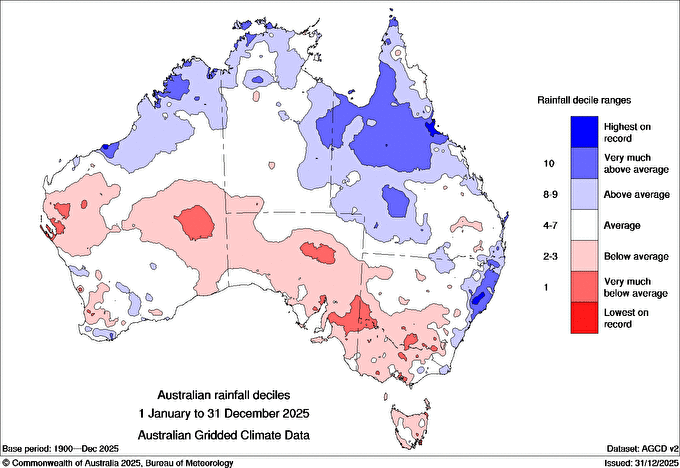
- Rainfall was below average for most of Tasmania, Victoria and South Australia, much of inland New South Wales and large parts of southern Western Australia.
- Rainfall was above average for much of Queensland, northern and eastern parts of the Northern Territory, coastal areas of New South Wales and a large area in the north of Western Australia and smaller areas scattered across its south.
Water resources
- Streamflow was above average across 33% of sites, mostly across north-eastern New South Wales and parts of northern Queensland, and below average for 29% of sites, across most of south-eastern Australia, including Tasmania.
- Surface water storage levels continued to decline across the country, reaching 68% of accessible capacity, a decrease of about 5% over the past year; this included a decline of 14% across the southern Murray–Darling Basin.
- Compared to the previous year, 12% more groundwater bores are above average and 8% fewer bores are below average, with most of the below average bores located in the south-eastern regions.
Oceans and atmosphere
- Sea surface temperatures for the Australian region were the warmest on record for the second consecutive year, at 0.93 °C above the 1961–1990 average.
- Global sea surface temperatures were 0.71 °C above the 1961–1990 average, the third-warmest on record.
-
Climate indicators of other major global oceanic and atmospheric systems during 2025 include:
- A strong negative phase of the Indian Ocean Dipole (IOD) was active from late July to early December. For the week ending 2 November, the IOD index dropped to -1.94 °C, the most negative value in the Bureau weekly data, which begins in 2008.
- A weak La Niña developed during summer 2024–25, returning to neutral El Niño-Southern Oscillation (ENSO) conditions in March. A weak La Niña redeveloped in late October, with atmospheric and oceanic conditions fully coupling by October and continuing into 2026.
- For the latter part of the 2024–25 tropical cyclone season (January to April), 11 tropical cyclones formed, with 8 reaching severe intensity (Category 3). In the early 2025–26 season (October to December) 4 tropical cyclones developed, with 3 reaching severe intensity.
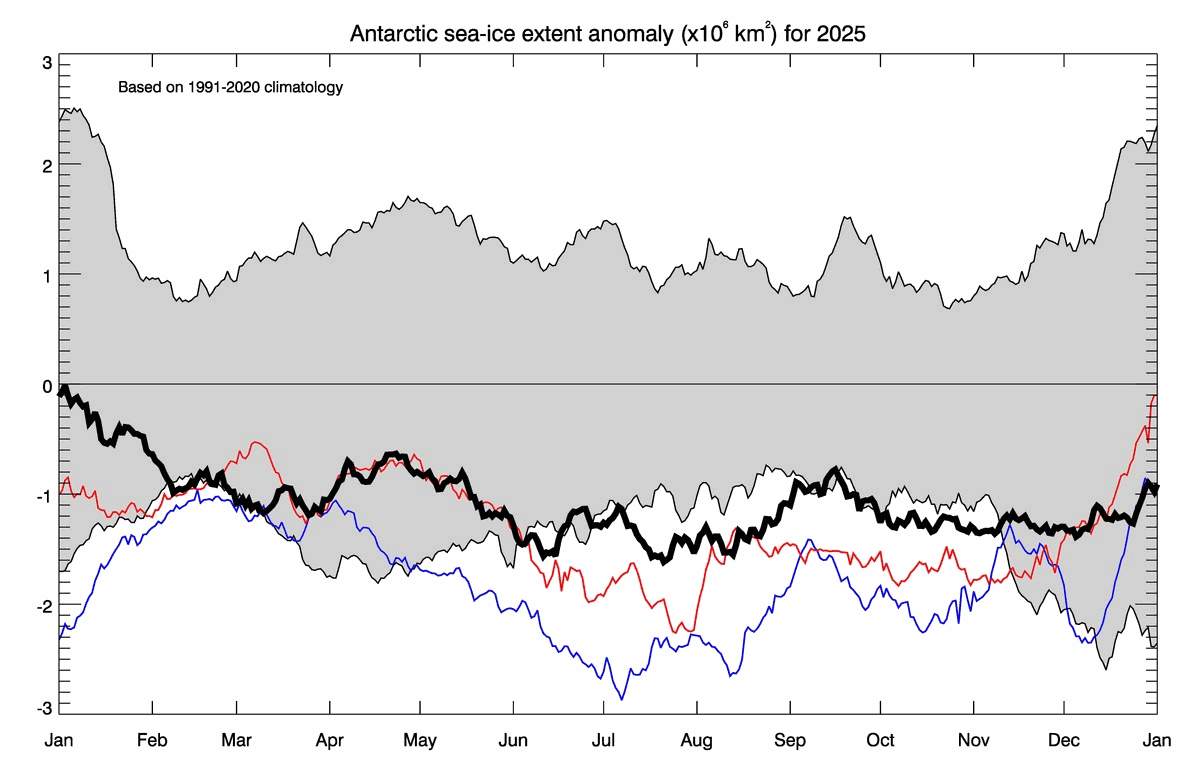
- Antarctic sea ice extent remained below the 1991–2020 average. Summertime daily values were fourth-lowest on record, at 1.96 million km2 on 1 March, and the wintertime daily maximum value was the third-lowest on record, at 17.85 million km2 on 15 September.
- The Antarctic ozone hole had a maximum area of 22.9 million km2 on 9 September before beginning to dissipate later that month following a stratospheric warming event.
- Concentrations of all the major long-lived greenhouse gases in the atmosphere continued to increase. By December, the baseline concentration of carbon dioxide (CO2) at Kennaook / Cape Grim reached 423.4 parts per million in dry air (ppm), an increase from 421.4 ppm in December 2024.
Australia's fourth-warmest year on record
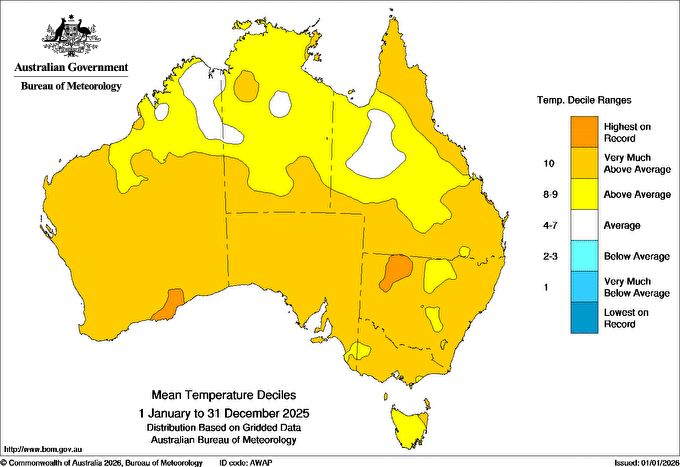
2025 was Australia's fourth-warmest year since national temperature records began in 1910. For Australia as a whole, the national annual average temperature was 1.23 °C above the 1961–1990 average. Globally, it was the third-warmest year on record at 1.44 ± 0.13 °C above the 1850–1900 baseline average. Sea surface temperatures for the Australian region were the warmest on record for the second consecutive year, while global sea surface temperatures were the third-warmest on record. The relative warmth of surface temperature across the globe, and particularly across global oceans, was unlikely influenced by natural interannual variability, and more consistent with climate change.
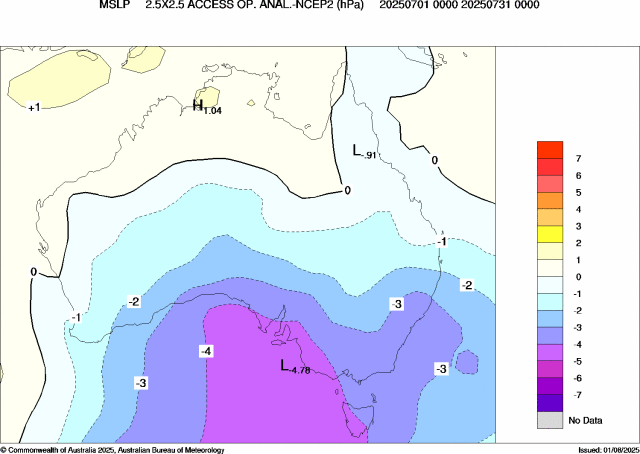
Australia's climate is influenced by global pattens in the oceans and atmosphere that can vary throughout the year. For much of 2025, mean sea level pressure (MSLP) remained predominately above average, indicating persistent high-pressure systems over Australia. This was consistent with long-term trends in MSLP associated with background global warming.
The Southern Annular Mode was positive from March to August, and negative from January to February and for most of September to December. A strong negative Indian Ocean Dipole (IOD) event lasted from late July to early December. In the Pacific, weak La Niña conditions emerged during summer 2024–25 and again in October, continuing until 2026.
Rainfall varied significantly across the country, influencing water availability. Much of the south and parts of the west had below average rainfall contributing to dry soils, reduced streamflow and declining surface water storages and groundwater levels. In contrast, large areas of the north and some parts of the east and south-west had above average rainfall resulting in wetter soils, higher streamflow and water storages and increased groundwater levels.
The national annual average mean temperature for 2025 was 1.23 °C above the 1961–1990 average, the fourth-warmest since records began in 1910–11. The nationally-averaged mean temperature for all months was warmer than average, with the mean national temperature for January–March and October in the top 5 warmest on record for their respective months.
Australia's fourth-warmest year on record
Australia
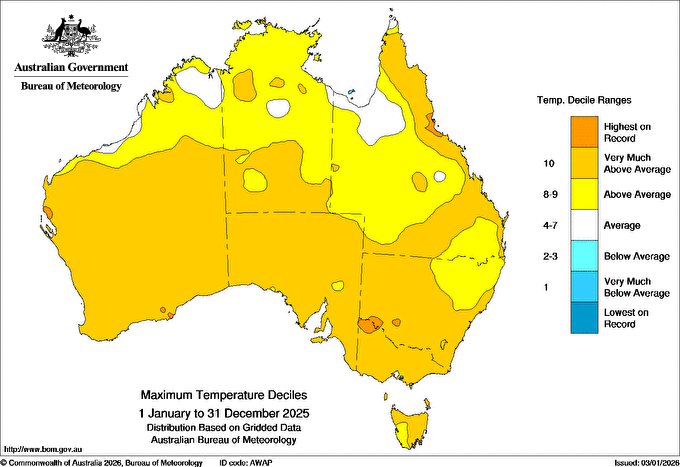
2025 was Australia's fourth-warmest year since national temperature records began in 1910. For Australia as a whole, the national annual average temperature was 1.23 °C above the 1961–1990 average. The annual average temperature for all states and territories, except Tasmania and the Northern Territory, were within their respective top 10 warmest on record.
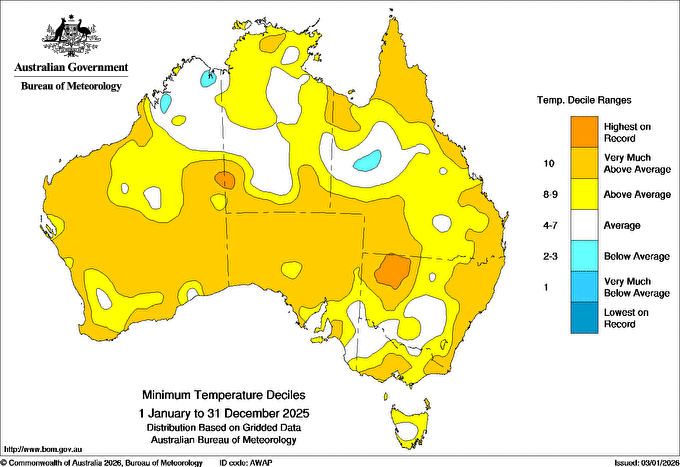
The national average maximum temperature in 2025 was 1.48 °C warmer than average, the equal fourth-warmest on record. The national average minimum temperature was 0.98 °C warmer than average, the eighth-warmest on record.
The annual average maximum and minimum temperatures were above to very much above average (in the warmest 10% of all years since 1910) across most of the country. Minimum temperatures were below average for isolated pockets in western Queensland and northern Western Australia.
Summer
Summer 2024–25 was the second-warmest on record, at 1.90 °C above average, with the national average temperatures for December, January and February within the top 5 warmest on record for their respective months. Prolonged low-intensity to severe heatwave conditions with areas of extreme severity affected large parts of Australia throughout summer. These conditions led to record high daily maximum and minimum temperatures in January and February across large parts of the country.
Autumn
Following a hot summer, autumn was the fourth-warmest on record, at 1.41 °C above average. The mean maximum temperatures for Victoria and Tasmania were the warmest on record.
Nationally, it was the warmest March on record as heatwave conditions impacted large parts of the country during the first half of the month. This heat persisted throughout autumn particularly in southern regions, driven by high pressure systems located south of the mainland that contributed to very much above average daytime temperatures across south-eastern Australia in April and May.
Winter
The winter national average temperature was 0.47 °C above average.
The national minimum temperature was 0.23 °C below average in June and the coldest since 2017. Overall, the Northern Territory, Queensland, New South Wales, Victoria and Tasmania observed below average June minimum temperatures.
Winter was characterised with cold fronts passing through southern Australia. High pressure systems followed these fronts and clear skies, and light winds allowed southerly air masses to move further inland towards northern Australia and causing minimum temperatures to fall below average across large parts of northern and eastern Australia.
Spring and early summer
Spring was the ninth-warmest on record, with the national average temperature 1.42 °C above average.
In October, low-intensity to severe heatwave conditions impacted northern, central and eastern parts of Australia and many locations had their warmest October maximum or minimum temperatures on record, including state maximum temperature records in Queensland and New South Wales. For Queensland and the Northern Territory, it was the warmest October on record.
Heatwave conditions persisted across large parts of the country during November and December; however, south-eastern Australia experienced frequent cold outbreaks leading to many sites observing their lowest daily maximum temperatures for November or December.
For more information on individual heat events, see the Events section.
Area-average temperatures
| Maximum Temperature | Minimum Temperature | Mean Temperature | |||||||
|---|---|---|---|---|---|---|---|---|---|
| Rank (of 116) |
Anomaly (°C) |
Comment | Rank (of 116) |
Anomaly (°C) |
Comment | Rank (of 116) |
Anomaly (°C) |
Comment | |
| Australia | = 112 | +1.48 | equal 4th highest | 109 | +0.97 | 8th highest | 113 | +1.23 | 4th highest |
| Queensland | 104 | +1.19 | = 107 | +1.24 | equal 9th highest | 107 | +1.21 | 10th highest | |
| New South Wales | 110 | +1.80 | 7th highest | 110 | +1.18 | 7th highest | 112 | +1.49 | 5th highest |
| Victoria | 108 | +1.23 | 9th highest | = 98 | +0.64 | 109 | +0.94 | 8th highest | |
| Tasmania | = 97 | +0.54 | = 77 | +0.02 | 86 | +0.28 | |||
| South Australia | 113 | +1.86 | 4th highest | 114 | +1.13 | 3rd highest | 114 | +1.50 | 3rd highest |
| Western Australia | = 114 | +1.68 | equal 2nd highest | 112 | +0.85 | 5th highest | 114 | +1.27 | 3rd highest |
| Northern Territory | 108 | +1.08 | 9th highest | = 98 | +0.71 | = 103 | +0.90 | ||
*Rank ranges from 1 (lowest value on record) to 115 (highest value on record). The national temperature dataset commences in 1910. A rank marked with '=' indicates that a value is shared by two or more years, resulting in a tie for that rank.
^Anomaly is the departure from the long-term (1961–1990) average.
In climatology a baseline, or long-term average, is required against which to compare changes over time.
The Bureau uses the 1961–1990 period as the climate reference period for the Annual Climate Statement and other climate monitoring products. It has no bearing on the calculation of trends over time, or the ranking of one year compared to all other years in a dataset.
Global temperatures
On 14 January 2026, the World Meteorological Organization announced that 2025 was the third-warmest year on record, based on data from 6 leading international datasets. The average global temperature was 1.44 ± 0.13 °C above the pre-industrial (1850–1900) baseline average. The past 3 years, 2023–2025, were the 3 warmest on record, with 2024 and 2023 at 1.55 ± 0.13 °C and 1.45 ± 0.12 °C above average, respectively. January 2025 set a new global monthly temperature record, while February to April were the second-warmest on record for their respective months. Despite much of the year seeing a developing or weak La Niña in the tropical Pacific.
Global warming
Australia's climate has warmed on average by 1.59 ± 0.23 °C between 1910 and 2025, with most of the warming having occurred since 1950. Every decade since 1950 has been warmer than preceding decades, and 14 of Australia's 15 warmest years on record have occurred in the 21st century. The observed warming in Australia is consistent with the overall average warming across the Earth's land areas.
National average rainfall in 2025 was 8% above the 1961–1990 average at 503 mm. Rainfall was above average for much of the north and below average for large parts of the south. Northern Australia rainfall during the 2024–25 wet season (October to April) was 18% above average, while southern Australia cool season (April to October 2025) rainfall was 12% below average.
Above average rainfall for the north and below average for the south
Australia's national average rainfall total for 2025 was 503 mm, 8% above the 1961–1990 average of 466 mm.
Total rainfall for the year was below to very much below average (in the lowest 10% of all years since 1900) for:
- most of Tasmania, Victoria and South Australia
- much of inland New South Wales
- large parts of southern Western Australia.
For South Australia, the area-averaged rainfall total in 2025 was 28% below average, the lowest since 2019.
Total rainfall for the year was above to very much above average (in the highest 10% of all years since 1900) for:
- much of Queensland
- coastal areas of New South Wales
- areas in the north and east of the Northern Territory
- a large area in the north of Western Australia and smaller areas scattered across its south.
Rainfall was the highest on record for parts of the North West, North Tropical Coast and Tablelands, and Herbert and Lower Burdekin districts in Queensland, and for parts of the Hunter and the Mid North Coast districts in New South Wales.
For Queensland, the area-averaged rainfall total in 2025 was 31% above average, the highest since 2011.
Monthly rainfall
January was drier than average for large parts of Australia, as the monsoon onset was delayed over the north. March saw widespread heavy rainfall across Queensland and neighbouring areas. It was Queensland's second-wettest March on record since 1900, and eighth-wettest on record nationally.
National rainfall was generally above average in April, July and August, and below average in May, June and September. While in November and December, national rainfall was above average as multiple weather systems brought widespread rainfall to large parts of Australia.
Northern Australia
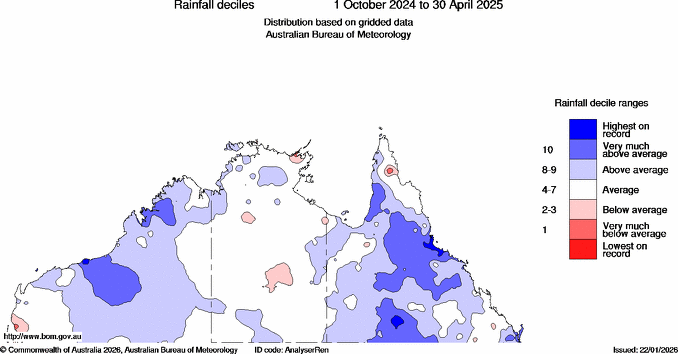
For northern Australia as a whole (north of 26°S, the South Australia and Northern Territory border), rainfall in the 2024–25 wet season (October to April) was 18% above the 1961–1990 average. Rainfall was above to very much above average (in the highest 10% of all wet seasons since 1900–01) for large areas of Queensland and parts of the Kimberley and Pilbara districts in Western Australia. This included small pockets of highest on record wet season rainfall, most notably along the Queensland coast between Townsville and Ingham. Rainfall was average to below average for most of the Northern Territory.
In January, large parts of the tropical north had below average rainfall as the onset of the Australian monsoon was delayed. Overall, it was northern Australia's driest January since 1994. In February, March and April, northern Australian rainfall was above average, related to low pressure troughs, tropical lows and Tropical Cyclones Zelia, Alfred, Dianne and Errol.
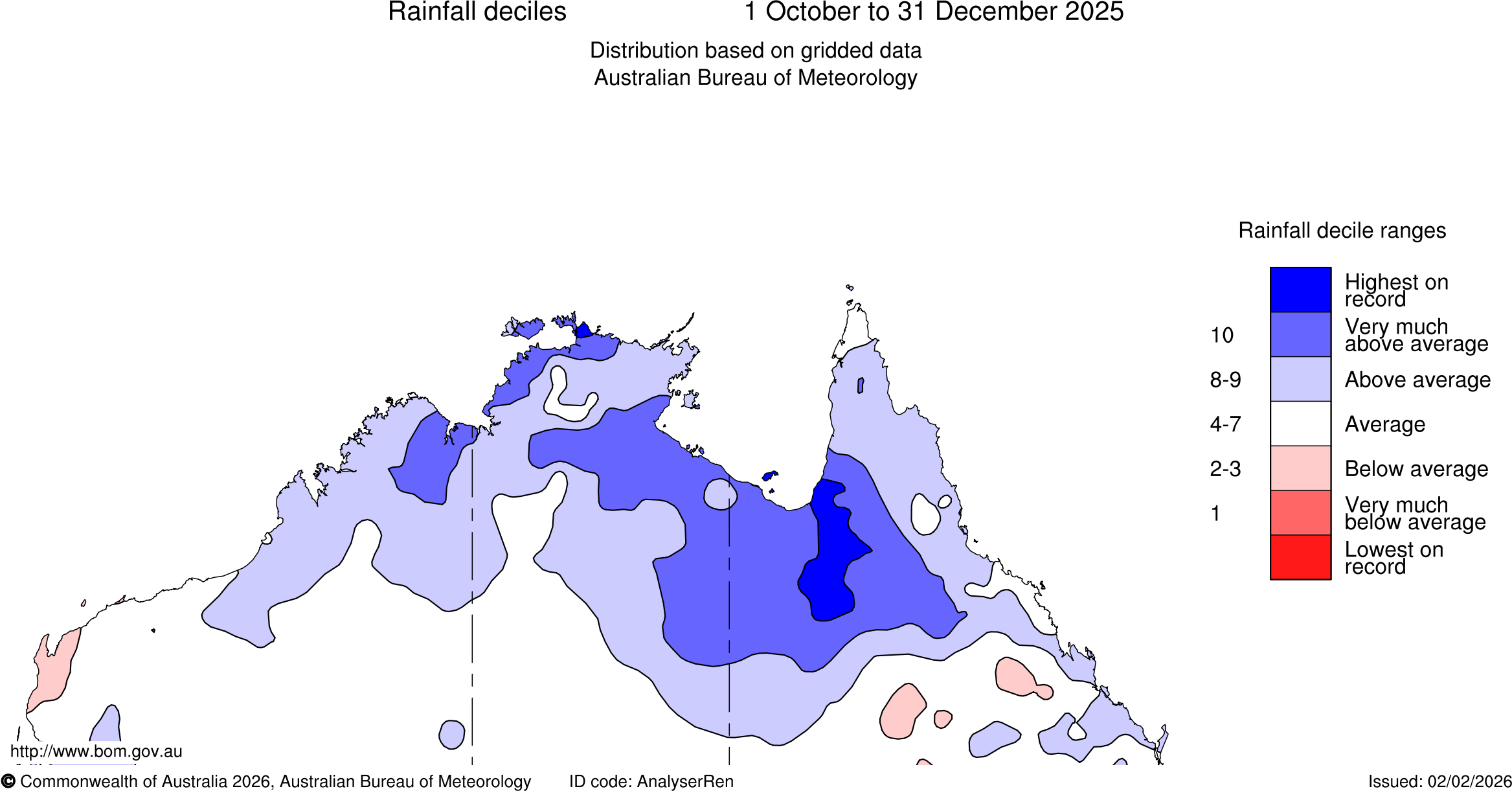
For October to December, the start of the 2025–26 northern wet season, rainfall was above to very much above average for much of Queensland, the Northern Territory and northern parts of Western Australia. The above average rainfall was mostly related to Tropical Cyclones Fina and Hayley, and the establishment of the monsoon trough from mid-December. Parts of north-western Queensland had their highest on record October to December rainfall.
State of the Climate 2024 reported that northern Australia has been wetter than average over the last 30 years across all seasons, especially in the north-west during the wet season. Since 1994, wet season rainfall in northern Australia has been 20% above the 1900–1993 average.
In addition, State of the Climate 2024 reported that the observed intensity of heavy rainfall events in Australia is increasing. Warmer air can hold more water vapour than cooler air, and moisture in the atmosphere can increase by 7% per degree of warming, all other things being equal. This can cause an increased likelihood of heavy rainfall events, particularly in northern Australia.
Further information: 2024–25 northern wet season summary | Latest Northern rainfall onset
Southern Australia
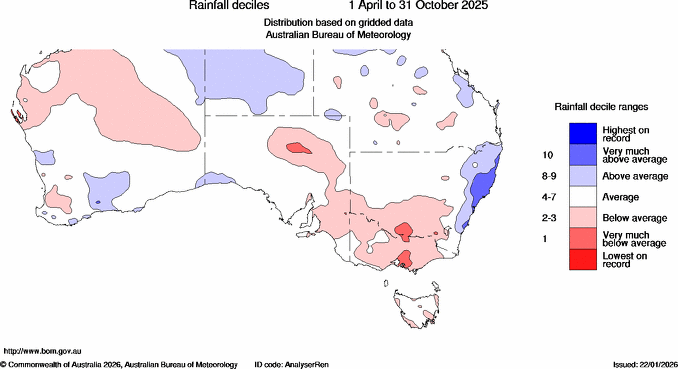
The cool season period (April to October) is an important monitoring period for rainfall in southern Australia (south of 26° S, the South Australia and Northern Territory border). As detailed in State of the Climate 2024 there has been a decline in southern Australian April to October rainfall over the south-west and south-east of Australia in recent decades, with more frequent periods of below-average rainfall in these areas in these months. Cool season rainfall across southern Australia since 1994 has been 9% below the 1900–1993 average.
In 2025, cool season rainfall for southern Australia as a whole was 12% below the 1961–1990 average. This was the third consecutive year where the overall April to October rainfall was below the 1961–1990 average for southern Australia. Rainfall was below to very much below average (in the lowest 10% of all years since 1900) for most of Victoria, large parts of southern New South Wales, south-eastern and north-eastern South Australia, western and central Western Australia, and areas in Tasmania and southern Queensland. Rainfall was above to very much above average (in the highest 10% of all years since 1900) for coastal and north-eastern New South Wales and some southern areas of Western Australia and South Australia.
For large areas of southern Australia rainfall was below average in each month between April and October, except July. This was due to high pressure systems that brought settled conditions and fewer cold fronts. Coastal areas of New South Wales had above average rainfall in May, July and August due to low pressure systems off the east coast that brought heavy to intense rainfall.
Further rainfall information
For more information on significant rain events, see the Events section. For more information on rainfall deficiencies, see the monthly Drought Statements.
Area-average rainfall
| Rank (of 126) |
Average (mm) |
Departure from mean |
Comment | |
|---|---|---|---|---|
| Australia | 95 | 502.9 | +8% | |
| Queensland | 116 | 817.6 | +31% | |
| New South Wales | = 67 | 532.6 | −4% | |
| Victoria | 27 | 544.6 | −18% | |
| Tasmania | 26 | 1208.4 | −11% | |
| South Australia | = 26 | 161.0 | −28% | |
| Western Australia | 70 | 348.4 | +2% | |
| Northern Territory | 88 | 579.4 | +6% | |
| Murray-Darling Basin | 46 | 426.9 | −13% |
*Rank ranges from 1 (lowest value on record) to 124 (highest value on record). The national rainfall dataset commences in 1900.
A rank marked with '=' indicates that a value is shared by two or more years, resulting in a tie for that rank.
^Departure from mean is relative to the long-term (1961–1990) average.
In climatology a baseline, or long-term average, is required against which to compare changes over time. The Bureau uses the 1961–1990 period as the climate reference period for the Annual Climate Statement and other climate monitoring products. It has no bearing on the calculation of trends over time, or the ranking of one year compared to all other years in a dataset.
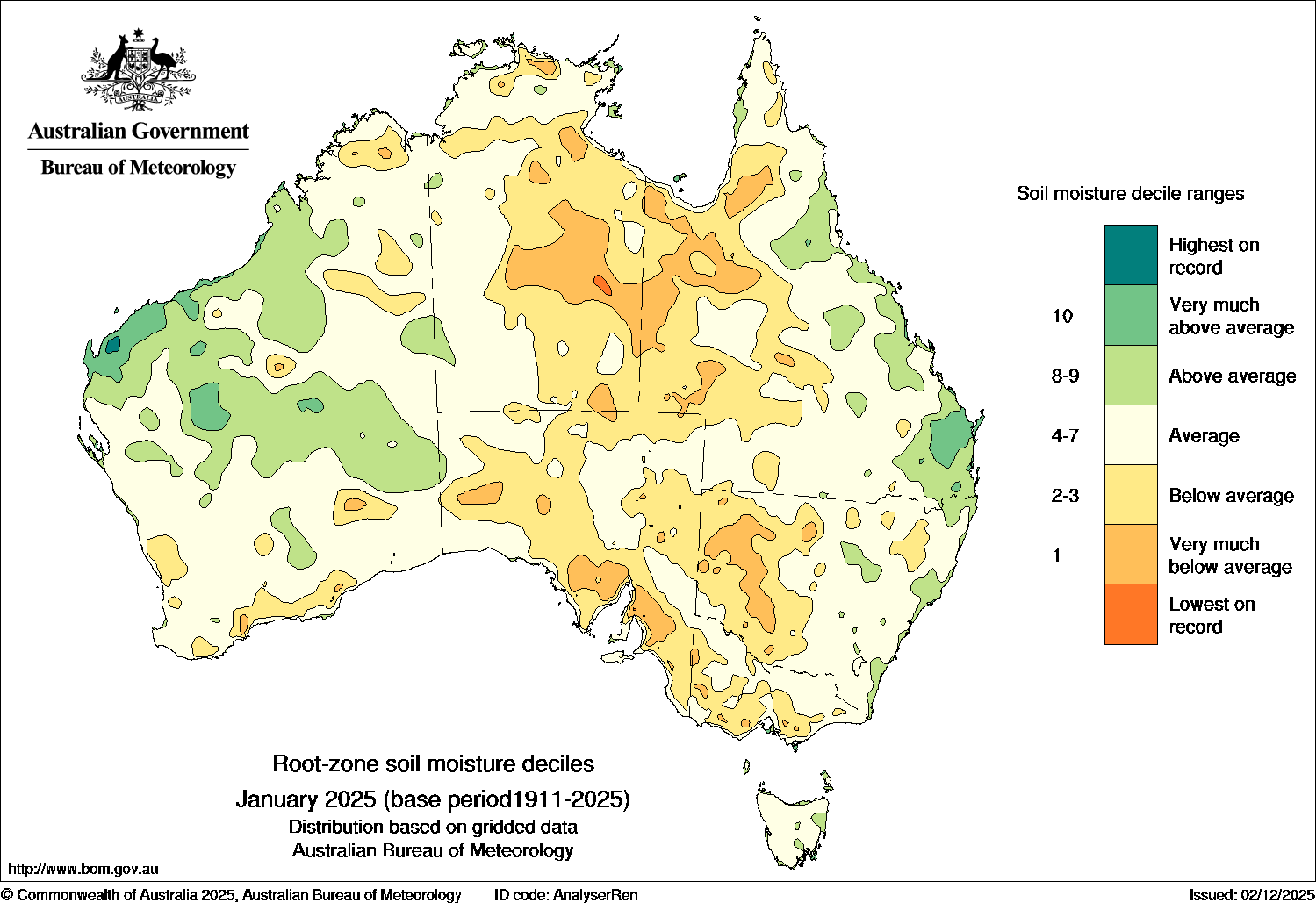
There was a contrast in soil moisture conditions between northern and southern regions of Australia. Soil moisture was above average across coastal New South Wales, central Queensland, the Northern Territory Top End and the Kimberley coast in Western Australia. However, soil moisture was below average in large parts of the southern mainland and most of Tasmania.
Above average soil moisture in the north and below average in the south
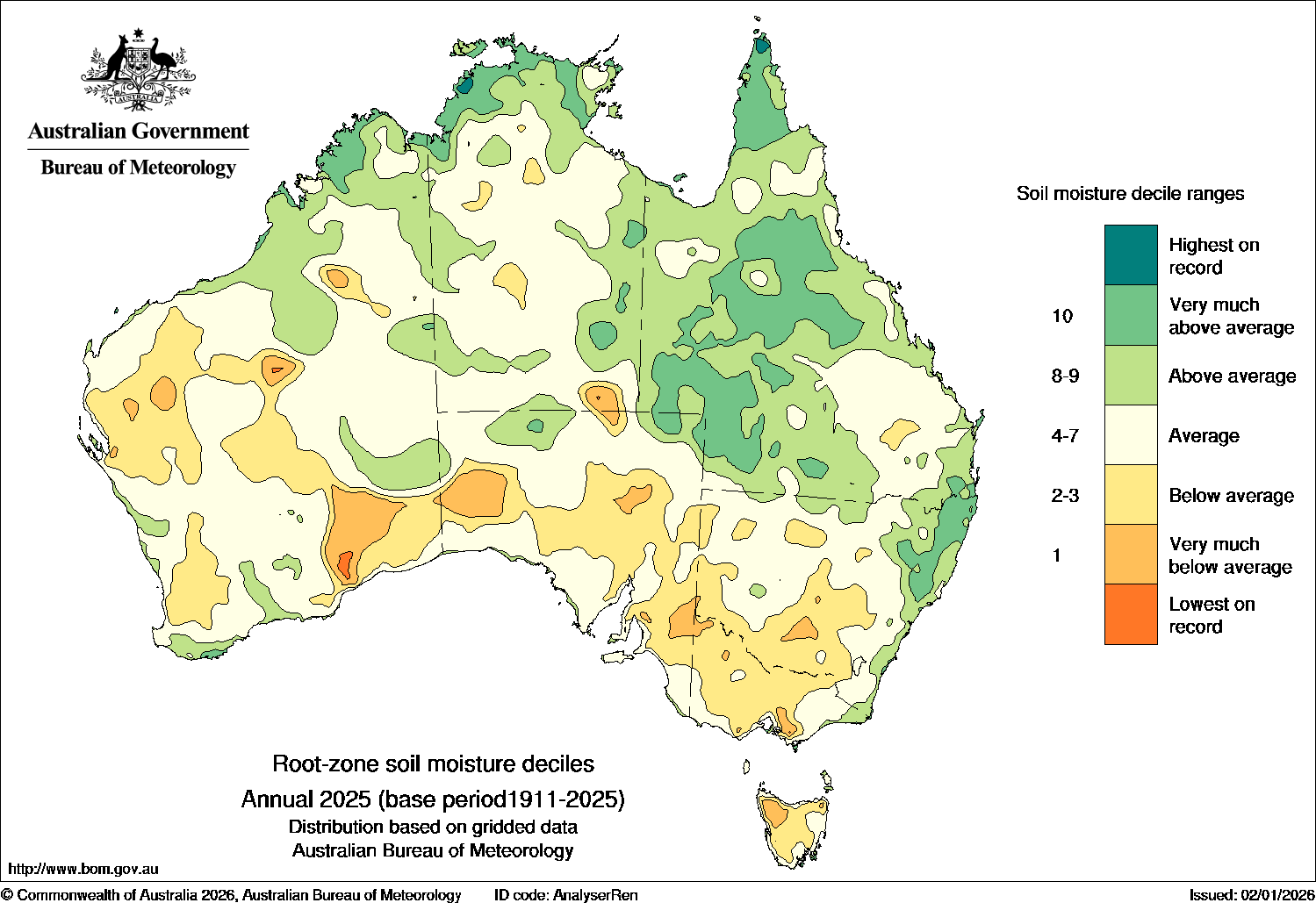
In 2025, root zone soil moisture (in the top 100 cm) was above to very much above average (in the highest 10% of all years since 1911) for:
- most of Queensland and adjacent parts of the Northern Territory
- coastal parts of the Northern Territory
- parts of the Kimberley, Pilbara and south coastal Western Australia
- coastal and north-eastern New South Wales.
Soil moisture was the highest on record for small areas south-west of Darwin and the northern tip of Cape York Peninsula.
Soil moisture was below to very much below average (in the lowest 10% of all years since 1911) for:
- most of Victoria, Tasmania and South Australia
- southern inland New South Wales
- much of the west and south of Western Australia.
Drier than average soil conditions were due to below to very much below average rainfall during the southern Australian cool season (April to October).
Northern Australia
In January, soil moisture was below to very much below average for most of northern Australia, except in parts of the west and small pockets of the coastal east.
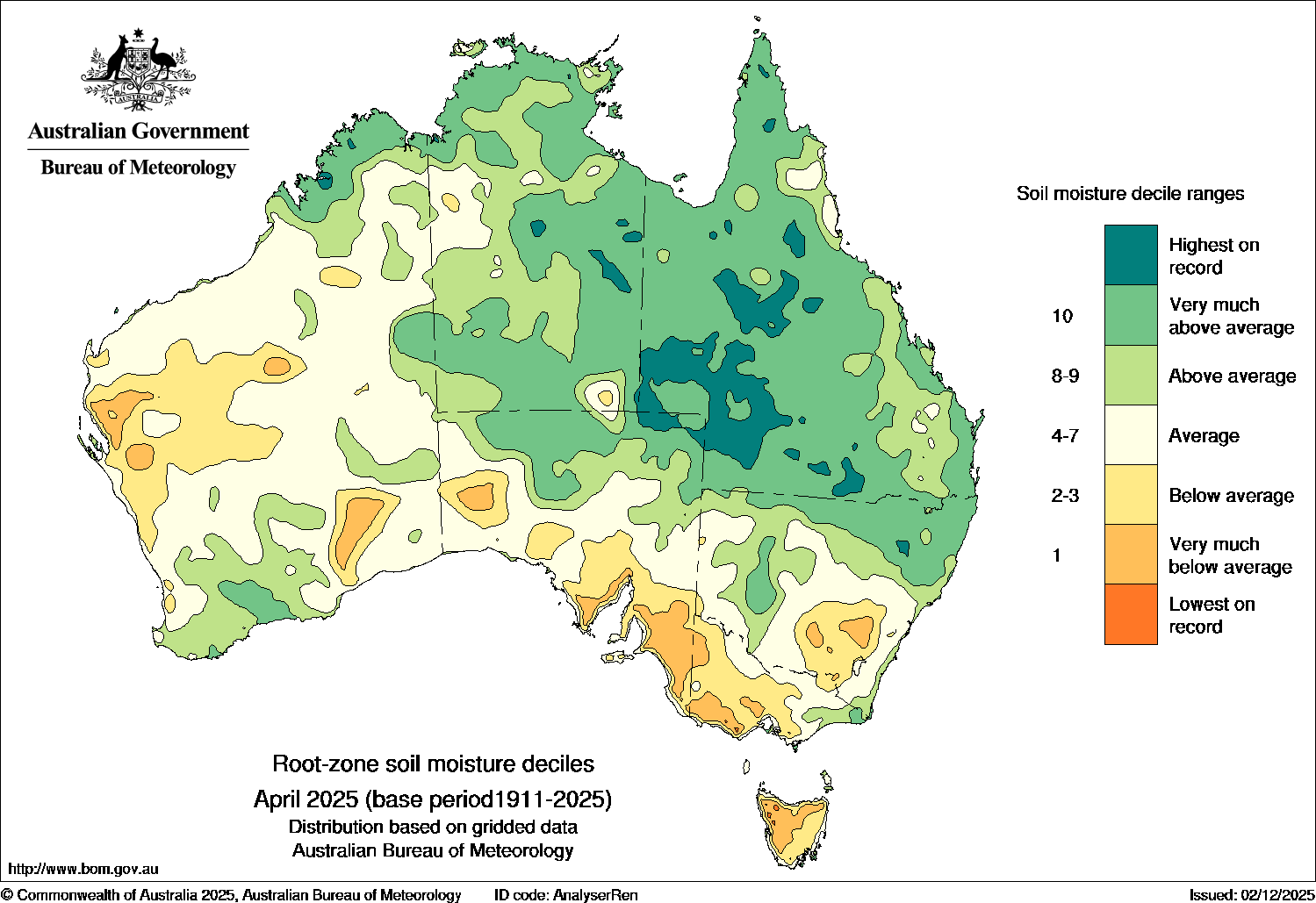
Extensive rainfall across northern Australia in February, March and April was associated with monsoonal activity and Tropical Cyclone Alfred, resulting in wetter than average conditions across much of the region by April. Wetter than average conditions across regions of northern Australia occurred again in each month from September to December. In November, Severe Tropical Cyclone Fina brought record rainfall to coastal areas to the south-west of Darwin.
Southern Australia
Long-term rainfall deficiencies had a significant impact on soil moisture, including deep soil moisture, once again setting up higher risk of dry fuel ahead of the bushfire season (December to February). The year began with average to below average soil moisture across most of southern Australia. Average to below average rainfall in January, February and March for most places except Victoria's East Gippsland and part of Western Australia's south-west, resulted in below to very much below average soil moisture in southern Australia by April.
In April, May and June, rainfall was below average for large areas of southern Australia. By June, soil moisture in southern Australia was mostly below to very much below average.
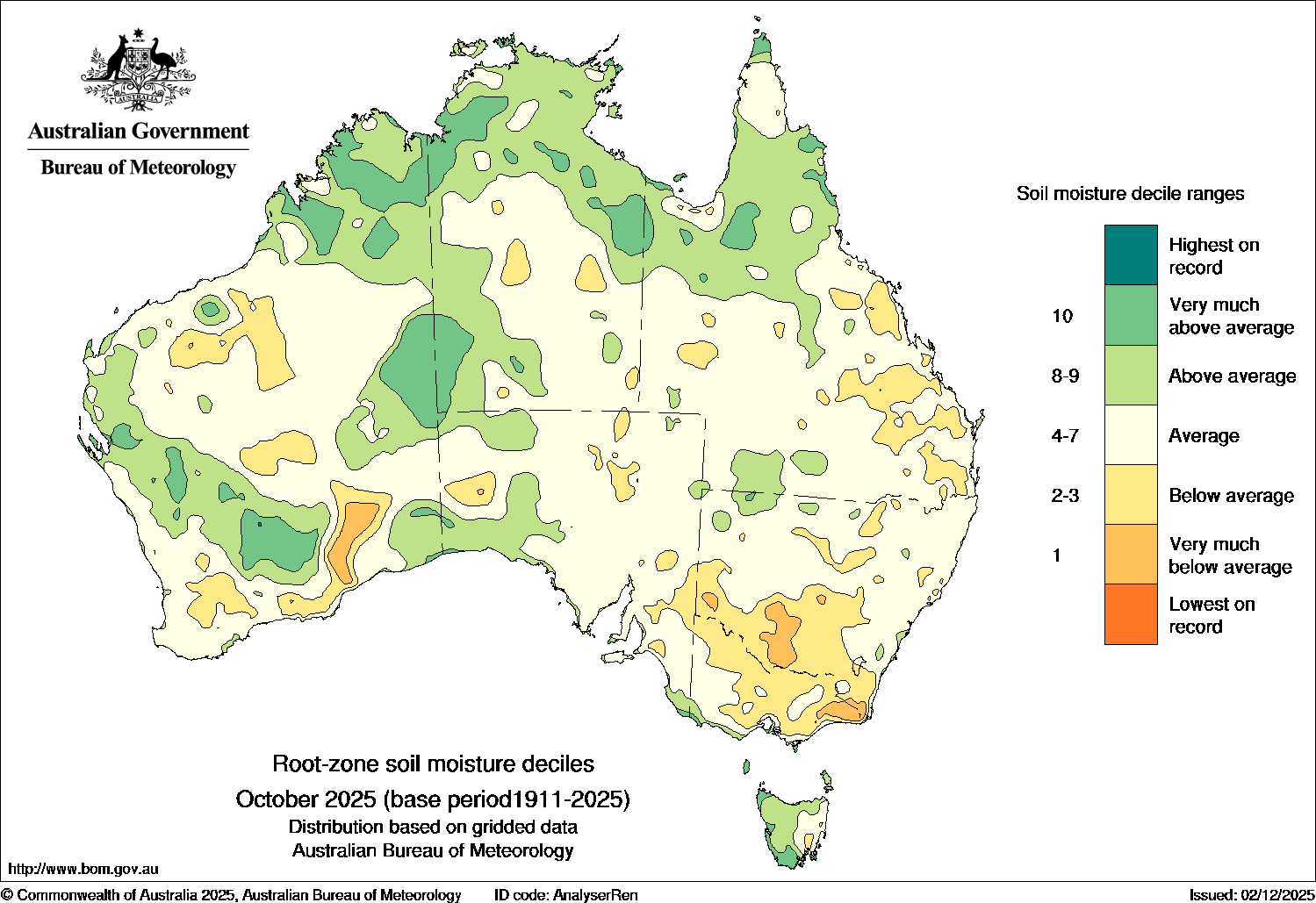
July rainfall was above average across the southern mainland, August was wetter than average in the far west, and both September and October recorded above-average rainfall in Tasmania. Elsewhere across southern Australia, rainfall continued to be average to below average. By October, soil moisture was above average in Tasmania and the south-east of South Australia, but below to very much below average across much of Victoria and southern New South Wales.
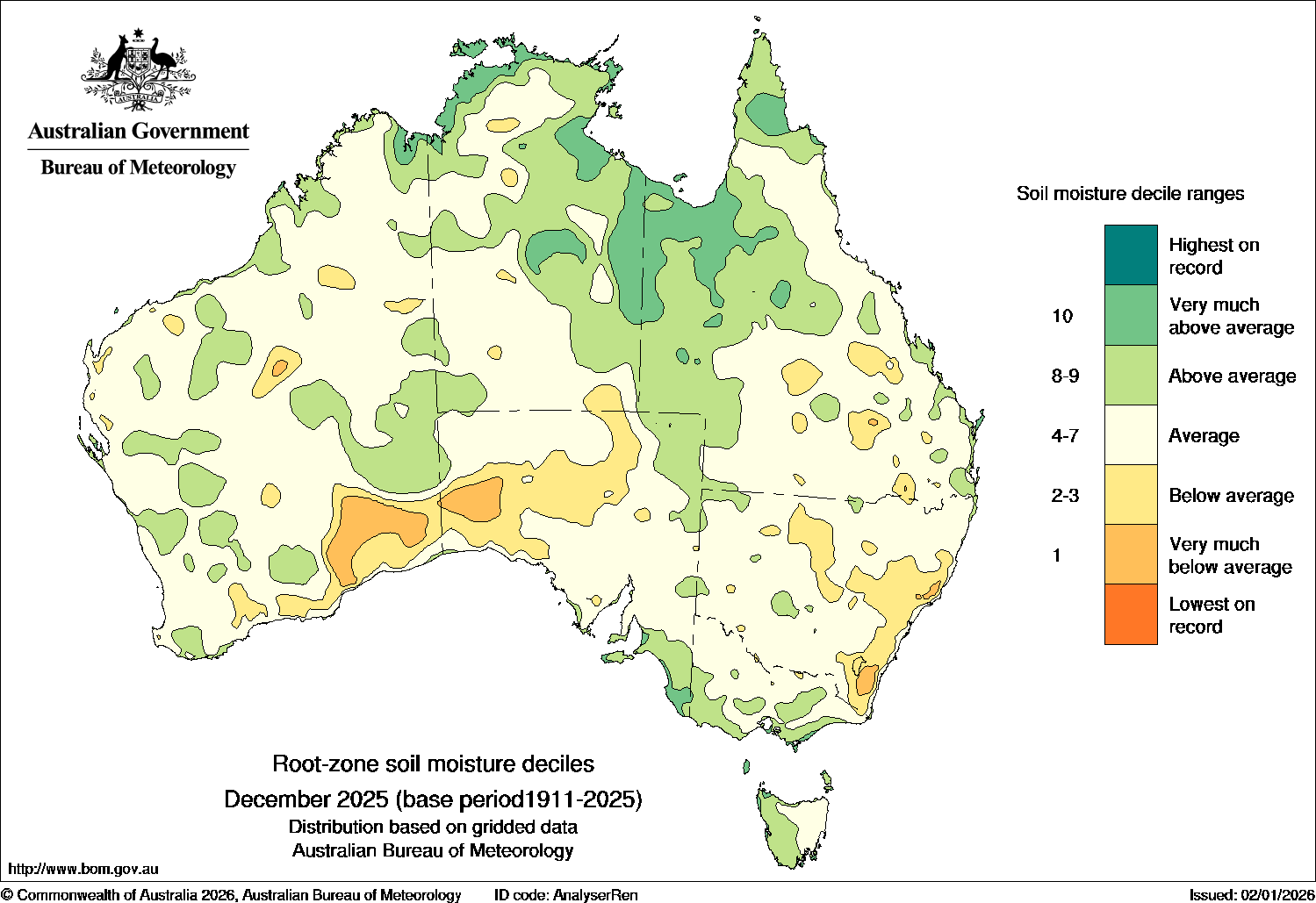
Soil moisture increased in November in western Tasmania, agricultural regions of South Australia, and southern Victoria. By the end of the year, soil moisture decreased to very much below average across south-west and inland South Australia and south-east Western Australia.
Streamflow conditions mostly followed rainfall and soil moisture conditions. Annual streamflow was below average across most of south-eastern Australia, including Tasmania, while most of north-eastern New South Wales and parts of northern Queensland had above average streamflow.
Above average streamflow in the east and parts of the north and below average in the south
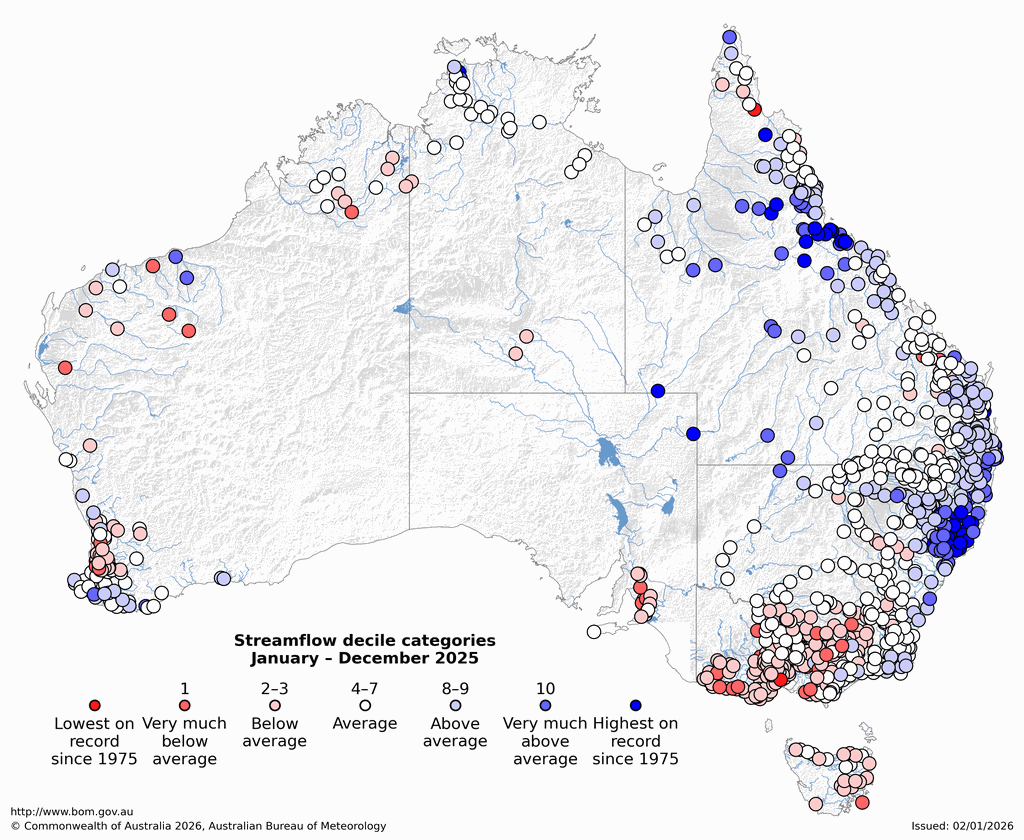
Annual streamflow was analysed for 941 sites with more than 80% of their daily records available for 2025.
Average annual streamflow (relative to all years since 1975) was observed at 38% of sites. Annual streamflow was lower than average at 29% of sites, including:
- most of Victoria, apart from East Gippsland
- most of Tasmania
- parts of the central interior of New South Wales
- south-east South Australia
- parts of the Kimberley, Pilbara and south-west of Western Australia.
Streamflow was the lowest on record at one site in south-west Victoria, and another in far north Queensland.
In contrast, due to above average rainfall and wet catchment conditions, higher than average streamflows were observed at another 33% of sites, including:
- much of Queensland
- much of northern and coastal New South Wales, particularly the north-east
- far eastern Victoria
- southern coastal Western Australia
- the Northern Territory Top End.
Streamflow was the highest on record (at 4% sites) in some areas of far north Queensland and north-eastern New South Wales.
| Streamflow decile category | Number of sites | Percentage of sites (%) |
|---|---|---|
| Highest on record | 42 | 4 |
| Very much above average | 82 | 9 |
| Above average | 185 | 20 |
| Average | 358 | 38 |
| Below average | 229 | 24 |
| Very much below average | 43 | 5 |
| Lowest on record | 2 | 0 |
Australia's total surface water storage at the end of the year was 68% of accessible capacity, compared with 73% at the end of 2024. Surface water storage levels decreased across most of the country due to dry conditions and low inflows. However, surface water storage levels increased in northern New South Wales and the Menindee Lakes following above average rainfall in their catchments.
Water storages continued to decline in the south
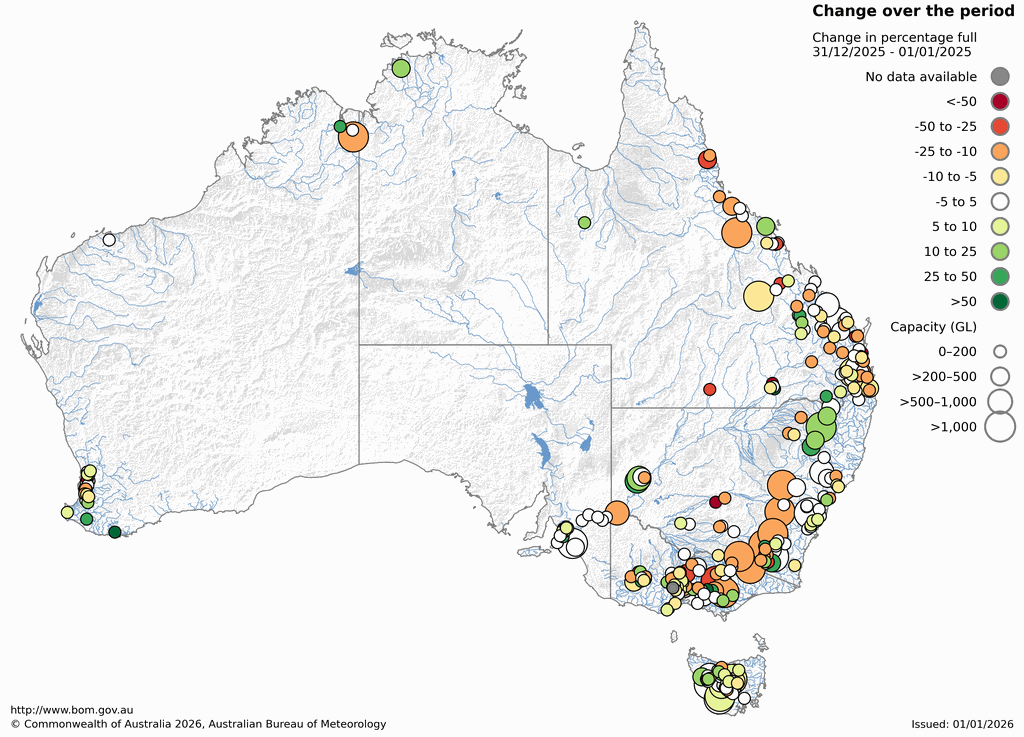
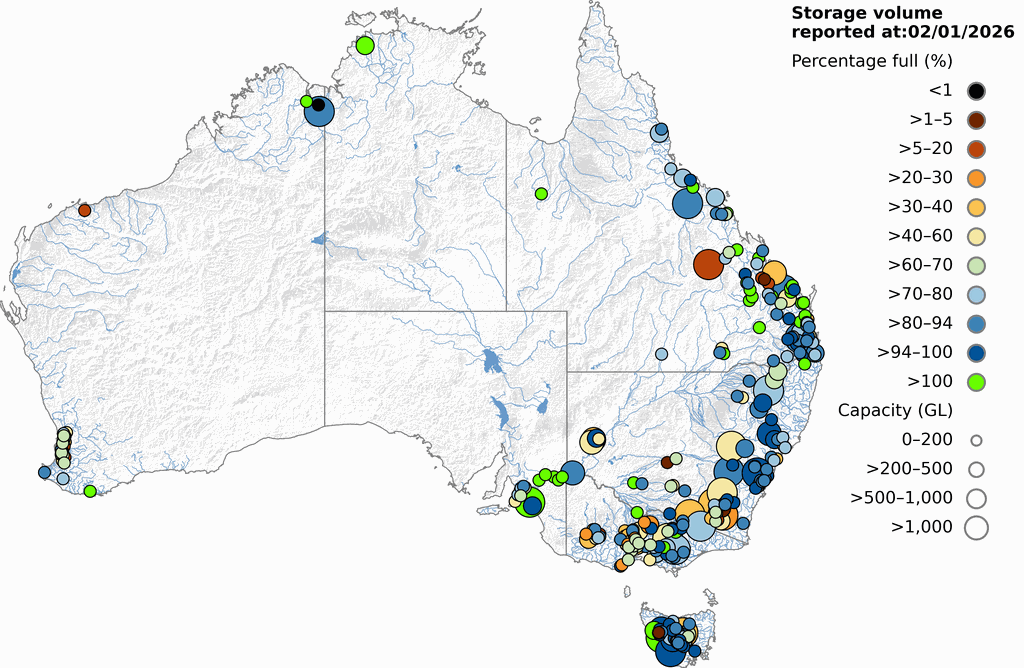
Annual rainfall was below average across much of southern Australia, where many water storages are located. As a result, catchments were dry and inflows to water storages were low, causing water storage levels in these regions to decline. Australia's total surface water storage volume was at 68% of accessible capacity at the end of the year, a decrease from 73% at the start of the year.
Urban
At the end of the year, surface water storages supplying capital cities were high (over 80% of their accessible capacity), except for Perth (44%), Adelaide (64%), Melbourne (75%) and Brisbane (79%). Melbourne's storage levels dropped from 86% at the start of the year. In contrast, Adelaide's storage levels rose from 45% at the start of the year. During the year, Adelaide, Melbourne, and Perth utilised desalination plants to supplement their water supply.
Warragamba, the largest urban water supply storage in Australia, provides approximately 80% of the Sydney region's water supply. It started the year at 98% of its accessible capacity. During the first half of the year, the Warragamba dam spilled multiple times due to high inflows generated from above average rainfall across its catchments. The water storage level remained high for the rest of the year, with 95% of its accessible capacity by the end of 2025.
Murray–Darling Basin
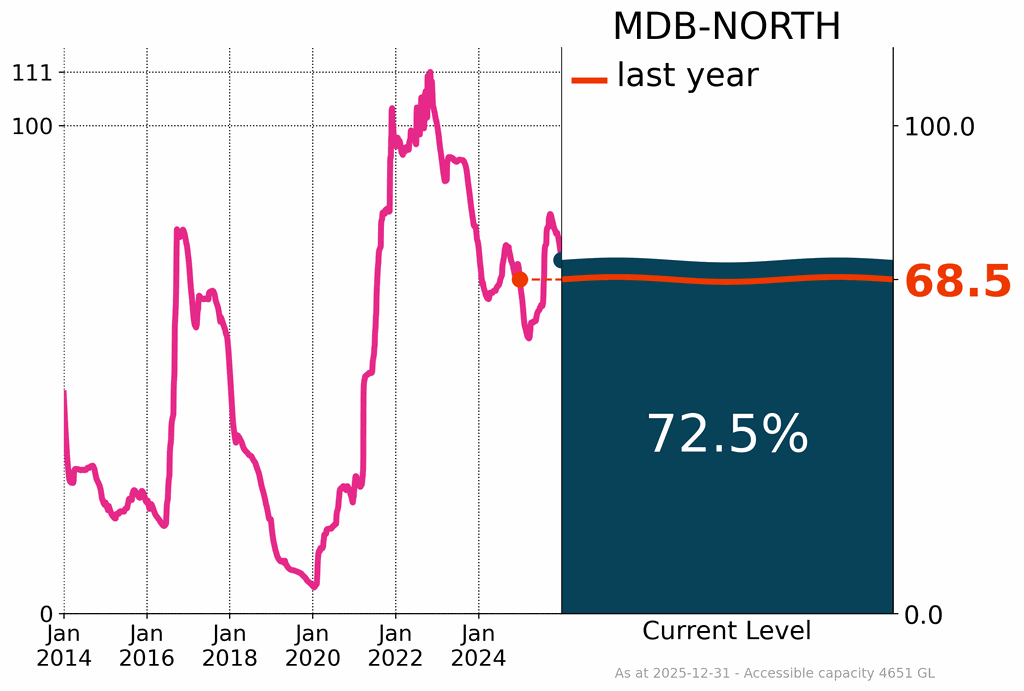
The major storages in the Murray–Darling Basin (MDB) have been in decline since the record rainfall in spring 2022. With dry catchment conditions in the south and increased demand during the irrigation season (October to March), total storage volume in the MDB decreased, reaching 62% of accessible capacity by the end of the year.
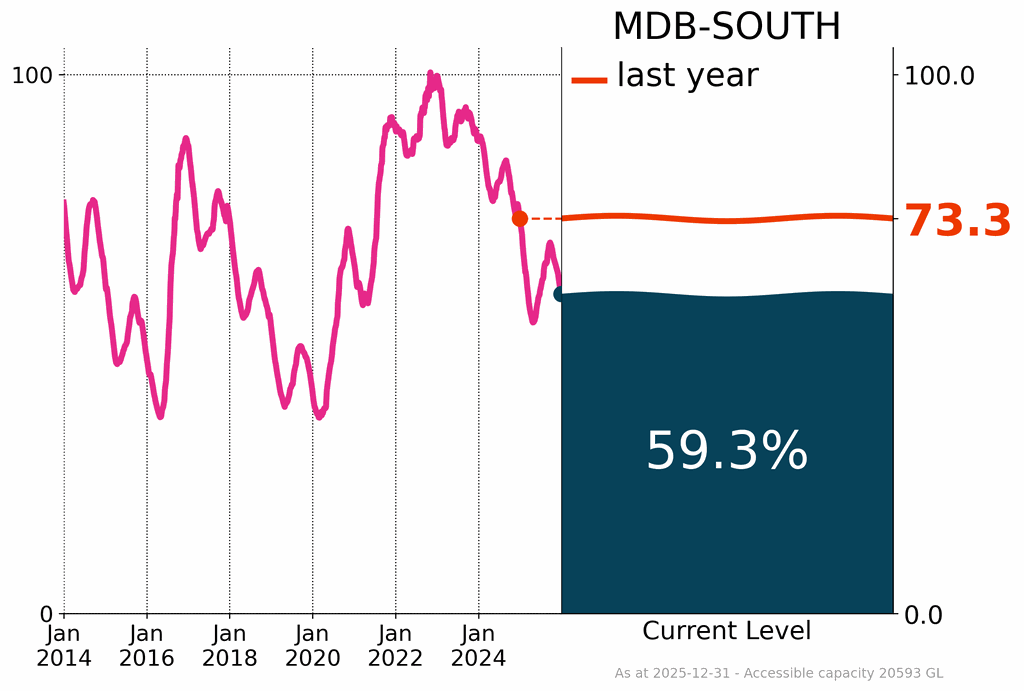
Over the year, storages in the southern MDB decreased from 73% to 59%, whereas those in the northern MDB increased from 69% to 73%.
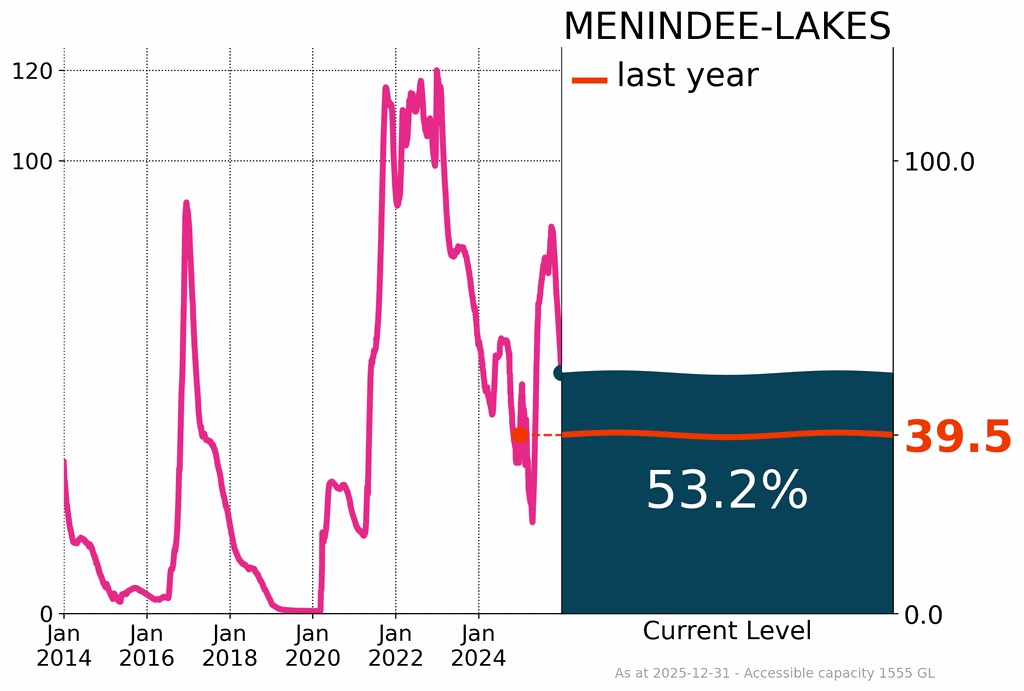
From 2023 until early 2025, storage levels in the Menindee Lakes system sharply declined. But following significant rainfall in the headwaters of the Darling River catchment in early 2025, storage in the Menindee Lakes system increased over the year, from 39% of its accessible capacity to 53%.
Northern Australia
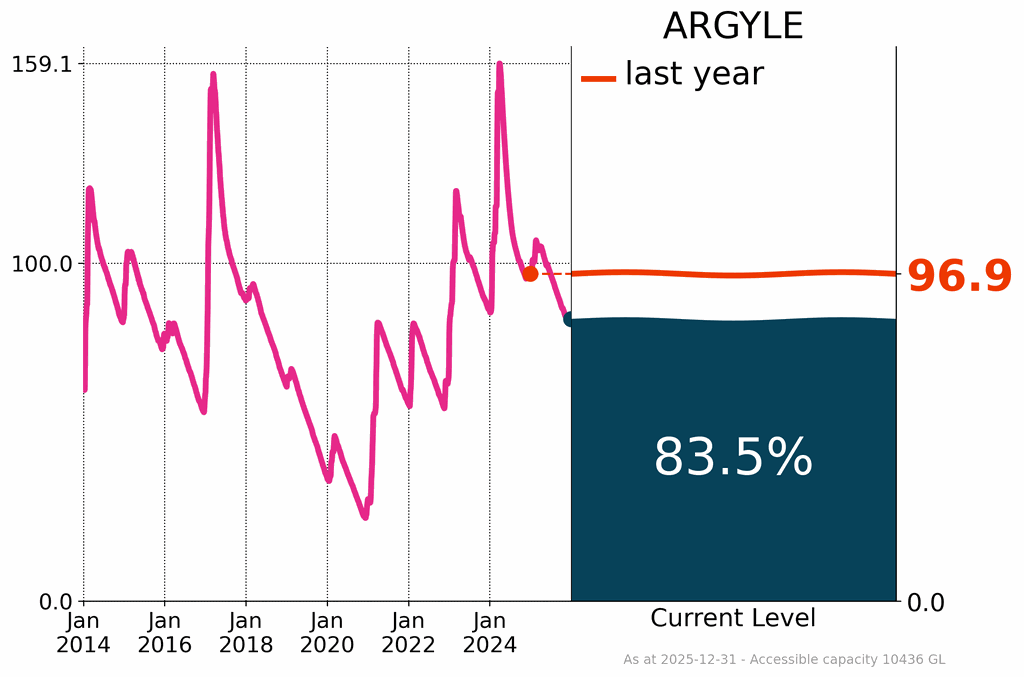
In northern Australia, average rainfall resulted in average inflows to Lake Argyle, the largest water storage in Australia. Lake Argyle's volume steadily increased during the wet season to a high of 107% in February and then declined to 83% by end of the year.
South East Queensland
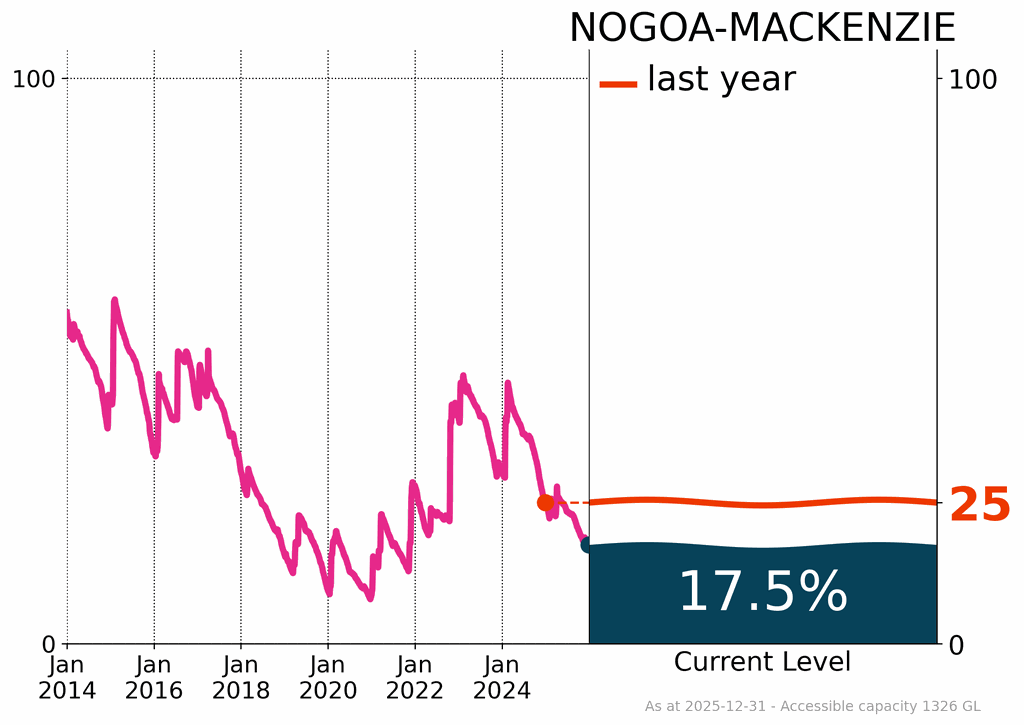
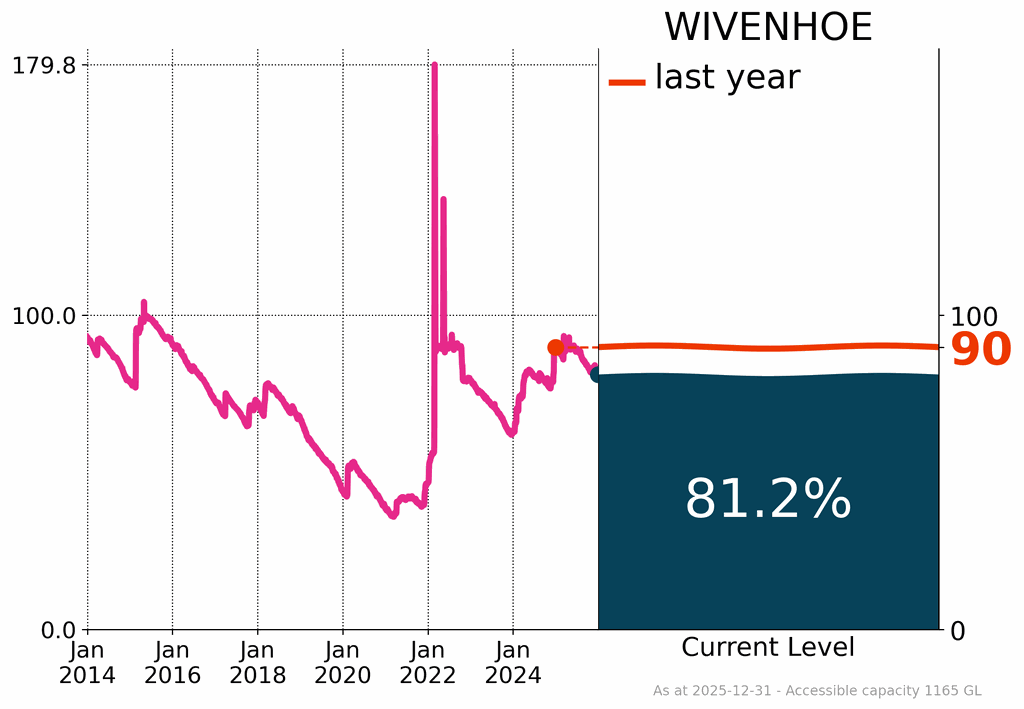
The Nogoa MacKenzie Water Supply Scheme services central Queensland communities. Below average rainfall saw storage levels drop, from 25% of its accessible capacity at the start of the year, to 17% at the end of December. Wivenhoe, the largest storage in south-eastern Queensland, started the year at 90% of its accessible capacity and dropped over the course of the year to 81%.
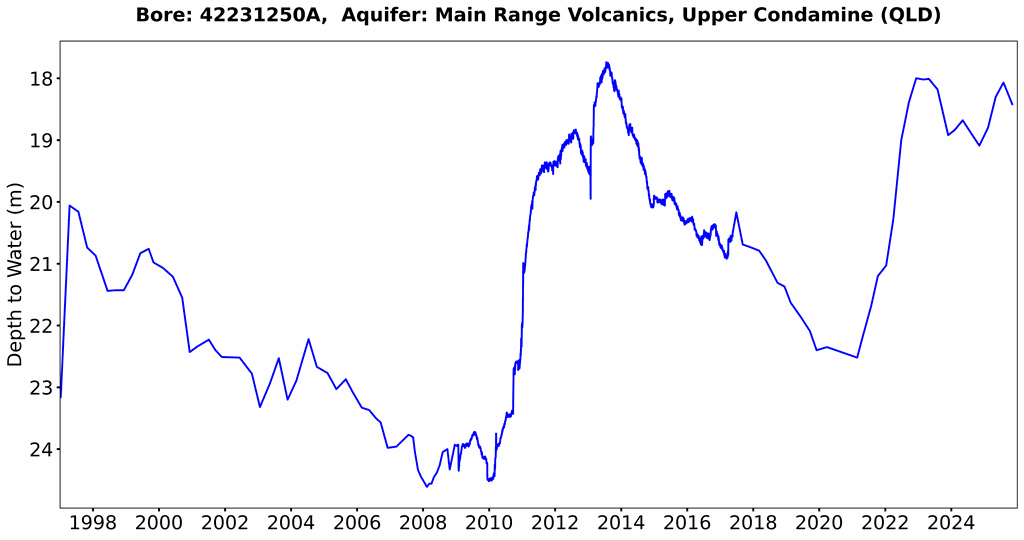
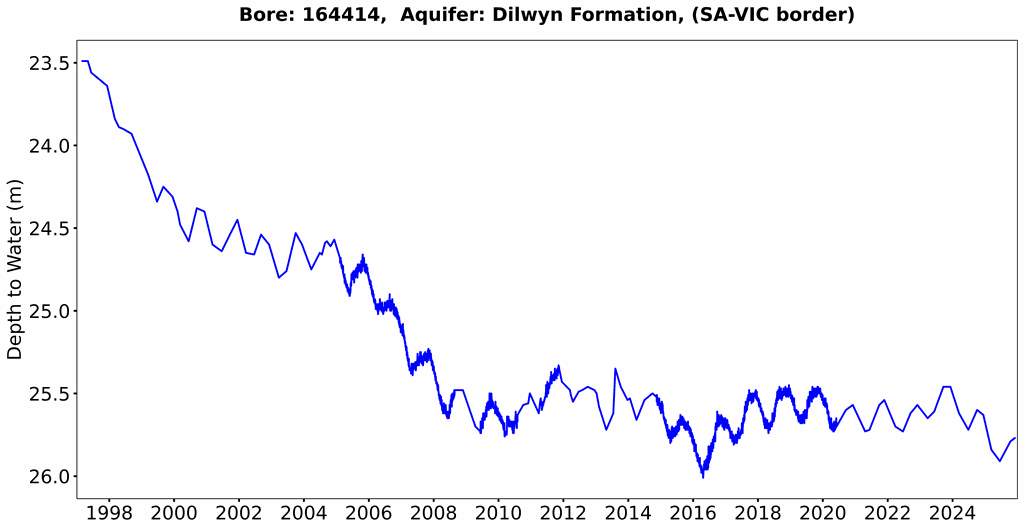
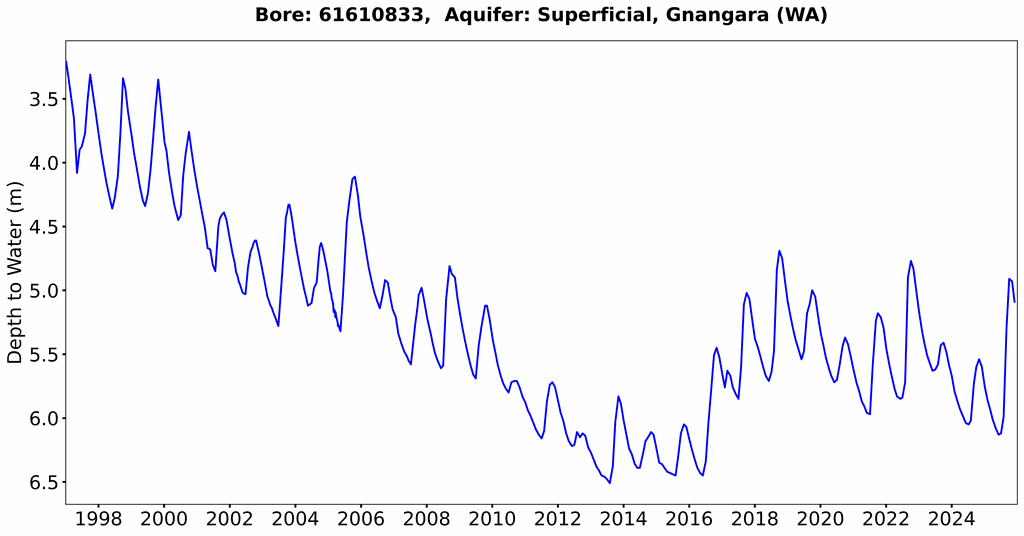
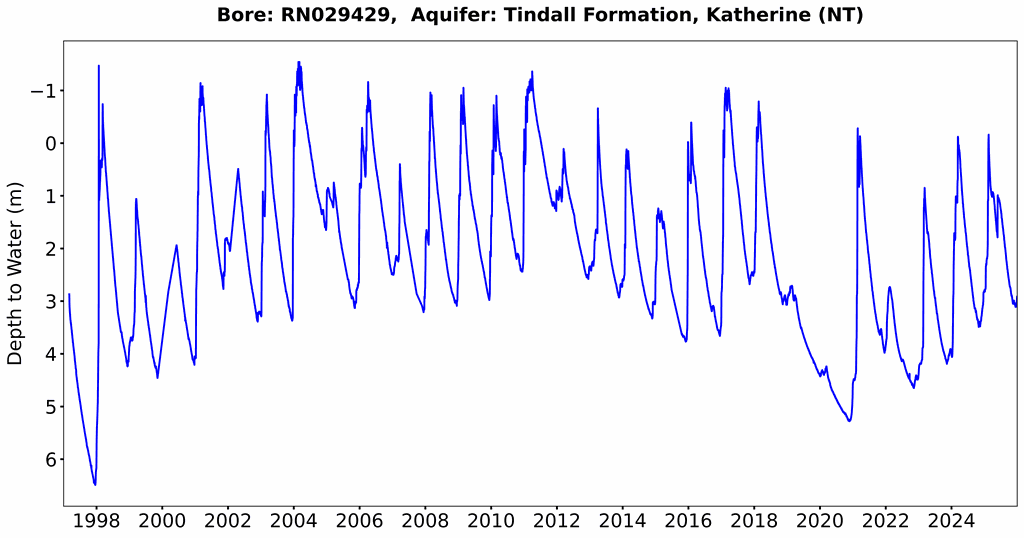
Overall, groundwater levels increased across Australia over the year compared to 2024, particularly in the east. In Queensland and northern New South Wales, groundwater levels were average to above average. Following another cool season of below average rainfall, groundwater levels declined across south-eastern Australia.
Groundwater levels rose the east and north-east and continued declining across the south
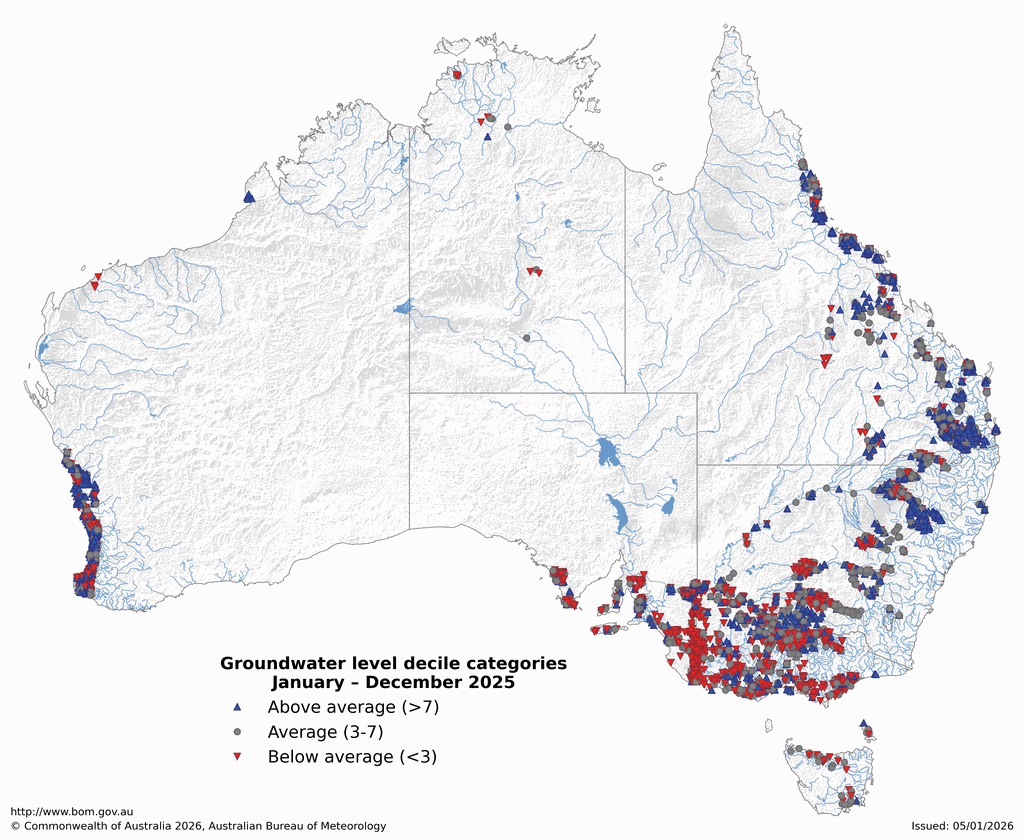
There was considerable variation in groundwater levels across the country, with 27% of bores being below average, 30% average, and 43% above average. Compared to 2024, there was a significant increase (about 12%) in bores classified as above average and a notable decrease (about 8%) in those classified as below average.
Groundwater level trends over the latest 5-year period (2021–2025) show that levels are rising in 39% of bores (same as 2024), 43% are stable (a 4% decrease from 2024), and 18% are declining (a 5% increase from 2024). Overall deterioration in the 5-year trend is largely driven by declining groundwater levels across the south, despite the improvement in levels across east and north-east this year.
Murray–Darling Basin and south-eastern Queensland
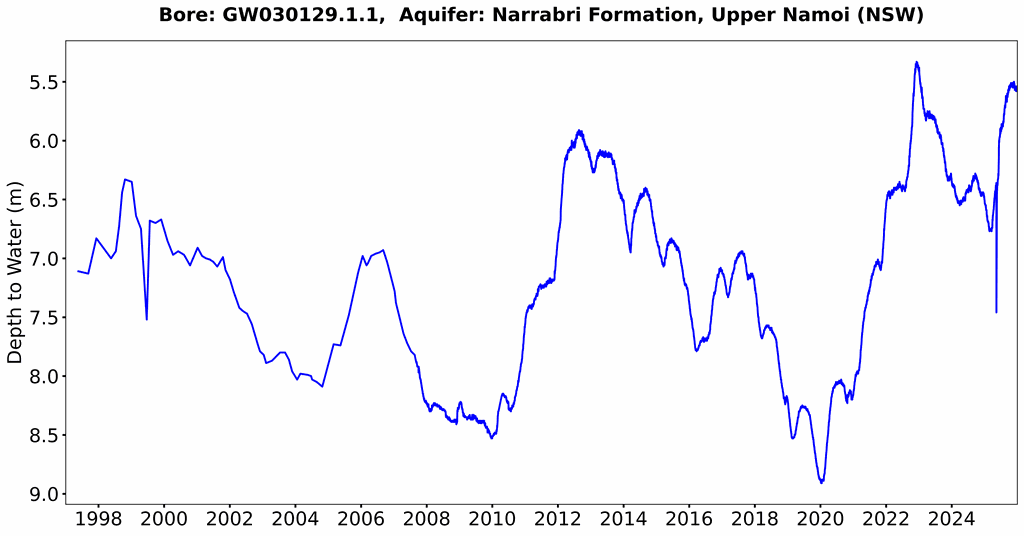
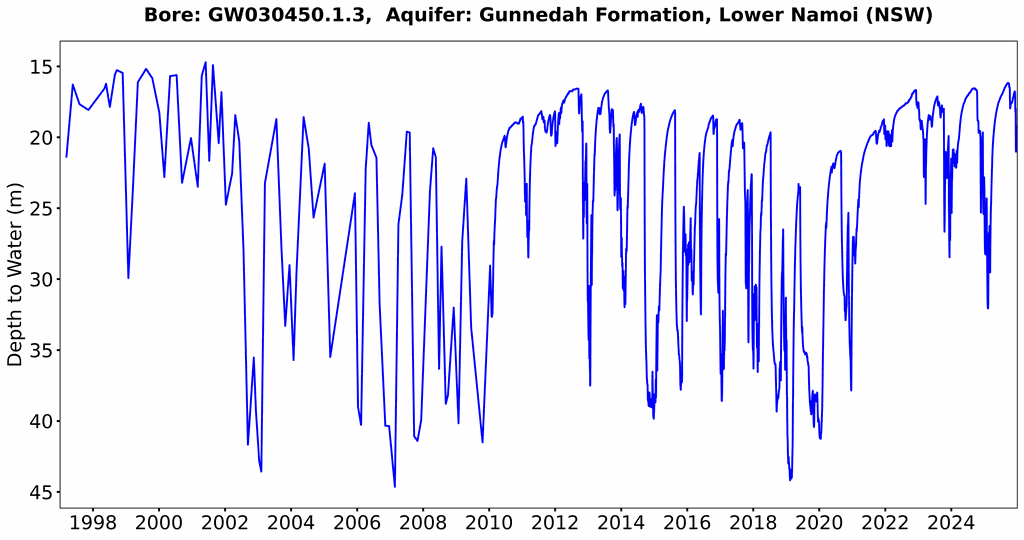
After heavy rainfall and flooding during 2021–23, groundwater levels recovered in 2024 in many areas of the northern Murray–Darling Basin and south-eastern Queensland, including the alluvial aquifers associated with the Namoi and Condamine River basins. With above average rainfall, groundwater levels remained high or continued to recover in those areas. With higher rainfall in recent years and increased surface water availability, reliance on groundwater for water supply continued to decline, which may have also contributed to the ongoing groundwater recovery.
Victoria–South Australia border
Groundwater levels in most bores in the Victoria–South Australia border region were below average. In South Australia and Victoria overall, below-average water levels were recorded in around 54% and 51% of bores respectively. This reflects both the impact of low rainfalls in recent years across this region and long-term consequences of groundwater extraction.
South-west Western Australia
In south-west Western Australia, groundwater levels have generally been in decline over the past 40 years due to the decreasing rainfall, which decreases surface water storages and increases demand on groundwater. Close to average winter rainfall resulted in a modest recharge to surface aquifers of the Gnangara Mound, and possibly a modest decrease in groundwater extraction in the region.
Northern Territory Top End
In the top end of the Northern Territory, where groundwater recharge relies on wet season (October–April) rainfall and streamflow, groundwater levels have shown some improvement since 2021. Overall, 65% of groundwater bores in the Northern Territory had average or above average water levels this year. Close to average rainfall around the Katherine region, and seasonal drawdown, led to a modest increase in groundwater levels in the Tindal formation.
Tasmania
In Tasmania, the cumulative impact of below average rainfall in 2024 and 2025 was noticeable in groundwater levels, with only about 7% of bores recording above average levels.
| Trend category | 5-year trend | 10-year trend | 20-year trend |
|---|---|---|---|
| Rising | 39% | 33% | 18% |
| Stable | 43% | 57% | 72% |
| Declining | 18% | 10% | 9% |
The 2025 sea surface temperature anomaly for the Australian region reached a record 0.93 °C above the 1961–1991 average. Global sea surface temperatures (SSTs) in 2025 were the third-warmest on record at 0.71 °C above the 1961–1990 average, behind 2024 and 2023. Indian Ocean SSTs were above average in 2025, with a strongly negative Indian Ocean Dipole peaking at -1.94 °C before easing in December. Pacific Ocean SSTs were also above average, a weak La Niña early in 2025 eased in March before redeveloping in October and persisting into 2026.
Sea surface temperatures warmest on record for the Australian region
(NOAA Extended Reconstructed Sea Surface Temperature dataset, ERSST v5)
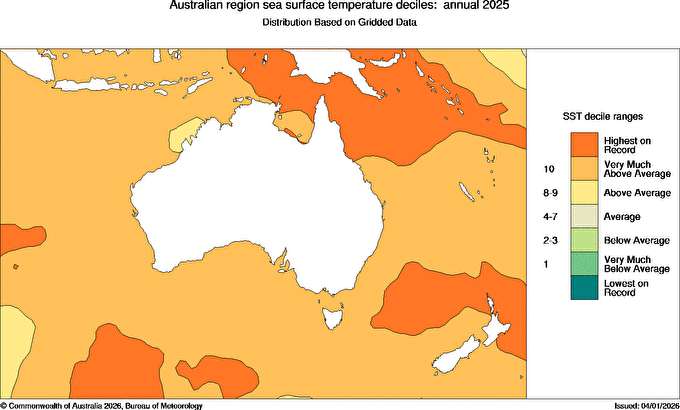
The 2025 annual sea surface temperature (SST) anomaly for the Australian region (4°S to 46°S and 94°E to 174°E) was the warmest on record and 0.93 °C above the 1961–1990 average. 2025 surpassed the previous record of 0.90 °C above average in 2024.
Australian region
SSTs were very much above average (in the warmest 10% of all years since 1900) around nearly all of Australia during 2025, and warmest on record in several areas, including:
- parts of the Coral and Arafura seas to the east and north of Australia
- parts of the Tasman Sea and around northern New Zealand.
Throughout 2025, monthly SSTs were very much above average for large parts of the region. SSTs were the highest on record during individual months at various locations, including:
- areas of the Arafura and Coral seas from January to April and from November to December
- areas of the Southern Ocean from January to March and in September
- areas of the Tasman Sea in March, and from July to November
- isolated areas off the west coast in January, March and November.
Area-averaged monthly SSTs for the Australian region were the warmest on record for January, February, May, July, August, September and November, with the remaining months either the second- or third-warmest on record.
Within the Australian region, annual SSTs were the warmest on record and above the 1961–1990 average for the Northern Tropics (0.97 °C), Southern Region (0.87 °C), Coral Sea (1.03 °C) and Tasman Sea (1.10 °C).
Two consecutive years of record SSTs in the Australian region may have increased the amount of moisture available to fuel heavy rainfall events and influence the frequency and severity of flooding events. Additionally, warmer oceans may also elevate the risk of more frequent and intense marine heatwaves. A severe algal bloom in South Australia's St Vincent and Spencer gulfs, that began in late 2024, persisted during much of 2025, with large-scale marine mortalities.
Annual average SSTs in the Australian region have warmed by 1.16 ± 0.11 °C between 1900 and 2025, similar to the warming rate of global average SSTs. Average annual SSTs have been above the 1961–1990 average for the Australian region every year since 1995, and 10 of the top 11 warmest years on record have occurred since 2010.
The black line shows the 11-year moving average. The value for the 11-year average is positioned over the middle year of each 11-year block.
Global oceans
In 2025, global SSTs (from 60°S to 60°N) were the third-warmest on record, 0.71 °C above the 1961–1990 average in the ERSST v5 dataset. The warmest and second-warmest years on record in ERSSTv5 were 2024 (+0.80 °C) and 2023 (+0.74 °C). Global SSTs for the past 11 years, have been the 11 warmest on record.
Throughout 2025, monthly SSTs averaged across the globe were among the second- to fourth-warmest on record for each respective month.
Indian Ocean
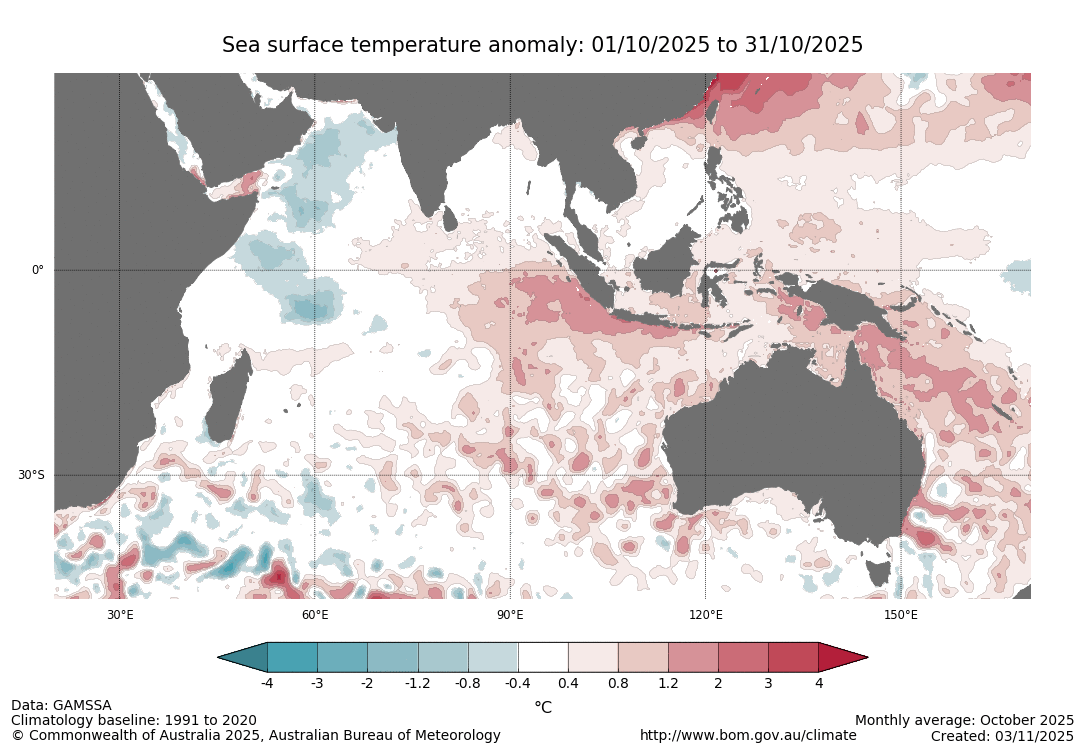
Indian Ocean SSTs for 2025 were very much above average (in the warmest 10% of all years since 1900) across most of the basin. Waters were closer to average, though generally still above average in the west, extending from the Horn of Africa to the Arabian Sea. Some small, isolated areas measured highest on record, mostly in the southern hemisphere subtropics.
The Indian Ocean Dipole (IOD) was in a negative phase from late July to early December. In late July, SSTs cooled off the Horn of Africa, while positive SST anomalies strengthened off the Indonesian islands of Java and Sumatra, dropping the weekly IOD index below the negative IOD threshold (-0.4 °C). IOD index values strengthened through August and September, with consistent values below -1.2 °C throughout September and October. In late October there was further cooling in the western node of the IOD, with the IOD index dropping to -1.94 °C for the week ending 2 November 2025, the most negative value in the Bureau weekly data (beginning 2008). The 2025 negative IOD event includes 5 of the top 10 most negative weeks on record (since 2008), alongside events in 2022 and 2016. The weekly IOD index values steadily declined through November and returned to neutral by the second week of December.
A marine heatwave off the Western Australian coast, which began in late 2024, continued in early 2025 with a second peak of heat in March–April. The monthly average SST for the Northwest Australian Region for January was the equal warmest on record, 0.83 °C above the 1991–2020 average, while March was equal-second warmest on record. Waters were exceptionally warm close to the coast, with weekly SSTs between 2 and 4 °C above average persisting there until late April 2025. Temperatures receded in May; however, it was deemed the longest, largest and most intense marine heatwave on record for Western Australia, resulting in widespread coral bleaching.
Pacific Ocean
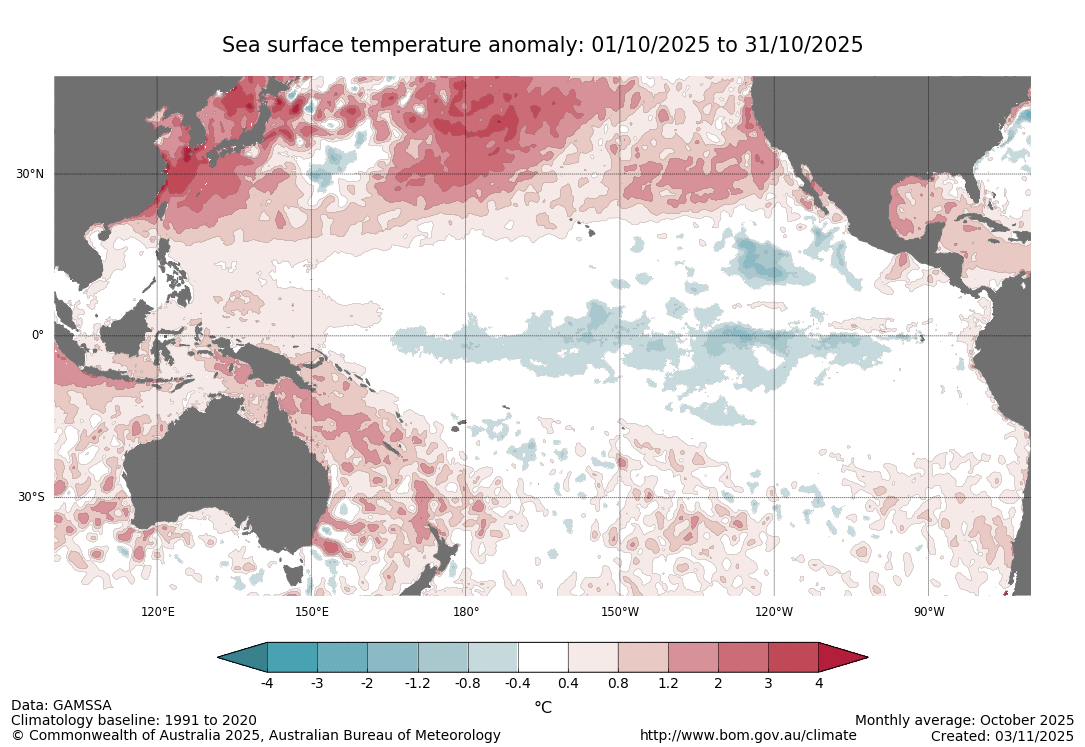
Pacific Ocean SSTs for 2025 were very much above average (in the warmest 10% of all years since 1900) across most of the basin, with SSTs close to average across the central and eastern equatorial Pacific. SSTs in the far western Pacific and Maritime Continent measured highest on record for 2025, as well as a broad band extending into the northern hemisphere subtropics.
A weak La Niña was underway at the beginning of 2025. The event dissipated in March, with the relative Niño-3.4 index returning to near average values and marking a transition to ENSO neutral conditions. Through the middle of the year, SSTs in the central and eastern equatorial Pacific generally hovered near or slightly below average.
In the second half of 2025, SSTs cooled in the east central tropical Pacific, re-establishing a weak La Niña pattern in October that persisted into 2026, supported by enhanced trade winds and suppressed convection near the Date Line.
2025 marked the second consecutive year of a weak La Niña state, also broadly reflecting longer-term (decadal) SST patterns in the Pacific Ocean.
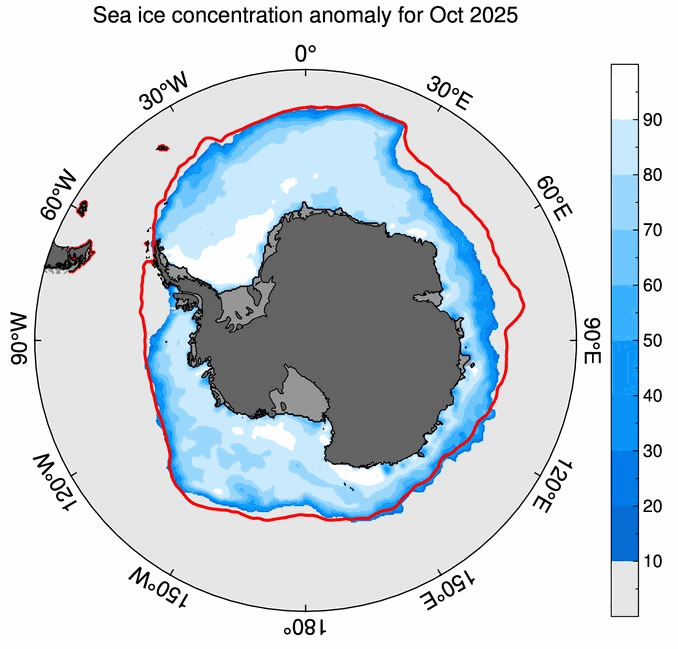
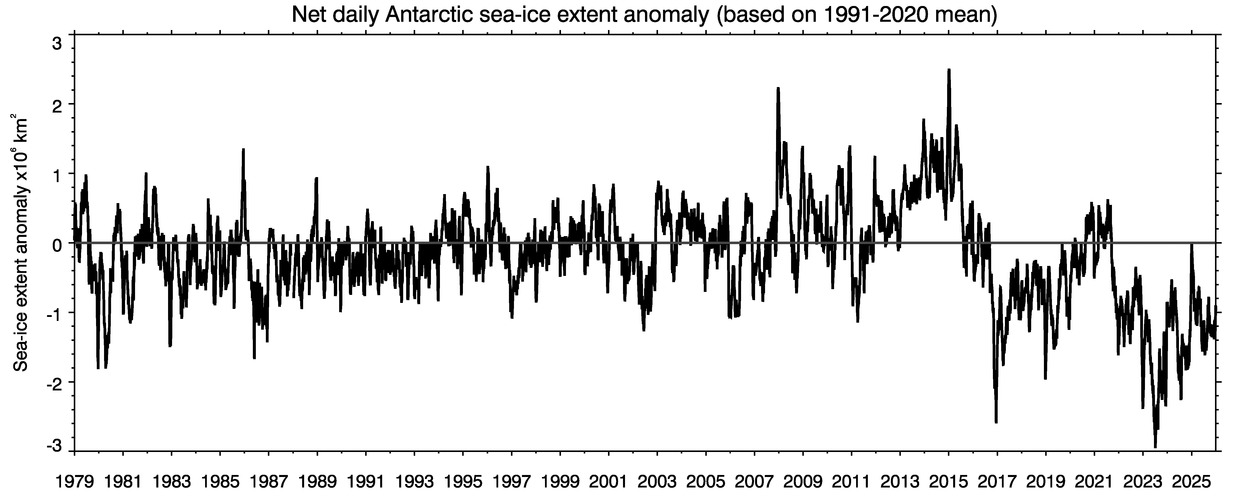
Antarctic summertime daily minimum sea-ice extent in 2025 was the fourth-lowest on record since 1979 at 1.96 million km2 on 1 March. The wintertime daily maximum value in 2025 was similarly low, reaching 17.85 million km2 on 15 September, the third-lowest on record. Sea-ice coverage was particularly diminished across East Antarctica.
Antarctic summertime and wintertime sea-ice extent reached near record-low levels
Antarctic sea ice (ice that is formed from the freezing of the ocean surface) is an important component of the Earth's climate and ecology, reflecting incoming solar radiation, influencing interactions between the ocean and atmosphere, contributing to the global ocean circulation, protecting ice-shelves from ocean processes, and providing a habitat for polar species.
The extent of Antarctic sea-ice (defined as the area of the Southern Ocean where at least 15% of the surface is frozen) experiences large seasonal changes, with net summertime sea-ice extent being ~2–4 million km2 expanding to a wintertime extent of ~18–20 million km2, based on satellite observations since 1979.
Recent years have seen quite a distinct rise in variability in sea-ice extent, with record high wintertime extents being observed in 2012–2014 followed swiftly by record low values observed since 2016. The record low values seen over the last few years are largely attributable to warmer than average subsurface Southern Ocean temperatures.
2025 sea-ice extent
Summertime daily sea-ice extent reached a minimum of 1.96 million km2 on 1 March, the fourth-lowest on record. The last four years have seen the lowest summertime daily values of sea-ice extent recorded, each below 2 million km2. Similarly, the last three years have each recorded the lowest wintertime daily maximum values, each below 18 million km2. 2025 was the third-lowest on record at 17.85 million km2 on 15 September. Sea-ice coverage was particularly low around much of East Antarctica, where Australia's Antarctic stations of Mawson and Davis are located.
High pressure systems dominated the Australian region earlier in the year, but low pressure systems dominated late in the year, consistent with positive and negative phases of the Southern Annular Mode. The monsoon onset for the 2024–25 wet season was unusually late, with the lack of an active Madden-Julian Oscillation in the Australian region in January. Tropical cyclone activity was relatively high during the 2024–25 season and for the start of the 2025–26 season.
Weather patterns influencing Australia's climate
Australian region
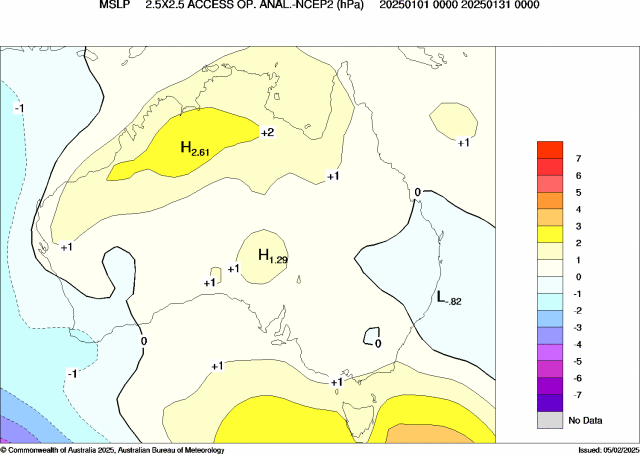
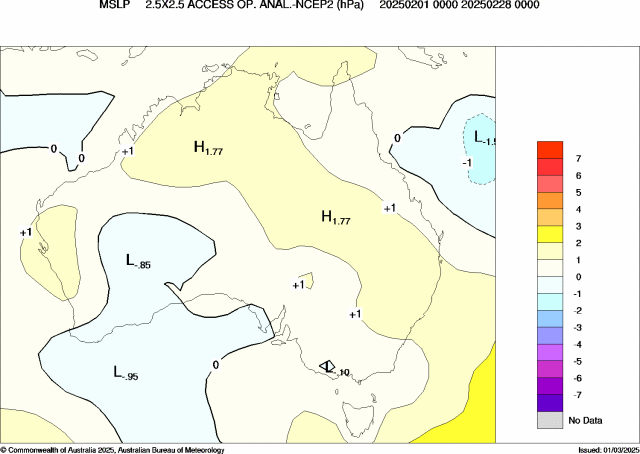
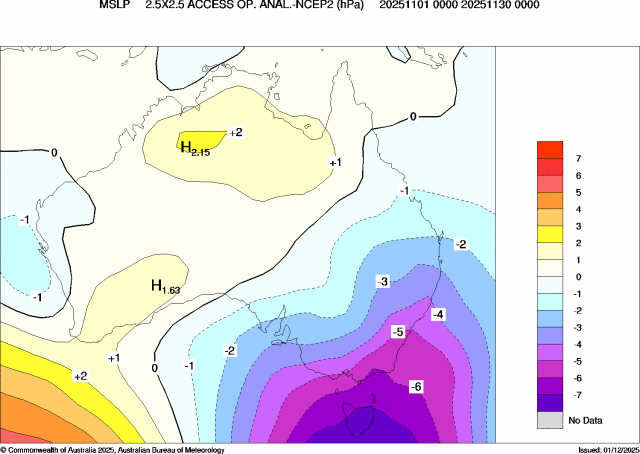
Throughout 2025, monthly-averaged mean sea level pressure (MSLP) anomalies across the country were predominately positive, reflecting high pressure systems dominating weather patterns. Their influence on Australian climate depended on the location, strength and movement across the Australian region.
Between January and February 2025, most of the country experienced heatwave conditions, as persistent high pressure systems extended over the continent and directed hot northerly winds across Australia. During these months, many stations across the country had their warmest daily maximum or minimum temperature on record.
Negative MSLP anomalies were prevalent across parts of southern Australia in mid and late 2025 and were generally associated with low pressure systems.
In July and November, persistent cold fronts and associated low pressure systems affected southern Australia, bringing average to above average rainfall to the region and in November cooler than average temperatures to the south-east.
For more details of the weather patterns related to significant weather, see the Events section.
Southern region
Southern Annular Mode
The Southern Annular Mode (SAM) is the north-south movement of weather systems across the Southern Ocean, compared to the usual seasonal position.
The SAM daily index was positive (greater than 1.0, a southward shift of weather systems) during:
- most of the period between March and August.
The SAM daily index was negative (less than −1.0, a northward shift of weather systems), during:
- at times in January and February
- most of the period between September and December
The impact of SAM on southern Australian climate depends on the time of year and its influence also depends on the complex relationship with other large-scale climate factors.
- In January and February, a negative phase of SAM may have contributed to drier than average conditions for parts of south-eastern Australia, due to reduced moist onshore easterly flow.
- In May, a positive phase of the SAM was likely attributed to high pressure systems dominating conditions across southern Australia and leading to below average rainfall. Enhanced onshore flow brought above average rainfall to coastal areas of eastern Australia and with some coastal areas of New South Wales recording highest on record May rainfall.
- In August, a positive phase of the SAM may have reduced the frequency of cold fronts crossing south-eastern Australia and resulted in below average rainfall. While, along the east coast onshore easterly flow led to above average rainfall for the east coast of New South Wales.
- Between October and December, a negative phase of the SAM persisted, likely due to an unusually weak stratospheric polar vortex. This period also saw an exceptionally strong negative Indian Ocean Dipole (IOD). The competing influences of negative SAM and negative IOD make it difficult to ascribe any weather pattern to either climate factor. However, it is possible that the negative SAM contributed to the below average rainfall in inland New South Wales late in the year.
Mid-latitude systems
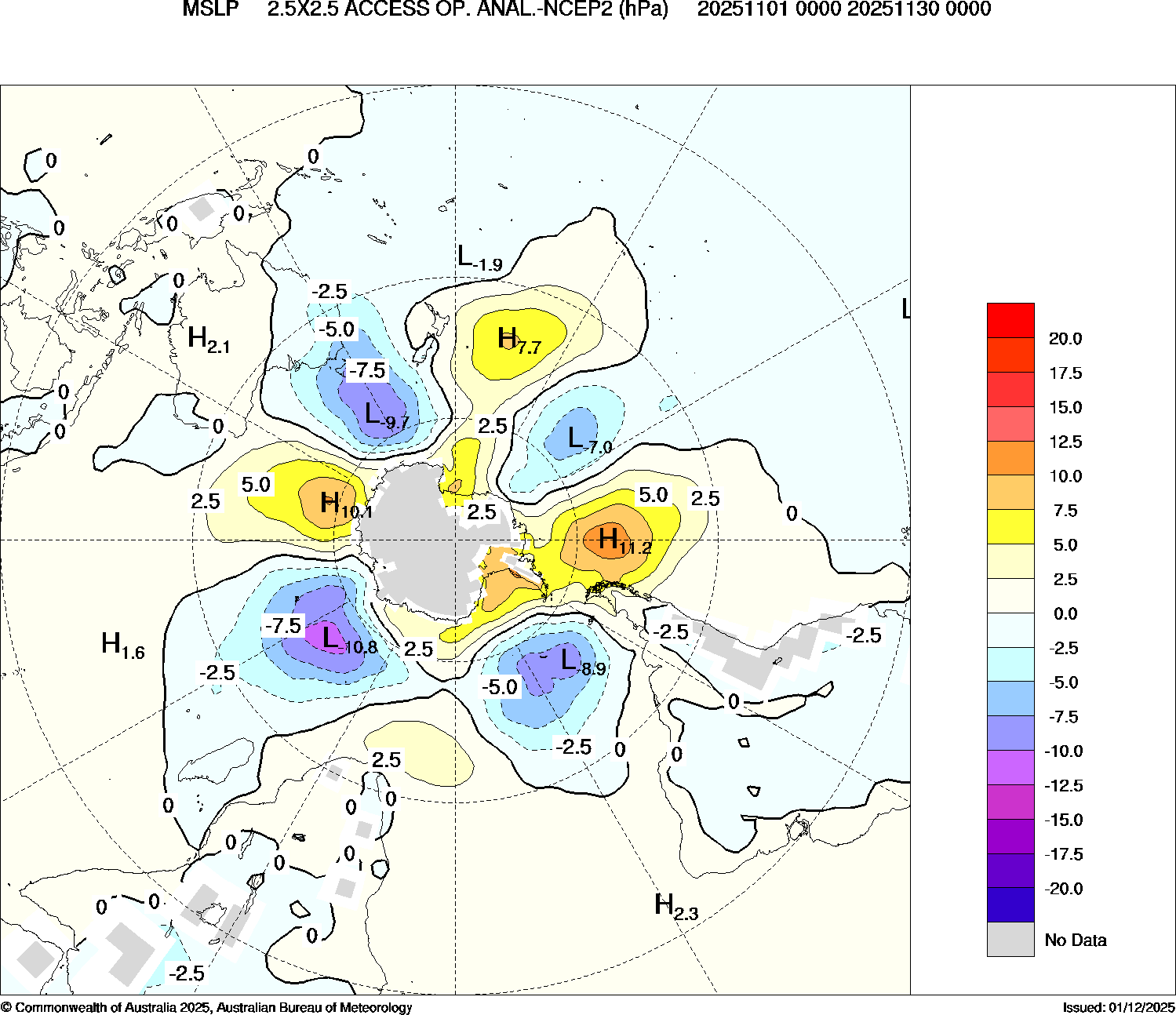
November was notable for the number of cold fronts the crossed Tasmania and the south-east of the mainland. The November MSLP for the southern hemisphere, show a succession of positive and negative anomalies, or 'wave train', around the mid-latitude region. The negative anomalies to the south of Tasmania indicate that this region was favourable for the passage of cold fronts over south-eastern Australia throughout November.
Tropics
Madden–Julian Oscillation
The Madden–Julian Oscillation (MJO), modulates rainfall patterns and tropical cyclone potential across Northern Australia on weekly to monthly timescales during the northern wet season.
In late January to early February, an active phase of the MJO was in the Australian region, with a moderate strength pulse. But the lack of MJO activity earlier in January likely contributed to the unusually late onset of the monsoon over northern Australia. The January rainfall for northern Australia was the lowest since 1994.
From late October to late November, the MJO was active over the Australian region, with moderate to strong strength. This likely contributed to above average rainfall across northern Australia and increased tropical activity, including Severe Tropical Cyclone Fina.
Monsoon
For the 2024–25 wet season, the Monsoon Onset was observed at Darwin on 7 February 2025, the latest onset since records began in the 1957–58 wet season and surpassing the previous latest onset date of 25 January 1973. While the monsoon was exceptionally late to arrive in Darwin, the monsoon trough was established over Queensland from the end of January and briefly in northern Western Australia.
The Monsoon Onset for the 2025–26 wet season was observed at Darwin on 23 December 2025, close to the average date of 29 December. Monsoonal conditions began developing from around 20 December across the southern Indian Ocean and Australia longitudes.
Tropical Cyclones
During January to April 2025, the latter part of the 2024–25 season, 11 tropical cyclones (TCs) developed in the Australian area of responsibility (AOR), 8 of which reached severe strength (at least Category 3). TC activity was particularly concentrated in the western region, with 10 systems forming or moving through the region, the most since 1999–2000. Only one TC, Alfred, formed in the eastern region off the Queensland coast. Two TCs, Zelia and Dianne, made landfall at TC strength on the Western Australia coast in February and March respectively, while Alfred (in March over south-eastern Queensland) and Errol (in the Western Australian Kimberley region in April) made landfall as tropical lows.
Between November and December 2025, the earlier part of the 2025–26 season, four TCs (Fina, Bakung, Grant and Hayley) developed within Australia's AOR. Three of these systems (Fina, Bakung and Hayley) reached Category 4 strength, the first time this has occurred since reliable estimates of TC intensity started in 1980. Fina and Hayley made landfall impacting the Northern Territory and Western Australian coastlines.
For more information on significant TCs in 2025, see the Events section.
The 2025 Antarctic ozone hole was modest and dissipated earlier than usual. It developed in mid-August, peaked at 22.9 million km2 in early September and was disrupted by a stratospheric warming event at the end of September. The unusual conditions led to persistently negative phases of the Southern Annular Mode from October to December.
Antarctic ozone hole modest in size and short lived
During spring, the stratospheric circulation over the Antarctic influences the weather patterns of the southern hemisphere. Sunlight returns to the stratospheric polar vortex, causing temperatures to rise. This seasonal cycle causes the polar vortex to break down, which in turn influences the Southern Annular Mode (SAM).
In recent decades, ozone-depleting substances have caused a seasonal 'hole' in stratospheric ozone over the Antarctic. This has affected the lifecycle of the polar vortex and its influence on SAM.
The year-to-year variability in the severity of the Antarctic ozone hole is determined primarily by meteorological conditions in the Antarctic stratosphere. However, actions taken under the Montreal Protocol to end the use of ozone-depleting substances have led to an underlying slow recovery in Antarctic stratospheric ozone since 2000. Other influences play a small role, including material injected into the stratosphere from major volcanic eruptions and bushfires.
2025 Antarctic ozone hole
The 2025 Antarctic ozone hole was relatively modest in size and early to dissipate. The maximum area attained was 22.9 million km2 on 9 September. This was similar to 2024 (22.4 million km2) and was smaller than 16 of the years since 2000. It follows 4 years of relatively large and long-lasting ozone holes from 2020 to 2023.
According to NASA satellite measurements, the 2025 Antarctic ozone hole began to develop in mid-August and grew at a rate slightly faster than the long-term average. The growth was disrupted by stratospheric warming events in early and late September.
The area of the ozone hole decreased to zero by 30 November, the earliest occurrence since 2019.
The minimum value of total ozone measured in 2025 was 127 Dobson Units (DU) on 25 September. Only 3 years since 2000 have recorded greater minimum values: 2002, 2017 and 2019, all marked by significant stratospheric warming over Antarctica during spring.
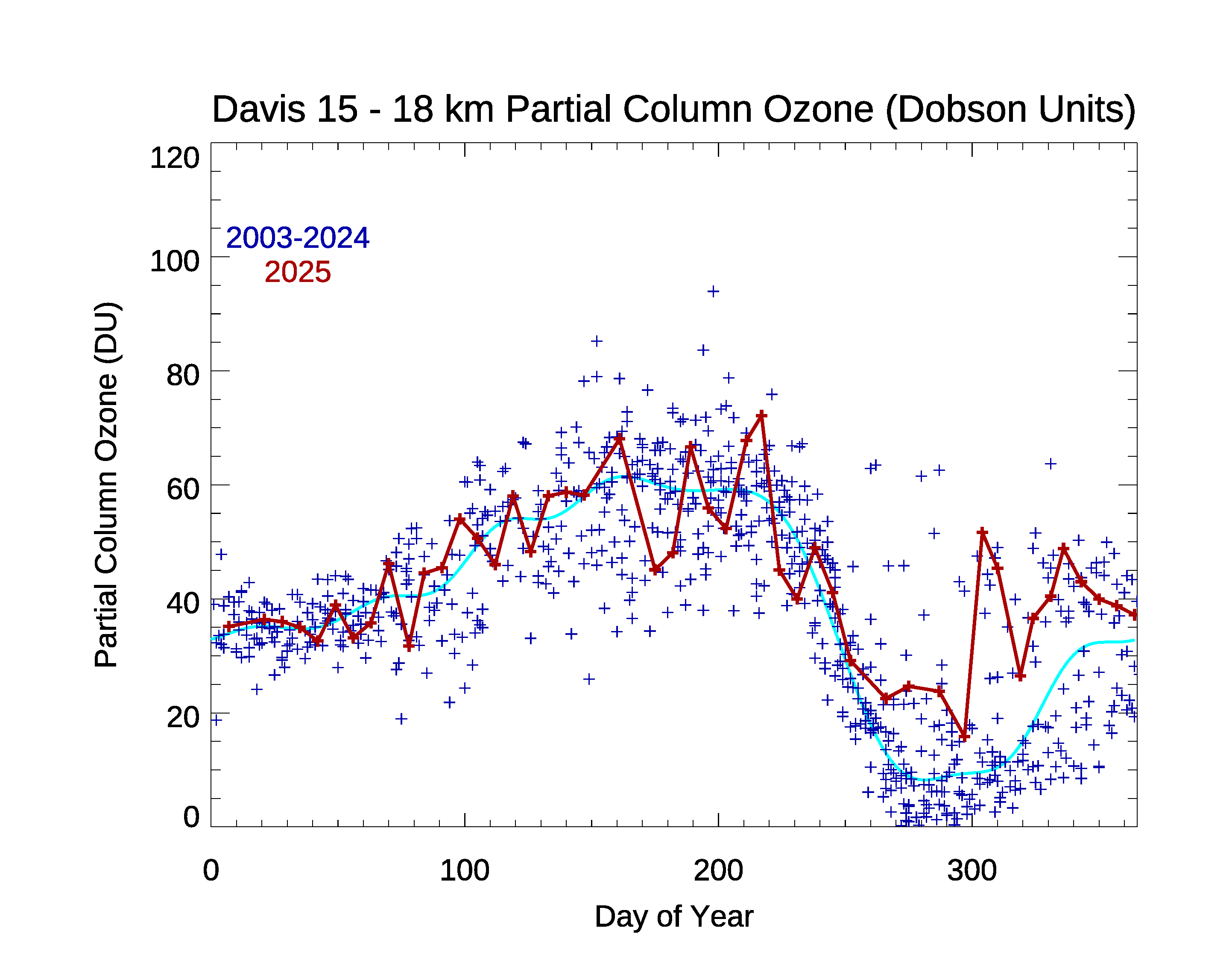
Weekly measurements made by the Bureau's balloon ozonesonde program at Davis station show that ozone in the 15–18 km altitude range, where the most severe ozone depletion is observed, decreased at a rate typical of the 2003–2024 records from early August (Day 215) until mid-September, with the flight of 23 September measuring 22.5 DU (Day 266). Further reductions were minimal, primarily due to the anomalous Antarctic stratospheric vortex weakening and warming. The minimum 15–18 km value recorded in 2025 was 15.9 DU on 24 October.
Stratospheric polar vortex
Antarctic stratospheric polar vortex in the mid-stratosphere in September 2025 was the third-weakest and third-warmest on record for the month since 1979. These anomalous conditions persisted throughout spring and led to the significantly earlier breakdown of the polar vortex. Weaker and warmer polar vortices in spring generally cause less ozone depletion, as occurred this year. The associated changes in stratospheric circulation also allowed more ozone to be transported from the tropics to the polar region.
Influence on weather patterns
The anomalous circulation and ozone concentration together likely influenced southern hemisphere weather patterns. Higher than average surface pressure over the Antarctic polar cap and below average surface pressure in the mid-latitudes persisted from October to December. The SAM index for this period was the second most negative record for the season since 1979.
While a negative SAM typically shifts weather patterns further northwards than usual, there is a complex relationship between the major influences on Australia's climate. Late spring also saw a strong negative Indian Ocean Dipole and a preference for cold fronts in the mid-latitudes, each of which is likely to have contributed to the observed weather patterns.
Greenhouse gas measurements from Kennaook / Cape Grim station in Tasmania showed continued increases in 2025 for carbon dioxide (CO2), methane (CH4) and nitrous oxide (N2O) and synthetic gases. By December 2025, the baseline concentration of carbon dioxide ( CO2) was 423.4 parts per million in dry air (ppm), an increase from 421.4 ppm in December 2024.
Continued increase in greenhouse gases
Greenhouse
Greenhouse gases are the principle driving force of global temperature increases. Carbon dioxide is the single most important anthropogenic greenhouse gas, accounting for approximately 66% of the radiative forcing by the long-lived greenhouse gases. Methane accounts for about 16% of the radiative forcing by long-lived greenhouse gases and nitrous oxide accounts for about 6%.
The remaining 12% of the radiative forcing is due to synthetic greenhouse gases, many of which are also ozone depleting substances. These synthetic greenhouse gases are many and include the chlorofluorocarbons (CFCs), hydrochlorofluorocarbons (HCFCs) and hydrofluorocarbons (HFCs) as well as other halogenated gases.
Greenhouse gas concentrations are based on air sampled at the Kennaook / Cape Grim Baseline Air Pollution Station (KCG BAPS) in north-western Tasmania. Air masses sampled at Kennaook / Cape Grim travel thousands of kilometres across the Southern Ocean, free of pollutants due to human and terrestrial influences. The air is well-mixed, making it representative of the background or 'baseline' composition of the atmosphere in the southern hemisphere.
2025 measurements
Concentrations of all the major long-lived greenhouse gases in the atmosphere rose again in 2025.
By December 2025, the baseline concentration of carbon dioxide (CO2) at KCG BAPS was 423.4 parts per million in dry air (ppm), an increase from 421.4 ppm in December 2024. A decade earlier, in December 2015, the concentration was 398.8 ppm. The December 2025 value marks a 52% increase from the pre-industrial concentration of 278.0 ppm in 1750. Pre-industrial concentrations are based on measurements of air trapped in ice and compacted snow collected at Law Dome, Antarctica.
The baseline methane (CH4) concentration in December 2025 was 1,886 parts per billion in dry air (ppb). This represents an increase of 4 ppb over 12 months and is 159% higher than the pre-industrial level of 729 ppb.
The baseline nitrous oxide (N2O) concentration in November 2025 was 338.6 ppb, 1.1 ppb higher than the same time in 2024, and 25% higher than the pre-industrial concentration of 270 ppb. Nitrous oxide accounts for about 6% of the radiative forcing by long-lived greenhouse gases.
See State of the Climate 2024 for further information about greenhouse gases
Notable events
In the first half of January, inland troughs combined with a humid airmass triggering outbreaks of isolated thunderstorms with hail, heavy rainfall and strong to damaging winds across southern Queensland, New South Wales and Victoria. Reported impacts included:
- On 8 January, large hail (3 to 4 cm in diameter) from a supercell storm north-east of St Geroge in Queensland.
- On 9 January, 62.0 mm of rainfall was recorded in 30 minutes at Jordan near Caloundra on the Sunshine Coast, Queensland.
- On 10 January, 35.8 mm was recorded in 30 minutes at Glen Innes Airport in New South Wales and hail 4 to 5 cm in diameter was observed north of Goondiwindi in Queensland.
- On 12 January, Melbourne (Olympic Park) recorded 26.4 mm of rainfall within 30 minutes, with flash flooding across the Melbourne Central Business District.
- On 14 January, giant hail up to 10 cm in diameter was reported near Applethorpe and Stanthorpe in Queensland.
- On 16 January, giant hail around 11 to 12 cm in diameter was reported south of Grafton in New South Wales.
Between 9 and 14 January large parts of Queensland had low to severe intensity heatwave conditions, reaching extreme intensity across northern and central areas of the state. Maximum temperatures were above 40 °C across inland parts of the state and many sites had temperatures above 45 °C, including 46.4 °C at Urandangi Aerodrome on the 11th and 46.0 °C at Birdsville Airport on the 14th.
On 17 January a low pressure system and associated trough developed off the northern coastline of New South Wales. This brought heavy rainfall, damaging winds and dangerous surf conditions as it remained offshore for several days before weakening. In the 48 hours to 9 am on 19 January, 10 to 25 mm of rainfall was recorded along coastal and adjacent inland areas of New South Wales, with falls between 50 to 100 mm in parts of the Northern Rivers, Mid North Coast and Hunter districts. Some sites had rainfall totals exceeding 200 mm in the 24 hours to 9 am on the 18th, including 281.0 mm at Careys Peak (Barrington Tops) inland on the Mid North Coast district. There were reports of flash flooding, and a moderate flood warning was issued for the Williams River. The system also brought wind gusts over 80 km/h on the 17th and 18th near coastal areas of the Sydney Metropolitan district. The strong south to south-easterly winds along the New South Wales coast generated large and powerful surf conditions.
On 17 January tropical low 11U formed in the Indian Ocean, off the west Kimberely coast in Western Australia. 11U reached Category 1 intensity (tropical cyclone (TC) Sean) on the 19th north of Karratha further strengthening to Category 4 (severe TC intensity) late on 20 January. Severe TC Sean travelled south-westward offshore along the Pilbara coast and weakened to a tropical low on the 23rd. Although severe TC Sean did not make landfall, it brought heavy rainfall to the Pilbara coastline with daily rainfall totals greater than 50 mm and with falls greater than 150 mm in an area surrounding Karratha in the 24 hours to 9 am on the 20th. Karratha Aero recorded 374.4 mm in the 24 hours to 9 am on the 20th, the highest annual daily rainfall on record for the station (54 years of data). Heavy rainfall led to flooding of the De Grey River Catchment and the west Kimberley Rivers. There was also several days of strong to damaging wind gusts along the Pilbara coastline and offshore islands. Maximum wind gusts on the 19th and 20th exceeded 100 km/h at several sites, including 113 km/h on the 19th at Barrow Island Airport, a January record for the site (23 years of data).
In late January Western Australia experienced low to severe intensity heatwave conditions, reaching extreme intensity at times along the west coast. On the 20th maximum temperatures were 10 to 12 °C above average across the west and south of Western Australia. Many sites recorded their highest January maximum temperature, including:
- Geraldton Airport with 49.3 °C (annual record, 84 years of composite data)
- Kalbarri with 48.3 °C (annual record, 54 years of data).
Minimum temperatures were also 2 to 10 °C above average for large parts of Western Australia between the 20th to 26th, and many sites across southern and inland parts of the state had their warmest January night on record, including:
- Donnybrook with 27.0 °C on the 22nd (118 years of data)
- Laverton Aero with 34.3 °C on the 25th (34 years of data).
On 23 January a severe thunderstorm impacted Marble Bar in the Pilbara region of Western Australia. A wind gust of 115 km/h was observed at Marble Bar from an associated microburst. There were reports of damage to properties.
On 25 January, a large dust storm was reported outside of Onslow, in the Pilbara district of Western Australia with swirling plumes of red dust rolling across the landscape.
Between 27 January and 12 February, two tropical lows (13U and 20U) and an active monsoon trough brought persistent and heavy to intense rainfall to northern Queensland. The rainfall was particularly intense along the coastal region from Ayr to Cairns, as the tropical lows increased the available moisture. The heaviest falls occurred between the 1st and the 3rd, with daily rainfall totals over 200 mm recorded across the Tropical North Coast and Tablelands, and the Herbert and Lower Burdekin districts. Paluma Ivy Cottage, in the upper Burdekin catchment reported consecutive days of rainfall totals greater than 700 mm with 721.5 mm (2nd) and 745.2 mm (3rd). This is the first known instance in Australia of 2 consecutive days of measured rainfall totals over 700 mm. Rainfall totals between 27 January and 12 February 2025 exceeded 800 mm between Ayr and Cairns, and over 1,200 mm along the coast from Townsville to north of Innisfail. For the 1 to 12 February period, the rainfall at some sites between Townsville and Ingham exceeded their previous record for any calendar month, most notably Paluma Ivy Cottage with 2,668.4 mm (54 years of data). The prolonged heavy rainfall led to widespread flash and riverine flooding in many catchments. There were major flood warnings issued for the Bohle, Ross, Haughton, Herbert, Upper Burdekin, Murray and South Johnstone Rivers. The Herbert River at Ingham Pump Station peaked on 3 February 2025 at major levels, within 0.30 m of the March 1967 record flood level. Flooding also extended across Central Coast, Inland and Gulf catchments. Major highways and roads were closed in both directions along the North Tropical Coast as the flash and riverine flooding inundated properties, businesses, agricultural lands and essential services.
Between 1 and 3 February low intensity heatwave conditions impacted large parts of the country, reaching severe intensity across large areas of Western Australia, Victoria and Tasmania. The nationally-averaged daily maximum temperatures on the 1st and 2nd were the highest (39.3 °C) and third-highest (38.8 °C) on record for February, respectively. Maximum temperatures were above 40 °C for large parts of the country, reaching above 45 °C across a large area of Western Australia. Many stations in Western Australia had their highest daily February maximum temperature on record on the 3rd, including 49.2 °C at Gascoyne Junction (annual record, 50 years of data). On the 3rd, maximum temperatures across most of Tasmania were 6 to 12 °C above average, and Cape Sorrell on the state's east coast had an annual record high temperature of 33.5 °C (29 years of data).
On 3 February, multiple bushfires started by dry lightning in remote regions across Tasmania's west and central highlands, including in several national parks and wilderness areas. These fires would burn for up to two months, as most of the state experienced many days of high fire danger from strong hot northerly winds ahead of cold fronts. These conditions were exacerbated by long-term serious to severe rainfall deficiencies (rainfall in the lowest 5% or 10% of periods, respectively, since 1900) that had persisted across large parts of the state since early 2023. These fires burnt approximately 95,000 hectares of vegetation, including endemic vegetation.
On 8 February, tropical low 18U developed near the northern coast of Western Australia, strengthening while moving south-west parallel to the coast. 18U reached Category 1 strength (Tropical Cyclone (TC) Zelia) on the 12th and rapidly intensified to Category 5 (severe TC intensity) late on the 13th. At this time, Severe TC Zelia started to move south-south-east towards the Pilbara coastline. Severe TC Zelia made landfall at 12:30pm AWST on the 14th as a Category 4 system near De Grey River mouth around 50 km north-east of Port Hedland. Severe TC Zelia was downgraded to a tropical low on the 15th while continuing to track south over inland Pilbara and towards the interior of Western Australia. Severe TC Zelia brought several days of heavy rainfall as it approached the coast and after it made landfall. In the 4 days to 9 am on the 15th, the broader Pilbara district received over 50 mm of rainfall, with large areas recording over 200 mm and coastal areas greater than 500 mm. De Grey received 261.0 mm of rainfall in the 24 hours to 9 am on the 14th, an annual record (112 years of data). Pardoo Station received 555.4 mm of rainfall between the 12th and 15th, its highest 4-day total on record (114 years of data). There were reports of flash and riverine flooding, with major flooding of the De Grey River. At Marble Bar, the De Grey River peaked on the 15th well above its previous 1998 record.
On 10 February low pressure troughs over western New South Wales and near the southern and central coast brought widespread rainfall and isolated severe thunderstorms. A severe thunderstorm impacted the Sydney metropolitan area leading to reports of flash flooding, strong winds and hail. In the 24 hours to 9 am on the 11th, 15 to 100 mm of rainfall was recorded across the Sydney Metropolitan district with Horsely Park Equestrian Centre AWS recording 88.2 mm, with 79.6 mm falling within 1 hour.
Between 11 and 13 February low to severe intensity heatwave conditions impacted northern, central and south-eastern parts of the country. Maximum temperatures were 6 to 12 °C above average and minimum temperatures were 6 to 10 °C above average. On the 12th, several stations in central Australia set records for their highest February daytime temperature including 48.7 °C at Oodnadatta Airport in South Australia (77 years of data), also a state record for February. On the 13th, several sites had their highest February minimum temperature on record including 34.3 °C at Birdsville Airport in Queensland (25 years of data), the second-highest minimum temperature ever recorded for the state in February.
On 13 and 14 February, a cold front and associated low pressure trough moved through south-eastern Australia followed by a strong southerly airflow. This generated strong wind gusts, rainfall and below average temperatures in the following days. Minimum temperatures on the 16th and 17th were 6 to 10°C below average. On the 16th, several sites in alpine areas of Victoria and New South Wales had their coldest February minimum temperature on record, including:
- Mount Baw Baw (Victoria) with -1.4 °C (28 years of data)
- Mount Ginini AWS (Australia Capital Territory) with -3.1 °C (21 years of data).
There were also reports of a dusting of snow on elevated areas in Victoria and Tasmania.
On the evening of 19 February, a trough extending along southern parts of the Western Australian coastline triggered thunderstorms with strong wind gusts that moved across the Wheatbelt region. The strongest wind gust recorded was 91 km/h at Cunderdin Airfield (February record, 23 years of data). Strong wind gusts also impacted the Perth region, with wind gusts above 40 km/h. There were reports of a microburst around the Perth Hills area in Mount Helena leading to damage to of properties, uprooted trees and power outages.
On 23 February low to severe intensity heatwave conditions impacted Victoria on with minimum temperatures 6 to 10 °C above average and exceeding 20 °C across central and northern parts of the state. Some sites across metropolitan Melbourne had their warmest February minimum temperature on record, including:
- Moorabbin Airport with 26.7 °C (54 years of data)
- Viewbank with 26.0 °C (26 years of data).
On 21 February tropical low 22U formed in the Coral Sea off the Queensland coast. 22U reached Category 1 strength (TC Alfred) on the 23rd and reached its peak intensity as a Category 4 system (severe) on the 27th while well offshore of the Queensland coast. From 1 March, conditions became unfavourable for TC Alfred and it began to weaken. Between the 2nd and the 4th TC Alfred was steered to the south-east while fluctuating between Category 1 and Category 2 intensity. On the 4th, TC Alfred abruptly turned westwards and slowly tracked towards the south-east Queensland coast, stalling several times. TC Alfred weakened to Category 1 intensity as it approached the Moreton Bay islands before crossing Moreton Island at 1.00 am AEST on the 8th and weakened below tropical cyclone strength later that morning. TC Alfred weakened further below tropical cyclone strength by 6.00 am AEST on 8 March and remained slow moving near Bribie Island for much of the day. The system crossed Bribie Island, north of Brisbane, at 8.00 pm AEST and the mainland coast at 9.00 pm AEST. TC Alfred was the first TC to cross the south-east Queensland coast, within 100 km of Brisbane, since TC Zoe in March 1974.
TC Alfred brought heavy rainfall with subsequent flooding, damaging wind gusts, and large swells with severe coastal erosion. There was significant damage across south-eastern Queensland and north-eastern New South Wales, with widespread closure of business, schools and public transport. 5-day rainfall totals (6th to the 10th) were over 200 mm from an area extending from the Sunshine Coast in Queensland to the Northern Tablelands and Mid-North Coast districts in New South Wales. Totals over 600 mm were recorded in New South Wales around Dorrigo, inland of Coffs Harbour, and in Queensland inland of the Gold Coast near the New South Wales border. The highest rainfall total during this period was 1111.0 mm at Upper Springbrook in Queensland. The most intense rainfall was recorded as the centre of the system crossed onto the mainland late on 8 March. Significant daily rainfall totals, to 9 am on 9 March, included:
- Brisbane with 275.2 mm, the highest daily total in the official city rain gauge since 26 January 1974, when 314.0 mm fell during the passage of cyclone Wanda.
- Hervey Bay Airport with 261.4 mm (annual record, 27 years of data), including 189.0 mm in the 2 hours from 4.50 am to 6.50 am.
- K'gari Eurong with 427.3 mm (annual record, 45 years of data).
Major riverine flooding in New South Wales occurred along the Richmond, Clarence and Bellinger Rivers. In Queensland, major riverine flooding occurred along the Lockyer, Laidley, Warrill and Bremer creeks, and the Logan and Albert rivers. Significant localised flash flooding was also reported.
In early March, low to severe intensity heatwave conditions impacted large parts of the country during early March with some isolated areas of extreme heatwave conditions in northern Australia. Between the 1st and the 5th, maximum and minimum temperatures were 6 to 12 °C above average for large parts of the country. Daytime temperatures were above 40 °C across large parts of the interior, northern and western parts of the mainland. The 1st was Australia's hottest March day on record since national observations started in 1910, with a nationally-averaged maximum temperature of 38.7 °C. Many sites had their hottest March temperature on record, including Giles Meteorological Office (Western Australia) with 44.6 °C on the 1st (69 years of data).
On 13 March, a low pressure system and associated low pressure trough over southern Western Australia brought widespread rainfall and isolated severe thunderstorms with areas of heavy rainfall and damaging wind gusts. In the 24 hours to 9 am on the 14th, daily rainfall totals of 10 to 25 mm were recorded across Western Australia's south-west and southern interior and falls greater than 50 mm were recorded in the Southern Coastal and Goldfields districts. Many sites had their highest daily March rainfall or highest annual daily rainfall on record, including 126.4 mm at Albany Airport (annual record,149 years of composite data). Around Perth, severe thunderstorms generated daily rainfall totals of up to 20 mm and damaging wind gusts, with Gooseberry Hill east of Perth recording a daily wind gust of 113 km/h.
Between 13 and 19 March, northern Queensland had persistent heavy to intense rainfall with isolated severe thunderstorms, due to a combination of low pressure troughs and strong south-easterly trade winds. Weekly rainfall totals (13th to the 19th) exceeded 400 mm across the north-east coast and with falls greater than 500 mm in isolated coastal areas of the North Tropical Coast and Tablelands, and Herbert and Lower Burdekin districts. Daily rainfall totals greater than 200 mm were recorded at many sites including:
- Euramo TM with 226.0 mm on the 15th (March record, 22 years of data)
- Mt Sophia with 255.0 mm on the 16th
- Townsville Aero with 301.4 mm on the 19th (3rd-highest daily rainfall for March, 86 years of data).
The rainfall led to minor to moderate flood warnings issued for catchments across northern and central coast areas of Queensland.
Between 22 and 31 March, widespread and persistent rainfall impacted much of Queensland, as tropical moisture was dragged towards the interior by a low pressure trough and associated low pressure system. Between 23 and 26 March, daily rainfall totals between 50 to 200 mm were recorded across much of western Queensland, before the system moved eastwards towards the coast. The most intense rainfall occurred south of Isisford on 26 March, with daily rainfall totals, to 9 am on 27 March, exceeding 200 mm. In the 4 days to 9 am on 27 March, parts of the Channel Country exceeded its annual average rainfall of 300 to 400 mm. The highest 4-day total in the area was 633.0 mm at Sunbury (annual average of 379.0 mm). Overall, it was the wettest March on record (since 1900) for much of south-western Queensland, with totals 5 to 8 times the monthly average. The exceptionally heavy rainfall resulted in minor to major flooding in many catchments in western Queensland, including the Channel Country. There was major to record breaking flooding along the Thomson and Barcoo Rivers, leading to Cooper Creek and Kati Thanda – Lake Eyre, and along the Bulloo and Paroo Rivers, leading into New South Wales. Based on available data, it is likely that river levels exceed the historical peaks of 1974 and 1955 at several locations, including Windorah (Cooper Creek), Stonehenge and Jundah (Thomson River), Thargomindah (Bullo), Eulo and Wanaaring (Paroo River). The rain and widespread flooding closed major outback highways, as well as many other access routes, isolating several towns and remote communities. There were reports of significant livestock losses.
On 27 March tropical low 28U developed off the north-west Kimberley coast of Western Australia. 28U reached Category 1 strength (Tropical Cyclone (TC) Dianne) on the 28th and started tracking southwards towards the coast. TC Dianne crossed the coast as a Category 2 system at 2:30 am AWST on the 29th close to the Koolan Islands north of Derby. The system rapidly weakened as it moved inland and was downgraded to a tropical low. TC Dianne brought widespread rainfall to the Kimberley district. In the 24 hours to 9 am on the 29th, daily rainfall totals greater than 50 mm were recorded around the north-west coast. The highest total was 153.2 mm at Derby Aero (second-highest on record for March, 72 years of data). This included 133 mm in the 6 hours from 3am to 9 am on the 29th.
On 30 March a deep low pressure trough developed off the New South Wales coast generating strong winds, showers and damaging surf. Around coastal areas of Sydney wind gusts exceeded 70 km/h, including 78 km/h recorded at Sydney Airport. The highest wind gust recorded was 111 km/h at Wattamolla AWS. Coastal Hazard Warning for damaging surf was issued due to southerly swells. There were reports of coastal erosion and storm surges inundating homes from the high tides combining with large and powerful waves, reaching 6 m off the coast of Eden and 5 m around Sydney's coast.
In early April, moisture from the remnants of ex-Tropical Cyclone Diane interacted with an inland trough and brought widespread rainfall and isolated heavy falls across central and eastern parts of the country. In the 24 hours to 9 am on the 1st, daily rainfall totals between 15 and 50 mm were recorded across southern regions of the Northern Territory, with Alice Springs Airport AMO recording 50.8 mm (3rd-highest on record for April, 85 years of record). In the 2 days to 9 am on the 3rd, widespread falls of 25 to 50 mm were recorded across western and south-eastern Queensland and north-eastern New South Wales.
On 4 and 6 April successive cold fronts crossed Tasmania, bringing widespread rainfall to western parts of the state. Daily rainfall totals, in the 24 hours to 9 am on the 5th and 7th, were greater than 15 mm, which was the highest daily rainfall at many sites since December 2024. The cold fronts were also associated with strong wind gusts, exceeding 100 km/h across elevated and coastal areas of southern Tasmania on the 6th. Snow was also reported on elevated areas of Tasmania on the 6th, from cooler airmasses behind the cold fronts.
On 9 April tropical low 29U formed in the Arafura Sea, tracking westwards and then to the south-west off the Australian coast while steadily developing. On the 15th 29U reached Category 1 strength (Tropical Cyclone (TC) Errol), before rapidly intensifying to Category 4 (severe TC intensity) within 24 hours. On the 17th, severe TC Errol began to move east-south-east towards the west Kimberley coast while rapidly weakening. The system was downgraded to a tropical low early on the 18th before crossing the coast at 5.00 pm AWST, south of Kuri Bay. There was widespread moderate to heavy rainfall to the northern parts of the Kimberley, with 25 to 100 mm of rainfall in the 24 hours to 9 am on the 19th. The highest total was 160.8 mm at Kalumburu (April record, 28 years of data).
On 21 and 22 April, a low pressure system off the New South Wales coast directed moist airflow towards the coast, resulting in rain, showers and isolated storms. New South Wales coastal areas and ranges and south-eastern Victoria, had two-day rainfall totals, to 9 am on the 23rd, generally between 30 and 60 mm, and locally over 100 mm. The highest two-day total of 185.2 mm was recorded at Combienbar AWS in Victoria. Moderate flood warnings were issued for the Cann and Genoa Rivers in the East Gippsland district of Victoria.
Between 25 and 27 April an upper-level low pressure system combined with a surface low pressure system generated rainfall and isolated thunderstorms for New South Wales, Victoria and south-eastern Queensland. The highest daily rainfall totals were in the 24 hours to 9 am on the 28th, as coastal and surrounding inland areas of the Hunter district recorded over 100 mm of rainfall, including 117.6 mm at Swansea (Catherine St) (April record, 39 years of data).
In early May a slow moving high pressure system in the Tasman Sea directed warm northerly winds towards south-eastern Australia. The northerly winds led to high fire danger ratings for regions across southern South Australia, western Victoria and southern Tasmania. Several sites had their highest May maximum temperature on record on the 6th, including Scoresby Research Institute in Victoria at 26.8 °C (59 years of data). Hobart (Ellerslie Road) had its warmest daily May minimum temperature on record on the 6th with 16.3 °C (139 years of data).
Over the first half of May large parts of Western Australia had above average temperatures as a large high pressure system centred over southern Australia directed warm air from central Australia towards the west coast. Between the 7th and the 12th maximum temperatures were 6 to 12 °C across large parts of the state. Many sites across the south-west and along the west coast had their warmest May maximum temperature on record on the 9th, including:
- Dwellingup with 30.6 °C (69 years of data)
- Geraldton Airport with 36.6 °C (119 years of composite data)
- Kalbarri with 36.8 °C (55 years of data).
Between 18 to 20 May, large areas of south-eastern Australia had consecutive mornings of minimum temperatures 4 to 10 °C below average. This was due to a cold air mass in the wake of a cold front that crossed the south-east and combined with clear skies and light winds from a slow moving high pressure system across the mainland. Sub-zero temperatures impacted large parts of Tasmania, Victoria and south-eastern South Australia leading to widespread frost. Many stations had set their lowest daily May minimum temperature on record, including:
- Wynard Airport in Tasmania with -3.3 °C on the 18th (41 years of data)
- Padthaway South in South Australia with -4.6 °C on the 19th (annual record, 26 years of data)
- Coldstream in Victoria with -5.5 °C on the 20th (31 years of data).
Between 19 and 23 May, a coastal trough and upper low combined with moist onshore winds to bring heavy rainfall to eastern New South Wales, particularly the northern regions of the Hunter, the Mid North Coast, and parts of the Northern Tablelands districts. 5-day rainfall totals (19th to 23rd) exceeded 400 mm across much of the Hunter and Mid North Coast districts. Some stations exceeded 600 mm for the period, including:
- Yarras (Mount Seaview) with 692.2 mm
- Taree Airport with 608.4 mm.
8 rain gauges in the Hunter and Mid North Coast districts had their highest daily rainfall on record on the 21st or 22nd. The highest daily rainfall total was 337.0 mm at Promised Land (Bellingen (Cystal Creek)) in the 24 hours to 9 am on the 22nd.
The rainfall led to flash and riverine flooding across the Hunter and Mid North Coast districts. The most significant flooding was along the Manning River, which at Taree reached major levels and likely (subject to quality control) exceeded the 1929 record level. Major flooding also occurred along the Hastings River, notably at Wauchope River Bridge, the Gloucester, Macleay, Paterson and Williams rivers and Wollombi Brook.
On 26 May a strong cold front moved across south-eastern Australia. Strong northerlies ahead of the cold front raised dust in areas of southern and south-eastern South Australia and western Victoria that have been in serious rainfall deficiency since April 2023. The dust cloud impacted a large area of south-eastern Australia extending from the Mid North district in South Australia towards the Mallee district of Victoria, reducing visibility and blanketing surfaces in red dust. By the 27th, the raised dust had travelled into southern and central coastal areas of New South Wales and a dust haze settled over the Illawarra and metropolitan Sydney reducing visibility and impacting air quality.
Between 26 and 29 May a surface trough and cloud band brought unseasonable rainfall across northern and central parts of the country. In the 2 days to 9 am on the 28th, 25 mm of rainfall was recorded across large parts of western and central Northern Territory and greater than 50 mm was recorded across the Kimberley district in Western Australia and pockets of the Northern Territory. Average May rainfall totals for these regions is generally less than 25 mm. The rainfall led to creek and river levels rising and flood watches were issued for northern and inland parts of Western Australia and the west and south-west Northern Territory. On the 27th, a middle level convergence line stretching between Daly Waters and Bathurst Island brought intense rainfall to areas around Katherine. Three sites record daily rainfall totals, to 9 am on the 28th, between 180 and 200 mm with most of it falling within 6 hours from midnight to 6 am on the 28th. These were among top 10 daily rainfall totals recorded in the Northern Territory in the dry season (May to September), and occurred in a region where the average May rainfall is less than 5 mm.
By the end of May, the year-to-date rainfall total at Townsville Aero was 2,507.8 mm. This exceeded the site's previous highest annual rainfall total of 2,399.8 mm in 2000 (83 years of data). It also exceeded the annual record for any site in Townsville, with records starting in 1871, of 2,482.6 mm in 1894 at Townsville Pilot Station. During February to May, parts of north-eastern Queensland had frequent heavy rainfall. Townsville Aero had its wettest February and March on record, and it was the first time consecutive monthly totals over 1,000 mm had been recorded in Townsville.
On 3 June, a slow moving low pressure trough crossed Western Australia bringing light to moderate rainfall with isolated thunderstorms and strong winds. In the 24 hours to 9 am on the 4th, 5 to 15 mm of rainfall was recorded in an area stretching from the South West to the Gascoyne districts and parts of the Goldfields district. There were isolated heavier falls greater than 25 mm, including 64.6 mm at Jarrahwood in the south-west. In the Great Southern district there were reports of large 3 to 4 cm hail at Wagin, and a cold season Tornado at Franklin River.
Between 6 and 10 June several cold fronts and a cut off low pressure system brought several days of showers, strong winds, below average temperatures and snow to alpine areas in south-eastern Australia. 4-day rainfall totals (7th to the 10th) were greater than 25 mm across south-eastern South Australia, southern and central areas of Victoria, southern parts of New South Wales and much of Tasmania, with several sites in south-west Victoria having record June daily rainfall. Across alpine areas in Victoria, New South Wales and Tasmania, maximum and minimum temperatures were below zero for several days. 50 cm of snow was reported as falling across alpine areas in north-eastern Victoria and southern New South Wales.
Between 10 and 15 June a stationary low pressure system in the Tasman Sea directed a cooler southerly airflow inland and a high pressure system centred over the continent generated clear skies and light winds. These conditions resulted in minimum temperatures 2 to 8 °C across many inland areas. Night-time temperatures were particularly cold for inland areas of Queensland with single digit and below-zero minimum temperatures and widespread frost. The coldest temperature recorded was -5.1 °C at Oakley Aero on the 13th and at Injune Post Office on the 15th. Several sites had their lowest June minimum temperature on record during this period.
On 17 June a low pressure system and associated cold front brought widespread rainfall with some heavy falls across the west coast of Western Australia. In the 24 hours to 9 am on the 18th, 5 to 25 mm of rainfall was recorded across coastal and surrounding inland areas from the South West to the Gascoyne districts. Daily totals over 50 mm were recorded in parts of the South West district, including at Jindong with 85.6 mm (annual record, 24 years of data).
Between 19 and 22 June, large parts of New South Wales had sub-zero temperatures due a to high pressure system centred over south-eastern Australia that brought clear skies and light winds. The coldest temperature recorded was -10.0 °C at Goulburn Airport on the 21st and Cooma Visitors Centre on the 22nd. Canberra Airport recorded 3 consecutive nights of -7.0 °C or colder between the 20th and the 22nd, the first instance since July 1971. This included -7.6 °C on the 21st, a June record low minimum temperature for the current site (opened in 2008) and the coldest June night at Canberra Airport since 1986. Canberra Airport also recorded 5 consecutive nights (26th to the 30th) of -5.0 °C or colder, the first instance since June 1965.
Between 22 and 26 June a series of troughs and associated cold fronts crossed south-eastern Australia. These generated strong to damaging wind gusts, below average temperatures, widespread rainfall and snow in alpine areas. Rainfall totals greater than 10 mm were recorded across much of the south-east during this period. 3-day rainfall totals (24th to the 26th) over 50 mm were across parts of the south-eastern coast of South Australia, western and eastern Victoria, south-east and eastern parts of New South Wales and much of Tasmania. Many of these regions had not yet received their 'autumn break' in 2025, of at least 25 mm in 3 days after 1 March. Strong west to south-westerly winds brought cooler than average temperatures with reports of up to 40 cm of snow in alpine regions in Victoria, New South Wales and Tasmania. These systems triggered abnormally high tides that led to inundation of low-lying coastal areas along the South Australia and Victorian coast.
On 30 June, a coastal trough developed off the northern New South Wales and south-eastern Queensland coast. The trough moved southwards while intensifying to a low pressure system to the coastal waters off the Illawarra coast of New South Wales coast on 1 July. This system generated several days of moderate to heavy rainfall and gale force to damaging wind gusts to coastal areas. In the three days to 9 am on the 3rd, up to 50 mm of rainfall was recorded across an area extending from the South Gippsland district of Victoria to the Hunter district of New South Wales, with falls greater than 100 mm in the East Gippsland district of Victoria and the South Coast and Illawarra districts in New South Wales. The highest daily rainfall total occurred in the 24 hours to 9 am on the 2nd, where Ulladulla recorded 224.0 mm (32 years of data) and Narooma (Marine Rescue) had 140.0 mm (101 years of data), the highest July daily rainfall on record for each station. This system also generated strong to damaging wind gusts with some coastal sites recording maximum daily wind gusts over 100 km/h, including 122 km/h at Port Botany (Molineux Point AWS). Large waves ranging from 5 to 7 m were recorded along southern and central coasts, the Sydney Buoy had a significant wave height of 5.4 m on the 1st and Batemans Buoy had a significant wave height of 6.6 m on the 2nd. The large seas and swells led to some coastal erosion.
On 2 July, a cold front and low pressure system crossed southern parts of Western Australia, generating widespread rainfall across the southern and central west coast. There were daily rainfall totals of 10 to 25 mm recorded across the southern and central coast of Western Australia in the 24 hours to 9 am on 3 July, with higher falls of 50 mm in the South West district. Several sites had their highest daily July rainfall on record, including 104.5 mm at Busselton Shire (145 years of data), and some stations had their highest daily annual rainfall on record including 107.8 mm at Ludlow (29 years of data).
From 8 to 10 July, a strong cold front brought widespread rainfall, strong to damaging winds and below average temperatures to south-eastern Australia. Rainfall totals greater than 25 mm were recorded in the 24 hours to 9 am on the 10th, for large parts of south-eastern South Australia, Victoria's south-west and northern parts of Tasmania. In South Australia, rainfall totals of 25 to 50 mm were recorded in the Mount Lofty Ranges and the Mid North districts, and some sites had their highest daily rainfall on record for July, including:
- 73.4 mm at Piccadilly (Woodhouse) (25 years of data)
- 67.0 mm at Uraidla (135 years of data)
The cold air mass behind this system also led to 10 to 50 cm of snow in elevated areas of Victoria, New South Wales and Tasmania.
On the afternoon of 18 July, a surface trough combined with an upper-level trough triggering severe thunderstorms in south-eastern and central parts of Queensland. This system brought moderate rainfall totals, with 10 to 15 mm in areas of the Southeast Coast, and Wide Bay and Burnet districts in the 24 hours to 9 am on the 19th. Hail was reported across parts of the south-east, including 2 to 3 cm hail in southern areas of Brisbane.
On the afternoon of 23 July, thunderstorms impacted parts of south-west Western Australia, ahead of a cold front that crossed the west coast. This system was associated with isolated heavy rainfall and gusty winds. Daily rainfall totals of 10 to 25 mm were recorded across the south-west in the 24 hours to 9 am on the 24th, with 25 to 50 mm recorded along southern and central coast areas. The highest daily rainfall total was 58.4 mm at Karragullen North in the Lower West district. On the 23rd, there was a confirmed cool season tornado in the Perth suburb of City Beach with reports of property damage.
From 24 to 27 July, a large cold front with a strong feed of tropical moisture from the Indian Ocean, brought widespread rainfall across a broad area of Australia. In the 72 hours to 9 am on the 27th, rainfall totals greater than 10 mm were recorded across Western Australia's south-west and interior, southern parts of the Northern Territory, large parts of South Australia, Tasmania, Victoria, New South Wales and Queensland. The highest three-day rainfall total was recorded in South Australia's Yorke Peninsula district at Picadilly (Woodhouse) at 112.6 mm. Several sites in South Australia, Victoria and Tasmania also had their highest daily rainfall for July, including:
- 23.2 mm at Keith (Munkora) in South Australia on the 26th (25 years of data)
- 28.4 mm at Nhill Aerodrome in Victoria on the 26th (23 years of data)
- 87.2 mm at Longley (River Ben Road) in Tasmania on the 27th (21 years of data)
From 24 to 31 July, a cold air mass behind a series of cold fronts, combined with a ridge of high pressure led to daytime and nighttime temperatures were 2 to 6 °C below average across much of Western Australia. Many stations had their lowest July daily maximum temperature on record on the 24th, including 11.6 °C at Jurien Bay, this was also the station's lowest daily maximum temperature ever recorded (56 years of data). Minimum temperatures on the 25th, were up to 6 °C below average in the south-west of the state, and several sites had their lowest nighttime temperatures for July, including 3.9 °C at Mandurah. This was also the station's lowest minimum temperature ever recorded (24 years of data). Perth Metro station recorded 0.3 °C, the lowest minimum temperature for the site since 2010. Reports of snow in the Stirling Rangers included snow settling on Bluff Knoll and falling there three times in 8 days.
On 1 August, a coastal trough developed off the Queensland coast and moved south. The trough developed into a complex low pressure system off the northern New South Wales coast on 2 August. This system generated several days of rainfall across eastern and adjacent inland areas of New South Wales, and strong to damaging winds and large swells. Over the 3 days to 9 am on the 4th, greater than 50 mm was recorded across coastal areas of New South Wales and falls of 25 to 50 mm further inland. Totals between 100 to 150 mm were observed across the Mid North Coast and Hunter districts, the highest multi-day rainfall total was 233.6 mm at Careys Peak (Barrington Tops). Many sites had their highest daily rainfall total in the 24 hours to 9 am, including:
- 101.8 mm at Cessnock Airport AWS (37 years of data)
- 75.6 mm at Taree Airport AWS (29 years of data)
Widespread and heavy rainfall resulted in minor to major flooding across some catchments in northern New South Wales. There was major flooding of the Naomi River at Gunnedah, with levels peaking above the major flood level of 7.90 m at 8.51 m on the morning of 5 August. There were also large swells and a hazardous surf warning issued for the New South Wales to south-eastern Queensland coastline. The low pressure system gradually moved away from the coast on the 3rd and impacted Lord Howe Island with damaging winds. Lord Howe Island Aero recorded a maximum daily wind gust of 107 km/h, and the station also received 58.6 mm of rainfall, the 2nd-highest daily rainfall for August, behind 1990.
On 2 August, a cold air mass associated with a low pressure system over the northern interior of New South Wales brought cooler than average daytime conditions over elevated areas of northern New South Wales and southern Queensland. Daytime temperatures were 8 to 10 °C below average on the 2nd, and Armidale (Tree Group Nursery) in north-eastern New South Wales had its coldest day on record for any month, at 2.5 °C (29 years of data). Rain fell as snow and there were reports of 20 to 40 cm of snow across the Northern Tablelands districts in areas of Guyra, Walcha, Armidale and Invergowrie, and in south-eastern Queensland there were snow flurries in the Darling Downs and Granite Belt districts.
On 3 and 4 August, much of northern Australia had minimum temperatures greater than 6 °C below average with some isolated areas 12 °C below average, as a cold air mass behind a low pressure system combined with a high pressure system, directed a cooler southerly airflow over northern Australia. Several sites had daily minimum temperature records. On the 3rd, Winton Airport in Queensland observed 0.7 °C, the station's lowest August minimum temperature on record (23 years of data). On the 4th, Tennant Creek Airport in the Northern Territory observed 4.1 °C, the station's lowest daily minimum temperature on record for any month (57 years of data).
On 18 August, daily minimum temperatures were 2 to 10 °C below average across large parts of northern, eastern and southern Australia. The low temperatures were a result of a cold airmass behind a cold front that passed through south-eastern Australia, and clear skies and light winds across northern regions. Thredbo AWS in New South Wales recorded a minimum temperature of -13.2 °C, the station's 3rd lowest August minimum temperature on record, and the lowest since 2018 (59 years of data). This was also the lowest temperature recorded for the state since 1998.
On 25 August, a cold airmass behind a strong cold front, brought cooler than average daytime temperatures to large parts of Western Australia. Daytime temperatures were 6 to 8 °C below average for parts of the Lower West, Central West and Central Wheat Belt districts, and 2 to 6 °C below average for large parts of the state. Several sites had their lowest annual or August daytime temperature on record, including Swanbourne, which had its lowest annual daily maximum temperature of 11.3 °C (32 years of data). Perth Metro had a daily maximum temperature of 11.4 °C, this was the station's coldest day on record for the current site (32 years of data) and coldest day since July 1975 when the station recorded 11.4 °C. Snow flurries were reported across the Stirling Ranges peak (Bluff Knoll).
On 29 August, a strong cold front associated with a low pressure system moved across south-eastern Australia, generating strong to damaging winds. Severe weather warnings for damaging winds were issued for an area extending across South Australia's Eyre Peninsula and south-east, much of Victoria and south-eastern areas of New South Wales. This front was also associated with showers, isolated thunderstorms, below average temperatures and snow down to low levels. On the 29th, across parts of southern and south-eastern South Australia, southern New South Wales and most of Victoria, maximum daily wind gusts exceeded 80 km/h, with gusts over 100 km/h across some sites in coastal and alpine areas. The highest daily maximum wind gust was 128 km/h at Mount Hotham in Victoria. Many sites also had their highest daily August wind gust on record, including 117 km/h at Cape Nelson Lighthouse (23 years of data) in Victoria. In the northern suburbs of Adelaide on the morning of the 29th, there were likely two small and fast-moving tornadoes as the front moved through. A cold airmass behind the front brought daytime temperatures 2 to 6 °C below average to southern parts of Australia on the 29th and extended to large parts of the country on the 30th. There were reports of snow across New South Wales and Victorian alpine regions as well as snow flurries in the Mount Lofty Ranges in South Australia, Mount Macedon in Victoria, and locations in the Central, Southern and Northern Tablelands districts of New South Wales and the Brindabella Range in the Australian Capital Territory.
Between 1 to 4 September, a high pressure system centred over the mainland directed a dry and cool south-easterly airmass towards central and northern parts of the country. Daytime temperatures were 2 to 6 °C below average, while night-time temperatures were 2 to 8 °C below average with some areas in the Northern Territory, Queensland and Western Australia recording minimum temperatures between 3 and 10 °C. Several sites had their coldest September mornings on record, including:
- 3.6 °C at Birdsville Airport in Queensland on the 1st (26 years of data)
- 8.7 °C at Kununurra Aero in Western Australia on the 4th (40 years of data)
On 5 September, a strong cold front moved across part of western and southern Western Australia triggering widespread rainfall and damaging winds. In the 24 hours to 9 am on 6 September, greater than 10 mm of rainfall was recorded across the state's south-west, with coastal areas receiving between 25 to 50 mm. Several sites had their highest September daily rainfall on record, including the highest daily rainfall at Windy Harbour of 73.2 mm (41 years of data). Daily maximum wind gusts exceeded 60 km/h across the state's south and west, with some coastal sites recording wind gusts over 80 km/h. Shark Bay Airport recorded a maximum daily wind gust of 81 km/h, the station's highest daily wind gust on record for September (23 years of data).
On 8 September, a cloud band associated with a low pressure trough developed across northern and central areas of the country. This system drew in tropical moisture from the Indian Ocean and triggered isolated thunderstorms across parts of southern Northern Territory, northern New South Wales and eastern South Australia with rainfall totals up to 10 to 25 mm recorded in the 24 hours to 9 am on the 9th. The trough was pushed eastwards over South Australia on the 9th, by a cold front associated with a low pressure system. This system interacted with tropical moisture and brought rainfall to an area extending from south-eastern South Australia and towards the east coast of New South Wales. This system was also associated with severe thunderstorms, and two confirmed tornados reported in paddocks near Young and Caragabal in New South Wales on the afternoon of the 10th. The highest rainfall totals occurred across much of New South Wales in the 48 hours to 9 am on the 11th, with falls of 25 to 50 mm across large parts of the state, and totals greater than 100 mm for the Sydney Metropolitan and Illawarra districts. Most of the rainfall fell in the 24 hours to 9 am on the 11th, with many sites especially in the Sydney Metropolitan district recording daily falls over 100 mm, which exceeded the monthly average rainfall total of 50 to 100 mm. Sydney Observatory Hill had its 2nd-wettest September day on record at 122.0 m to 9 am on the 11th, and its highest daily September rainfall since 1879. Many sites also had their highest September daily rainfall on record from this event on the 11th, including 145.8 mm recorded at Randwick (Randwick St) (118 years of data). The low pressure system moved off the New South Wales southern coast on the evening of the 10th and into the Tasman Sea.
Between 13 and 18 September, Queensland's North Tropical Coast had persistent showers and isolated thunderstorms, from moist onshore easterly flow. Daily rainfall totals of 50 to 100 mm with falls exceeding 100 mm for several days between the 13th and 17th were recorded across parts of the North Tropical Coast and Tablelands, including 116.2 mm at Innisfail Aerodrome on the 16th and 279.0 mm at Daintree Village TM on the 17th. Some stations recorded their highest daily rainfall record for September, including 198.0 mm recorded at Millaa Millaa Alert (25 years of data). Heavy falls around the North Tropical Coast led to flash flooding and riverine rises. The average monthly rainfall for the area was between 25 to 100 mm, however 7-day rainfall totals to 18 September exceeded monthly average rainfall totals, with weekly rainfall totals greater than 100 mm in the North Tropical Coast and Tablelands, and Herbert and Lower Burdekin districts, and with isolated falls greater than 200 mm in the North Tropical Coast and Tablelands district.
On 15 and 16 September, a strong cold front crossed the south-east of Australia bringing strong to damaging winds. Many sites across south-eastern South Australia, much of southern Victoria, Tasmania and southern New South Wales, recorded wind gusts exceeding 80 km/h. Some of the strongest wind gusts included:
- 144 km/h at kunanyi (Mount Wellington Pinnacle) in Tasmania on the 15th
- 133 km/h at Mount Hotham in Victoria on the 15th
- 104 km/h at Melbourne Airport in Victoria on the 15th, the station's highest September gust since 2002.
On the afternoon of 2 October, an upper trough that moved across southern Queensland, supported the formation of a supercell thunderstorm in Queensland's Wide Bay and Burnett district. This system was associated with large hailstones around Maryborough, including hailstones up to 8 cm at Tinana and 5 to 6 cm at Oakhurst. Additionally, isolated rainfall totals of 25 to 50 mm were recorded in the 24 hours to 9 am on the 3rd across the Wide Bay and Burnett district.
Between 8 and 10 October, a series of cold fronts and low pressure systems crossed Tasmania bringing strong to damaging wind gusts, days of rain and scattered thunderstorms, some severe. On the 10th, a severe weather warning for widespread damaging winds was issued across Tasmania, and daily wind gusts over 100 km/h were recorded across many sites with some setting their highest daily October maximum wind gusts on record, including 163 km/h at Maatsuyker Island Lighthouse (27 years of data) and 109 km/h at Launceston Airport (22 years of data). In the 72 hours to 9 am on the 11th, up to 25 mm of rainfall was recorded across much of Tasmania, with 50 to 100 mm in western and central parts of the state. Several days of rainfall led to flood watches issued for large parts of Tasmania, with minor flood warnings for the Meander, North Esk and Huon Rivers and moderate flood warnings for the River Derwent.
Between 10 and 18 October, a series of low pressure troughs generated unstable conditions and led to severe thunderstorm activity across areas of Queensland and north-eastern New South Wales, with the following impacts:
- On 10 October, a daily maximum wind gust of 100 km/h was recorded at Glen Innes Airport AWS in New South Wales, the station's highest daily maximum wind gust on record for October (23 years of data).
- On 12 October, reports of large hail (2 to 5 cm) north of Goondiwindi and giant hail (>6 cm) hail near Bellthorpe in Queensland. Large hail (4 to 5 cm) was reported at Stanmore in New South Wales.
- On 17 October, large hail (>2cm) was observed at many locations in New South Wales including Coonabarabran, Dubbo, Morlong and Gilgandra and giant hail (>5cm) at Blaxlands Creek and Gulgong.
- On 17 October, damaging wind gusts were observed across New South Wales, including 91 km/h at Williamtown RAAF, and 83 km/h at Paterson (Tocal AWS) which was also the highest daily maximum wind gust on record for the station (24 years of data).
- On 18 October, giant hail (>5cm) at Caboolture and Samford in Queensland.
- On 18 October, daily maximum wind gusts of 80 km/h at Amberly Aero and 83 km/h at Dalby Airport in Queensland.
During the second half of the month, dominant high pressure systems allowed a hot dry airmass to develop across much of the country, leading to low-intensity to severe heatwave conditions across parts of northern, central and eastern Australia. Daytime temperatures were generally 2 to 10 °C above average with some instances of temperatures greater than 12 °C above average. Many sites had their highest October maximum temperature on record including:
- 44.3 °C at Telfer Aero in Western Australia on the 18th (50 years of data).
- 43.9 °C at Tarcoola Aero in South Australia on the 19th (37 years of data).
- 46 1 °C at Birdsville Airport in Queensland on the 21st (26 years of data), an October state record and the eighth-highest on record nationally.
- 44.9 °C at Wanaaring in New South Wales on the 21st (35 years of data), an October state record.
- 39.8 °C at Williamtown in New South Wales on the 22nd (77 years of data).
- 44.0 °C at Longreach in Queensland on the 26th (60 years of data).
- 39.1 °C at Brisbane Airport in Queensland on the 27th (32 years of data).
Night-time temperatures were generally 2 to 8 °C above average with some instances of temperatures greater than 8 °C above average. Many sites had their highest October maximum temperature on record including:
- 32.0 °C at Carnegie in Western Australia on the 19th, the third-highest national and the state's October minimum temperature on record (38 years of data).
- 31.7 °C at Telfer Aero in Western Australia on the 19th, the fourth-highest national and the state's October minimum temperature on record (50 years of data).
- 30.1 °C at Brewon AWS in New South Wales on the 22nd, and a state record for October.
- 27.1 °C at Willis Islandon the 22nd (98 years of data).
On 22 October, strong winds impacted Victoria as a low pressure system and cold front moved across the south-east. Maximum daily wind gusts exceeded 80 km/h for most of the state, with the highest daily maximum wind gust recorded in elevated and coastal areas including 130 km/h at Wilsons Promontory Lighthouse and 120 km/h at Colac (Mount Gellibrand). Several sites had their highest maximum daily wind gust on record for October including 91 km/h at Stawell Aerodrome (23 years of data).
On 26 October, a cold front and low pressure trough triggered thunderstorms, strong winds and moderate to high rainfall across Victoria and southern inland New South Wales. In the 24 hours to 9 am on the 27th, 15 to 25 mm was recorded in large parts of Victoria with falls of 25 to 50 mm in central, northern and eastern Victoria, including 35.4 mm at Melbourne Olympic Park, the site's wettest October day since 2010. There was evidence of a likely tornado in Melbourne's western suburbs on the afternoon of the 27th.
On 26 to 28 October, widespread thunderstorms impacted an area extending from central Queensland to northern New South Wales as a series of low pressure troughs moved across these states, with the notable impacts:
- On 26 October, wind gusts were recorded up to 109 km/h at Gayndah Airport , the 2nd highest October maximum daily wind gust on record behind 180 km/h in 2007 (23 years of data), and 96 km/h at Archerfield Airport, its highest October maximum daily wind gust on record behind 102 km/h in 1941 (37 years of data).
- On 26 October, giant hail was reported at numerous locations in southern Queensland including at Yengarie in the Fraser Coast region, Goonda, Ipswich and St Lucia.
- On 28 October, hail was reported at several sites across central Queensland including giant hail (7 cm) at Rockhampton and large Hail (3 to 4 cm) at Gladstone.
- In the 24 hours to 9 am on 29 October, daily rainfall totals greater than 50 mm were recorded in isolated areas of the Northern Rivers district of New South Wales and the Southeast Coast district of Queensland, including the highest total of 109.2 mm at Tweeds Head Golf Club, and 53.8 mm recorded at Brisbane, its highest October daily rainfall since 2020 (72.0 mm on the 28th).
On 1 November, multiple severe thunderstorm warnings were issued for south-eastern Queensland and north-eastern New South Wales. These storms generated intense rainfall and strong to damaging winds. Several areas experienced intense rainfall as severe thunderstorms moved across parts of New South Wales, with Glenreagh recording 60 mm in 30 minutes, and Grafton Airport recording 84 mm in 1 hour, while in Queensland, 60 mm was recorded in under one hour at O'Conner. Rainfall totals greater than 10 mm were recorded in the 24 hours to 9 am on 2 November, extending from north-eastern New South Wales to central Queensland with isolated falls of 25 to 100 mm. These storms were also associated with strong to damaging winds across the region, with many sites recording daily maximum wind gusts over 50 km/h, with the highest at 104 km/h at Dalby Airport in Queensland, and 89 km/h at Grafton Airport AWS in New South Wales.
On 12 November, minimum temperatures were 4 to 12 °C below average across south-eastern Australia, following a cold front that crossed the region and a high pressure system that settled behind it producing clear skies and light winds. Many sites in South Australia, Victoria and New South Wales had their lowest on record minimum temperature for November, including;
- -2.3 °C at Canberra Airport in the Australian Capital Territory (86 years of data)
- -0.5 °C at Orange Agricultural Institute in New South Wales (50 years of data).
- -0.4 °C at Yarrawonga in Victoria (33 years of data).
- 1.9 °C at Renmark Aero in South Australia (31 years of data).
Between 10 to 16 November, tropical moisture interacted with deepening surface troughs that moved eastward over the mainland, generating widespread rain and thunderstorms, some severe, across much of central and northern Australia. From the 14th, the unsettled conditions moved across much of the east forming a thick cloud band leading to severe storms associated with localised heavy rain and giant hail (up to 7 cm) affecting parts of Queensland, New South Wales, Northern Territory, South Australia and Western Australia. Weekly rainfall totals exceeding 50 mm were recorded across large areas of the north and east. Several stations in south-east Queensland recorded their November rainfall record on the 16th, including 101.0 mm at Bellbird Creek TM (26 years of data).
Tropical low 02U formed on the 16th in the Arafura Sea off the north coast of the Top End, tracking east north-eastward and rapidly developed into Tropical Cyclone Fina, peaking briefly at a category 2 late on 19th. TC Fina briefly weakened back to a category 1 on the 20th and tracked south towards the Northern Territory coast. On the 21st, Fina re-intensified to a category 2 and made landfall on the Cobourg Peninsula, Northern Territory. On the 22nd, Fina intensified to category 3 as it moved through the Van Diemen and Beagle Gulfs between the Tiwi Islands and the Darwin region. The system brought heavy rainfall to the Darwin region and surrounds, with rainfall totals exceeding 150 mm in the 24 hours to 9 am on the 23rd. Several sites had their highest November daily rainfall on record, including:
- 168.6 mm at Darwin Airport (85 years of data)
- 430.0 mm at Middle Point (25 years of data)
The system also brought gale force winds, with maximum daily wind gusts exceeding 100 km/h at several sites surrounding Darwin on the 23rd, including107 km/h at Darwin Airport. On the 23rd, the system intensified further to a category 4 as it approached the Kimberley coast of Western Australia. Fina crossed the coast near Berkley River Mouth at 9:30 pm AWST on 24 November as a Category 3 system and weakened.
Between 22 and 27 November, thunderstorms, some severe, impacted large parts of Queensland and New South Wales, driven by surface troughs and a hot, humid, unstable airmass. These storms were associated with several days of low to moderate rainfall totals, large to giant hail, and destructive winds, including:
- On 24 November, giant hail up to 14 cm at Chandler in Brisbane and 10 to 12 cm at Alexandra Hills
- On 24 November a maximum daily wind gust at Brisbane Aero of 96 km/h, the 2nd highest in November for the station (26 years of data)
- On 26 November a maximum daily wind gust of 80 km/h at Inverell Research Centre, the highest on record for November (23 years of data)
- On 26 November maximum daily wind gusts over 70 km/h across the Sydney Metropolitan district, including the highest wind gust of 83 km/h at Manly (North Head).
Between 27 and 30 November low intensity to severe heatwave conditions impacted large parts of Queensland. Maximum and minimum temperatures were 2 to 6 °C above average, as a trough moved across the state dragging northerly winds inland towards the coast. Many coastal sites had their warmest November night on record, including:
- 26.0 °C at Rockhampton Aero on the 27th (87 years of data)
- 27.9 °C at Townsville Aero on the 29th (86 years of data)
- 27.2 °C at Mackay Aero on the 30th (40 years of data)
On 30 November, a cold front with a cold air mass behind it, moved across south-eastern Australia, bringing cooler than average temperatures. Maximum temperature anomalies on 1 December were 6 to 10 °C below average for much of mainland south-eastern Australia, and several alpine areas in Victoria and New South Wales observed temperatures below 0 °C. Following the passage of the cold front, minimum temperature anomalies on 2 December were 6 to 10 °C below average for New South Wales, and with temperatures below 0 °C in elevated areas south-east of New South Wales. Canberra Airport had its coldest December minimum temperature on record at -0.3 °C on the 2nd (86 years of data). There were also reports of several centimetres of snow in alpine areas of Victoria, New South Wales and Tasmania.
Between 4 to 6 December, a slow moving high pressure trough dragged hot north-westerly winds across New South Wales, ahead of a cold front. Low-intensity to severe heatwave conditions impacted eastern and some inland areas of New South Wales, increasing fire danger across the state, with areas of Extreme Fire Dangers in eastern and inland areas. Daytime temperature on 5 and 6 December were 6 to 10 °C above average for much of the state. At many sites in the Sydney Metropolitan and Hunter districts, daily maximum temperatures on the 6th were above 40 °C, including 41.9 °C at Badgerys Creek AWS and 40.2 °C at Williamtown RAAF. By the afternoon of the 6th, many bushfires were burning across central and eastern New South Wales. For several days bushfires impacted some areas in the states Mid Coast and Central Coast. One fire south of Bulahdelah burned more than 4,000 hectares, at Milsons Gully a fire burnt over 12,000 hectares, and bushfires also impacted Koolewong. Smoke from the fires led to poor air quality around the Newcastle and the Central Coast area.
Between 10 and 16 December, a series of inland troughs combined with a warm and unstable airmass triggering thunderstorms, some severe, across eastern parts of the mainland. With the notable impacts:
- On 11 December, there were strong wind gusts across northern New South Wales, including 100 km/h at Burke Airport, its highest daily wind gust on record for December (24 years).
- On 13 December, heavy rainfall totals in the 24 hours to 9 am, including 50 to 100 mm around the Lake Macquarie region of New South Wales.
- On 13 December, high rainfall rates around the Ballarat area in Victoria, and 15 to 25 mm was recorded in the 24 hours to 9 am on the 14th.
- On 14 December, maximum daily wind gusts of 91/km/h at New May Downs near Mount Isa in Queensland, and 91 km/h at Walgett in the northern interior of New South Wales.
- On 16 December, thunderstorms brought locally heavy falls and flash flooding to the Sunshine Coast and Wide Bay and Burnett districts. In the 24 hours to 9 am on the 16th, 169.8 mm was recorded at Tewantin RSL Park including 96 mm in 2 hours. This was also the highest daily December rainfall on record for the station (30 years of data).
On 11 December tropical low 05U formed west of Sumatra, Indonesia. The system reached tropical cyclone strength on the 12th, while moving west-south westwards in Indonesia's Area of Responsibility. On the 14th, severe Topical Cyclone Bakung reached Category 3 strength and moved into the north-west corner of Australia's Area of Responsibility. On the 16th severe TC Bankung was downgraded to a tropical low and was located west-northwest of Cocos and (Keeling) Islands, bringing strong winds and rainfall to this island. On the 15th, Cocos Island Airport had a maximum daily wind gust of 54 km/h and in the 48 hours to 9 am on the 16th the station recorded 26.8 mm of rainfall.
On 11 December, tropical low 03U developed in the Timor Sea before tracking south-westwards into the Indian Ocean and staying well off the Western Australia coast. On the 20th, the system passed south of Christmas Island, and Christmas Island Aero recorded 56.2 mm of rainfall in the 24 hours to 9 am on the 21st. 03U reached tropical cyclone strength (Category 1) on the 23rd and was named Grant, the system continued to track westwards and passed to the north of Cocos (Keeling) Islands on the morning of the 25th. Cocos Island Airport received 127.8 mm in the 24 hours to 9 am on the 25th and had a maximum daily wind gust of 102 km/h, the station's 2nd-highest on record for December (75 years of data). On the 26th, TC Grant continued to move westwards, intensifying to a Category 2 and exited the Australian area of responsibility on the 27th.
Between 14 to 21 December, low-intensity to severe heatwave conditions with isolated areas of extreme intensity, impacted large parts of the mainland, as a slow moving high pressure system centred in the Great Australian Bight moved east towards the Tasman Sea. Daytime temperatures were up to 12 ° C above average and nighttime temperatures were up to 10 °C above average. Some stations had their highest or equal highest daytime temperatures on record. Notable maximum and minimum temperatures included:
- Eyre in Western Australia with a maximum temperature of 47.5 °C on the 17th (42 years of data)
- Sydney Observatory Hill in New South Wales with a maximum temperature of 42.2 °C on the 19th, its equal highest daytime temperature on record (>100 years of data)
- Moruya Heads Pilot Station in New South Wales on the 20th, with a minimum temperature of 22.2 °C (115 years of data)
- Lightning Ridge Visitor Information Centre in New South Wales on the 21st, with a minimum temperature of 29.9 °C (29 years of data)
- Williamtown RAAF in New South Wales on the 22nd, with a minimum temperature of 25.7 °C (77 years of data)
On 15 December, tropical low 07U formed along a weak trough in the northern Arafura Sea and slowly moved south towards northern Australia approaching the north-east Top End coast of the Northern Territory on the 18th. The system continued to move towards the southern Gulf of Carpentaria and brought several days of rainfall. In the 48 hours to 9 am on the 21st, 50 to 150 mm was recorded in parts of southern Gulf coast and adjacent inland areas. Centre Island recorded 148.0 mm in the 24 hours to 9 am on the 20th, the stations highest December daily rainfall on record (58 years of data), and on the 21st, McArthur River Mine Airport recorded 107.0 mm, the stations 3rd highest daily rainfall on record (57 years of data).
On 22 December, a cold front with a cold airmass behind it brought cooler than average temperatures to Tasmania. Daytime temperatures were 6 to 8 °C below average for much of Tasmania on the 24th and 25th. On the 25th, -0.1 °C was observed at Kunanyi (Mount Wellington Pinnacle), the equal lowest daily maximum temperature for December for the station (45 years of data), while Hobart (Ellerslie Road) recorded 14.7 °C, its lowest December daytime temperature since December 1964. There were reports of snow fall in elevated areas in Tasmania including Kunanyi (Mount Wellington Pinnacle).
Between 24 to 31 December, parts of northern Queensland and northern and central Northern Territory experienced heavy to intense rainfall from a low pressure system, embedded in a monsoon trough, that moved slowly from north-central parts of the Northern Territory towards north-western Queensland. Daily rainfall totals exceeded 100 mm across the area and several sites in Queensland had their highest daily December rainfall on record, including:
- 117.6 mm at Cloncurry Airport on the 26th (34 years of data)
- 123.6 mm at Normanton Airport on the 29th (25 years of data)
- 215.0 mm at Brinard Station on the 30th (82 years of data)
- 151.8 mm at Julia Creek on the 30th (25 years of data)
The highest rainfall total for the seven day period occurred in western Queensland with totals between 300 to 400 mm. The highest rainfall total for the event was 386.0 mm at Julia Creek Airport and 390.0 mm at Normanton Airport. By the 31st, Major Flood Warnings were issued for the Flinders River and Moderate Flood Warnings were issued for Norman, Cloncurry, Georgina and Western Rivers. Prolonged cloud cover during the period, particularly between the 28th and 29th, resulted in daytime temperatures up to 12 °C below average for a large area of northern and western Queensland. Many stations had their lowest daily maximum temperature on record for December including:
- 26.4 °C at Burketown Airport on the 28th (25 years of data)
- 22.6 °C at Cloncurry Airport on the 29th (33 years of data)
Between 28 to 31 December, a low pressure system embedded into a monsoon trough and combined with enhanced onshore winds, brought heavy to intense rainfall across north-eastern Queensland. Daily rainfall totals exceeded 100 mm across the North Tropical Coast and Tablelands, and Herbert and Lower Burdekin districts. The highest daily rainfall totals included 405.6 mm at Bingil Bay (101 years of data) and 414.0 mm at Innisfail Warf Alert (26 years of data) in the 24 hours to 9 am on the 31st, a station record for the highest daily rainfall for December for both stations. In the 4 day period to 9 am on the 31st, greater than 150 mm was recorded across the region, with coastal and surrounding areas recording 200 to 400 mm, and localised falls greater than 600 mm. The highest rainfall total was 1114.2 mm at Bingil Bay, and it was the station's highest annual 4-day rainfall total on record. (over 100 years of data).
On 28 December, tropical low (08U) formed north-west of the Kimberley coast in Western Australia. The system reached tropical cyclone strength (Hayley) on the morning of the 29th as it tracked towards the Kimberley coast and intensified to Category 3 (severe strength) later that day to early on the 30th. Severe TC Hayley intensified to Category 4 intensity early on 30 December and made landfall at 5 pm AWST on the 30th as a Category 3 system, just south of Lombadina on the northern Dampier Peninsula. The system brought several days of rainfall across the Kimberley, with rainfall totals greater than 25 mm in the 48 hours to 9 am on the 31st, and falls of 50 to 150 mm across some north-western coastal and surrounding inland areas. The highest daily rainfall total was 108.0 mm at Cygnet Bay, in the 24 hours to 9 am on the 31st. Severe TC Hayley weakened to a tropical low on the 31st and tracked east across the Kimberley before weakening, bringing light to moderate rainfall totals of 100 mm in the east Kimberley district.
Data currency
All values in this statement were compiled from data available on the issue date. Subsequent quality control and the availability of additional data may later result in minor changes to values published elsewhere in the underlying datasets as compared to the values published in this statement.
Accessing datasets
The Bureau collects, manages and safeguards Australia's climate data archive. Several datasets have been developed from this archive to identify, monitor, and attribute changes in the Australian climate. You can access these datasets on our website. The datasets used in the preparation of this statement are outlined below.
Area-averaged temperature values are from the national homogenised Australian temperature dataset (ACORN-SAT), which starts in 1910.
Mapped temperature analyses use AWAP temperature data, which starts in 1910.
Area-averaged rainfall values and mapped monthly analyses use the national AGCD dataset which starts in 1900.
Sea surface temperature data are from the NOAA Extended Reconstructed Sea Surface Temperature dataset, ERSST. Comparisons are made in the Australian region for all years since 1900.
Soil moisture analysis uses Australian Water Resources Assessment Landscape model (AWRA-L) data, which starts in 1911.
Atmospheric gas charts use data from CSIRO Kennaook / Cape Grim Baseline Air Pollution Station (KCG BAPS)
Sea-ice extent values use data from the National Snow and Ice Data Center, University of Colorado, Boulder – Nimbus-7 SMMR and DMSP SSM/I-SSMIS Passive Microwave Data for 1979 to the year before last, and Near-Real-Time DMSP SSM/I-SSMIS Daily Polar Gridded Sea Ice Concentrations for observations during the most recent year.
A note on climatology periods
In climatology a baseline, or long-term average, is required against which to compare changes in climate over time. Except where noted in the text, the Bureau uses the 1961–1990 period as the climate reference period for the Annual Climate Statement and other climate monitoring products.
A minimum 30 years of data is required to form a robust climatological average, accounting for decadal variability. In general, baseline climatological periods try to make use of the period with the best data coverage, and can best represent the average climate conditions for the region of interest. The 1961–1990 period is used as a benchmark for reporting climate change.
Alternate averaging periods are used for other purposes, such as facilitating comparison to a more recent period for climate outlooks, or where climate change has shifted the average climate conditions. For example, the sea surface temperature and sea ice extent datasets presented here use the 1991–2020 period.
The choice of base period is a convention. It has no bearing on the calculation of trends over time, or the ranking of one year compared to all other years in a dataset.
More information:
 Unless otherwise noted, all maps, graphs and diagrams in this page are licensed under the Creative Commons Attribution 4.0 International Licence
Product code: IDCKGC5AR0